


FSRU fragility exposing gas supply vulnerabilities

Bangladesh’s floating LNG terminals have repeatedly exposed the fragility of the country’s gas supply.
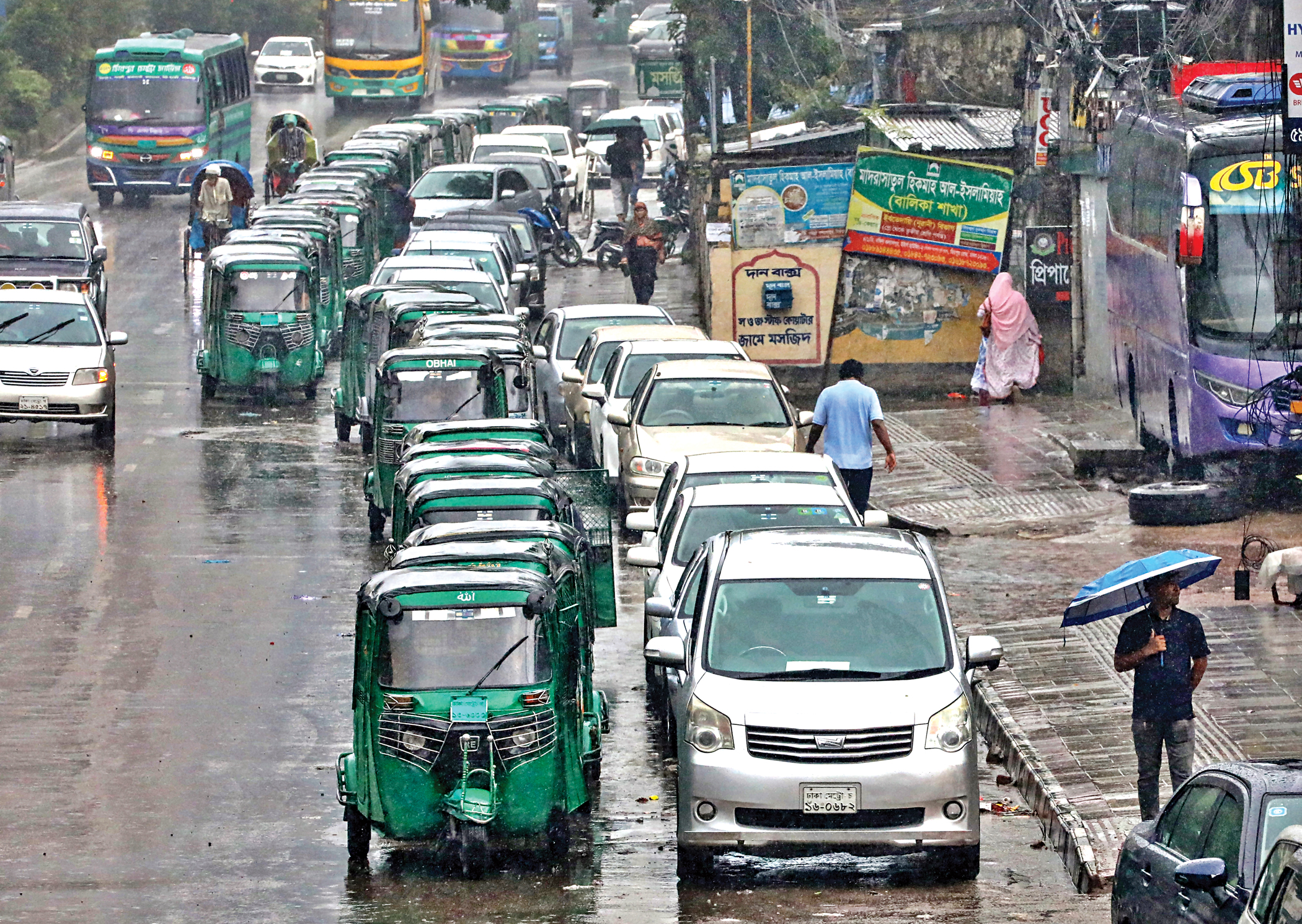
Each disruption -- whether caused by technical faults, maintenance or cyclones -- has sharply reduced supplies, forcing power cuts, scaled back industrial production, long queues at CNG stations and dwindling pipeline gas at households.

The latest shutdown of Excelerate Energy’s floating storage and regasification unit (FSRU) at Maheshkhali has once again underscored this vulnerability.
The July incident cut roughly 450 million cubic feet per day (MMcfd), or half the LNG supply, from the national grid, worsening an already severe deficit.
Electricity shortages exceeded 3,000MW at times, industries faced critically low gas pressure, CNG stations struggled to refuel vehicles, and households in many areas received inadequate supplies.
Engineers are expected to restart one of the FSRU’s two boilers, potentially restoring 200-250MMcfd, according to Md Salahuddin, managing director of Karnaphuli Gas Distribution Company Ltd.
Even then, national gas supply will remain far below demand, with around 2,400MMcfd available against a requirement of roughly 3,800MMcfd.
FROM SUPPLEMENT TO LIFELINE
Bangladesh began importing LNG in 2018 through Excelerate Energy’s FSRU as domestic gas production started to decline and demand continued to rise. Summit Group’s FSRU began operations in April 2019.
At the time, imported LNG was intended to supplement domestic production. But as local output steadily declined, it evolved into a critical pillar of the country’s gas supply, leaving Bangladesh increasingly exposed whenever an LNG terminal goes offline.
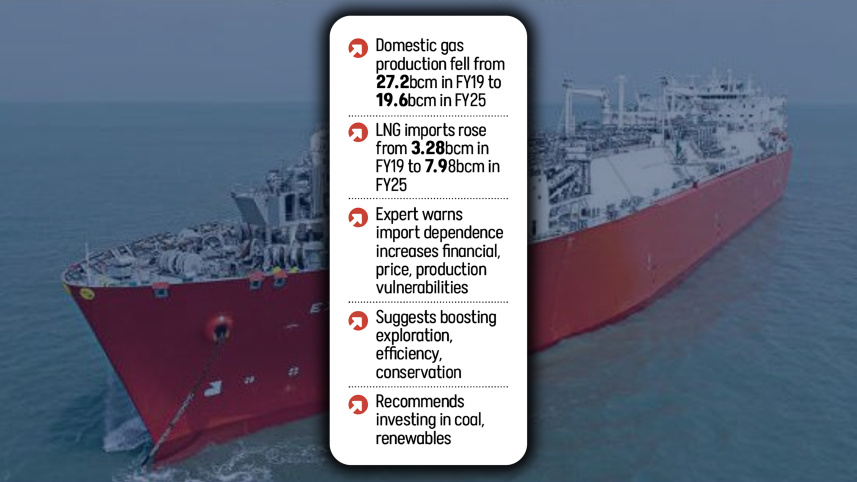
Domestic gas production fell from around 27.2 billion cubic metres (bcm) in FY2018-19 to 19.6bcm in FY2024-25 -- a decline of around 28 percent over seven years.
During the same period, LNG imports increased 143 percent from 3.28bcm to 7.98bcm, while domestic production slipped further to 14.84bcm in the first 10 months of FY2025-26.
The country has experienced similar disruptions repeatedly. Cyclone Mocha forced both FSRUs at Maheshkhali to disconnect as a precaution in May 2023, temporarily shutting down Bangladesh’s entire LNG regasification capacity.
In early 2024, statutory maintenance at the two terminals, carried out at different times, again tightened gas supplies.
The most prolonged disruption came after Cyclone Remal damaged Summit’s FSRU in May 2024, reducing the country’s regasification capacity to around 600MMcfd from roughly 1,100MMcfd for nearly four months before the terminal resumed operations following repeated repair attempts.
The impact was particularly severe on the power sector. Bangladesh Power Development Board data showed that more than 4,000MW of generation capacity sat idle in August 2024 because of gas shortages.
Against this backdrop, the government on July 28 approved in principle the fast-tracking of a third FSRU at Kutubjom in Cox’s Bazar under a government-to-government arrangement with China National Energy Engineering and Construction Co.
The proposed terminal is expected to add another 550-600MMcfd of regasification capacity. The government is also pursuing a land-based LNG terminal at Matarbari.
 For all latest news, follow The Daily Star's Google News channel.
 MOUNTING VULNERABILITIES
Prof M Tamim, former dean of Buet’s Faculty of Chemical and Materials Engineering, said LNG was initially conceived as a short-term solution, but gradually became embedded in the country’s long-term gas supply strategy.
“If we cannot increase our own supply and have to depend on imports, we will face financial, production and price vulnerabilities,” he told The Daily Star.
Those vulnerabilities are already becoming more pronounced.
Petrobangla’s LNG import bill rose from Tk 16,505 crore in FY2020-21 to around Tk 59,000 crore in FY2025-26, while Bangladesh has become increasingly exposed to international LNG prices, shipping disruptions and geopolitical developments.
That exposure has already materialised this year.
The US-Israeli war on Iran disrupted LNG shipments through the Strait of Hormuz, prompting QatarEnergy to halve its scheduled LNG deliveries to Bangladesh for 2026.
Bangladesh, which received about 60 percent of its LNG imports from Qatar last year, has since sought alternative supplies, including increased purchases from the spot market.
Data from Kpler, an analytics platform, in July showed Bangladesh has imported 35 spot LNG cargoes since the conflict began to compensate for the disruption to long-term supplies.
The episode highlighted Bangladesh’s dual vulnerability.
While an FSRU failure can restrict the country’s ability to receive and regasify LNG, geopolitical disruptions can simultaneously reduce supplies and make replacement cargoes more expensive.
A similar challenge emerged in 2022, when Bangladesh was unable to buy spot LNG for several months after international prices surged following Russia’s invasion of Ukraine.
Prices climbed to around $60 per million British thermal units (mmBtu), compared with the roughly $10-12/mmBtu range that had prevailed before the crisis, demonstrating that Bangladesh cannot always rely on the spot market when long-term supplies are disrupted.
NO SINGLE FIX
A third FSRU would reduce the impact of future technical failures by ensuring that the loss of a single terminal accounts for a smaller share of Bangladesh’s regasification capacity.
But experts say additional regasification capacity cannot guarantee access to affordable LNG or reverse the long-term decline in domestic gas production.
The additional terminal should be viewed as a temporary bridge rather than a substitute for domestic exploration and production, said Prof Tamim, currently vice-chancellor of Independent University, Bangladesh (IUB).
“Another FSRU could be justified as a short-term measure because Bangladesh cannot increase domestic gas production quickly enough to address its immediate supply shortage,” he said.
To reduce the exposure to vulnerabilities, Bangladesh must simultaneously pursue domestic gas exploration, coal, renewable energy, energy efficiency and conservation to strengthen its long-term energy security, Prof Tamim said.
“There is no single solution,” he added.
Comments