


Rising energy costs threaten export competitiveness
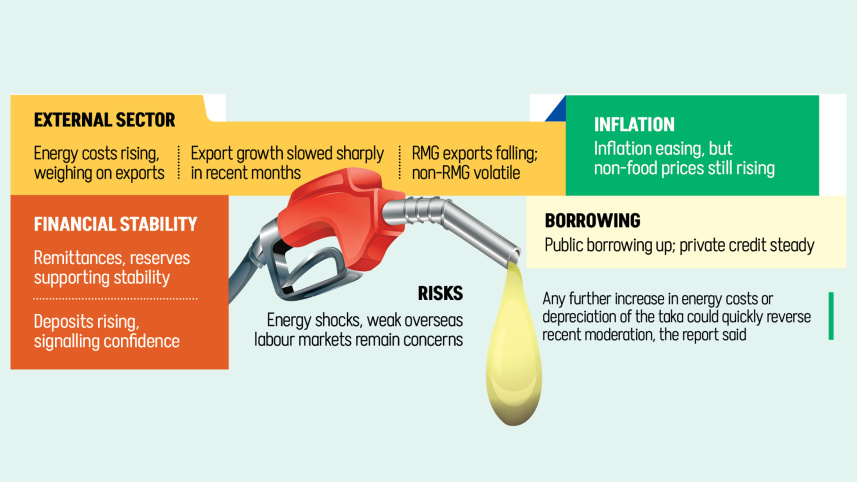
Rising global energy prices, driven by geopolitical tensions, along with recent domestic fuel price adjustments, are pushing up production and transport costs and threatening Bangladesh’s export competitiveness, according to a General Economics Division (GED) report published yesterday.
Export performance weakened in the first quarter of 2026 after a relatively strong start, the GED said in its April issue of the Economic Update & Outlook.

Year-on-year export growth fell sharply from negative 0.50 percent in January to negative 12.03 percent in February, before declining further to negative 18.07 percent in March. The report linked this trend to softer external demand and emerging supply-side constraints.
Readymade garment (RMG) exports declined from $3.61 billion in January to $2.78 billion in March, reflecting seasonal normalisation and weaker global demand.
Non-RMG exports were more volatile, dropping to $679 million in February before rising slightly to $698 million in March. The GED said the broad-based decline across export categories points to broader pressure on the sector.
However, it added that a modest recovery in non-RMG exports and steady demand for garments offer some cautious relief, although policy support and efficiency improvements may be needed going forward.
On inflation, the report said there were some positive developments as headline inflation eased slightly in March. Lower rice prices helped offset continued price increases in meat, fish, and vegetables.
Non-food inflation rose slightly, reflecting persistent cost pressures in housing, transport, utilities, and services. The GED linked these pressures to exchange rate effects, higher energy costs, and rising production and distribution expenses.
“Persistent non-food inflation suggests that underlying inflationary pressures remain entrenched despite temporary relief from food prices,” the report said.
The GED also highlighted strong remittance inflows and higher foreign exchange reserves compared to last year as key buffers for external sector stability.
It said remittances continue to support the economy by strengthening reserves, financing the current account, and improving macroeconomic resilience.
It added that, amid the energy crisis, higher remittances are helping offset rising import payments and supporting reserve accumulation. However, it warned that geopolitical tensions could affect labour markets in energy-exporting countries where many Bangladeshi migrants work.
While seasonal factors may support inflows in the short term, the report said remittance sustainability in the medium term will depend on external labour demand and global economic stability.
It also cautioned that rising global energy costs and tensions in the Middle East pose renewed risks to inflation, the trade deficit, and exchange rate stability. “Any further increase in energy costs or depreciation of the taka could quickly reverse recent moderation.”
On the domestic financial sector, the GED said public sector borrowing from banks has increased significantly. Credit growth to the public sector rose nearly 30 percent year-on-year in February 2026, the highest in five months, compared to 26.15 percent in February 2025.
“Public sector credit growth is accelerating sharply, partly reflecting increased government borrowing amid mounting energy-related fiscal pressures,” the GED said.
Private sector credit also increased, although growth remained stable at 6.03 percent in both months.
The report said that up to February 2026, both bank deposits and credit disbursement showed a generally positive trend, indicating gradual recovery and improving confidence in the banking sector.
Total bank deposits reached Tk 19.95 lakh crore in February, up 11.28 percent year-on-year.
 For all latest news, follow The Daily Star's Google News channel.
 This was higher than Tk 19.67 lakh crore in January, when deposits grew 10.44 percent year-on-year.
The data used in the report were sourced from the Bangladesh Bureau of Statistics (BBS), Implementation Monitoring and Evaluation Division (IMED), Export Promotion Bureau (EPB), Bangladesh Bank (BB), and the National Board of Revenue (NBR).
Comments