


Oil prices jump, stocks skid on Middle East turmoil
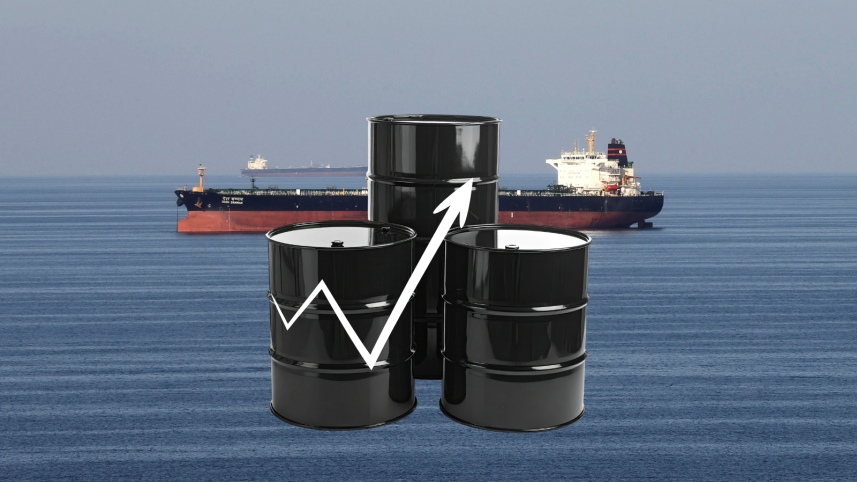
Oil prices surged on Monday and shares slid as military conflict in the Middle East looked set to last weeks, sending investors flocking to the relative safety of the dollar and gold.
Brent LCOc1 jumped 4.5% to $76.07 a barrel, though it had briefly topped $82.00 at one stage, while U.S. crude CLc1 climbed 3.9% to $69.59 per barrel. Gold rose 1.0% to $5,327 an ounce XAU=. O/RGOL/
 For all latest news, follow The Daily Star's Google News channel.
 Military strikes by the United States and Israel on Iran showed no sign of lessening, while Iran responded with missile barrages across the region, risking dragging its neighbours into the conflict.
President Donald Trump suggested to the Daily Mail the conflict could last for four more weeks, while posting that attacks would continue until U.S. objectives were met.
All eyes were on the Strait of Hormuz where around a fifth of the world's seaborne oil trade flows and 20% of its liquefied natural gas. While the vital waterway has not yet been blocked, marine tracking sites showed tankers piling up on either side of the strait wary of attack or maybe unable to get insurance for the voyage.
"The most immediate and tangible development affecting oil markets is the effective halt of traffic through the Strait of Hormuz, preventing 15 million barrels per day (bpd) of crude oil from reaching markets," said Jorge Leon, head of geopolitical analysis at Rystad Energy.
"Unless de-escalation signals emerge swiftly, we expect a significant upward repricing of oil."
A prolonged spike in oil prices would risk reigniting inflationary pressures globally, while also acting as a tax on business and consumers that could dampen demand.
OPEC+ did agree a modest oil output boost of 206,000 barrels per day for April on Sunday, but a lot of that product still has to get out of the Middle East by tanker.
"The nearest historical analogue in our view is the Middle East oil embargo of the 1970s, which increased oil prices by 300% to around $12/bbl in 1974," said Alan Gelder, SVP of refining, chemicals and oil markets at Wood Mackenzie.
"That is only US$90/bbl in 2026 terms. Eclipsing this in today's market concerned about significant losses of supply seems very achievable."
That would be expensive for Japan, which imports all its oil, sending the Nikkei .N225 down 1.4%, with airlines among the hardest hit. Chinese blue-chips .CSI300 went their own way and held steady.
MSCI's broadest index of Asia-Pacific shares outside Japan .MIAPJ0000PUS fell 1.2%.
AND IT'S A BIG US DATA WEEK
In the Mid East, the UAE and Kuwait temporarily closed their stock markets citing "exceptional circumstances".
For Europe, EUROSTOXX 50 futures STXEc1 shed 1.4% and DAX futures FDXc1 slid 1.3%. On Wall Street, S&P 500 futures ESc1 and Nasdaq futures NQc1 both lost 0.6%.
The oil shock rippled through currency markets with the dollar a main beneficiary. The U.S. is a net energy exporter and Treasuries are still considered a liquid haven in times of stress, shoving the euro down 0.2% to $1.1788 EUR=EBS.
While the Japanese yen is often a safe harbour, the country imports all of its oil making the flows more two-way. The dollar added 0.1% to 156.25 yen JPY=EBS, while gaining on the Australian dollar AUD=D3, which is often sold as a liquid proxy for global risk.
In bond markets, 10-year Treasury yields steadied at 3.970%, having briefly touched an 11-month low of 3.926% US10YT=TWEB.
Bonds had gained a bid on Friday when UK mortgage lender MFS was placed into administration following allegations of financial irregularities. Its collapse stoked wider credit fears, with well-known big banks among its lenders. MFS had borrowed 2 billion pounds ($2.69 billion).
The news slugged banking stocks and combined with jitters over AI-related stocks to hit Wall Street more broadly. .N
Investors also have to weather a squall of U.S. economic data this week, including the ISM survey of manufacturing, retail sales and the always vital payrolls report.
Any weakness could shake confidence in the economy after a disappointing fourth quarter, but would also likely narrow the odds on rate cuts from the Federal Reserve.
Markets currently imply a 50% chance of an easing in June and about 60 basis points of cuts this year. 0#USDIRPR
Comments