


How Big Tech’s $630b AI splurge will fall short
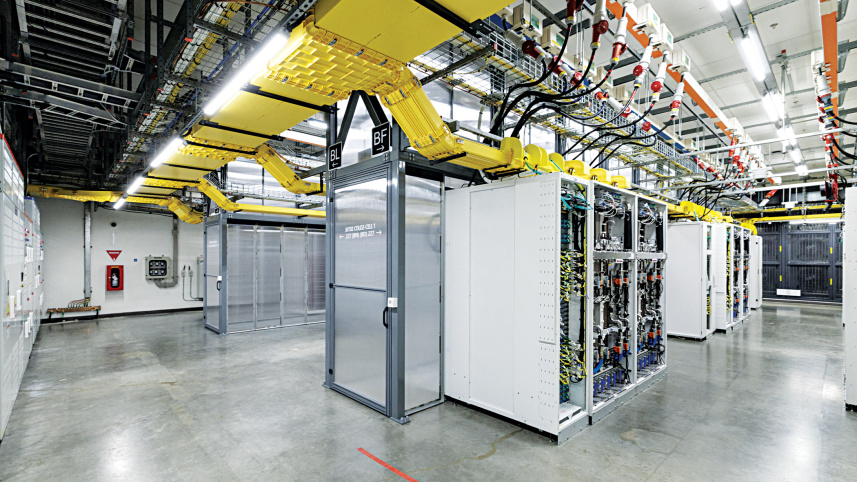
For all the hand-wringing in financial markets about an artificial intelligence bubble, investors may be focusing on the wrong risk. The prevailing fear is that technology giants will spend hundreds of billions of dollars on AI infrastructure only for demand to fall short. The more immediate problem, though, is that tech firms will struggle to spend their massive 2026 budgets in ways that deliver functioning data centres.
The scale of Silicon Valley’s ambition is already colliding with physical reality. Just four companies — Amazon.com, Microsoft, Alphabet, and Meta Platforms — are projected to spend about $630 billion on data centres and AI chips in 2026 alone, Morgan Stanley estimates. That’s more than four times the 2023 figure, and equates to roughly 2.2 percent of US GDP. Widen the lens to include the top 11 providers of cloud computing and infrastructure, like Oracle and CoreWeave, and total capital expenditure is set to hit $811 billion.
 For all latest news, follow The Daily Star's Google News channel.
 Even for the world’s largest companies, this expansion is staggering. The four tech giants currently operate roughly 600 data centre facilities globally, and have another 544 in planning or under construction, according to S&P Global Energy Horizons data. Turning that development pipeline into live computing power could prove a bigger challenge than mobilizing the necessary capital.
On paper, the economics look straightforward. A modern 100-megawatt AI data centre can cost more than $4 billion, including chips. About 70 percent of spending goes on servers and graphics processing units, much of it linked to the most sought-after chips designed by Nvidia. Land typically consumes up to 6 percent of that budget, depending on location. The rest is split between buildings, electrical gear, networking, security and cooling systems required to run dense AI workloads. The catch is that the industry’s worst bottlenecks are not necessarily in semiconductors, but in physical infrastructure and the local permits required to install it.
Power is one of the primary constraints. Securing a connection to the public grid in major hubs like London can now take up to a decade. To escape this purgatory, operators are pushing into rural locations like parts of Texas. But while permits are easier to get in remote places, skilled labour is harder to find. In some cases, companies have to build supporting communities to staff their facilities. Even then, this workaround has limits as data centre demand shifts from training large-language models to inference — the process of running a trained AI model to generate outputs for real-world use. Providing swift responses to customers requires inference data centres closer to populated areas.
Operators are trying to bypass the power grid entirely by building “island” data centres powered by on-site gas turbines. About one-third of US facilities currently under construction rely on on-site power generation, according to McKinsey’s Diego Hernandez Diaz. But this workaround has created its own bottleneck: new suitable gas turbines are effectively sold out until 2029, prompting developers to look for alternatives, Boston Consulting Group’s Thomas Bumberger says. Geopolitics adds a further layer of fragility. Most data centres rely on diesel backup generators that kick in if the main power source fails, according to McKinsey. These units are tested daily, leaving the AI boom exposed to potential shortages of refined fuel caused by conflict in the Middle East.
The broader industrial supply chain is also struggling to keep up with overwhelming demand. The process of making kit like substations, transformers and cooling systems is out of sync with the tech industry’s cycle. The lead time for transformers supplied by groups such as Schneider Electric, Eaton and Hitachi Energy is now up to 100 weeks in Europe, while generators in the United States can take around 50 weeks to arrive, according to BCG. Nearly 60 percent of data centre projects were delayed by more than three months last year. Roughly 88 percent of projects face setbacks simply laying concrete foundations, while 78 percent are delayed during the installation of cooling systems and fire alarms, according to data centre project forecasting firm nPlan.
Rapid innovation adds to the backlog. Nvidia’s newest Blackwell chips — and its upcoming Rubin architecture — generate far more heat than previous versions. This has forced data centres to shift from air cooling to more complex liquid systems, which require new plumbing and water purification infrastructure. Meanwhile, next-generation server racks will draw so much power that traditional ways of delivering electricity no longer work efficiently. To cope, data centre operators are shifting to more advanced solid-state transformers (SSTs), which also enable fast charging of electric vehicles. As a result, tech companies are competing with carmakers for components.
Some operators like Amazon Web Services are using workarounds, such as designing proprietary equipment. Others like Microsoft are renting capacity from agile “neocloud” operators like CoreWeave and Nebius. These companies, many of which own repurposed former bitcoin mining facilities, have often secured valuable land, power and permits.
History offers a stark warning of the dangers of investment splurges. Take the commodity boom of the late 2000s, when large oil groups, including Exxon Mobil, Shell, BP and Chevron sharply increased capital spending to take advantage of record crude prices. Global investment in searching, drilling and pumping oil and gas nearly tripled from roughly $250 billion in 2000 to almost $700 billion by 2013. But shortages of labour, specialized equipment, and permitting constraints took their toll. Overall production output barely budged while costs spiralled. Returns collapsed, exacerbated by a sharp drop in oil prices from $147 a barrel in mid-2008 to below $60 months later.
Rising construction costs and delays are a threat to tech giants’ returns, too. A data centre originally budgeted at $1 billion can easily inflate to $1.3 billion or more, nPlan reckons. Meanwhile, cloud providers only monetize a data centre once it is plugged in and leased to customers. If a company spends $10 billion on advanced AI chips but cannot secure the transformers to power them, those semiconductors become stranded capital, depreciating rapidly without generating a cent of revenue.
All this will compress profit margins and drag down tech giants’ returns on their investment. Alphabet’s return on invested capital after tax is expected to fall from 51 percent last year to about 36 percent by 2030, according to forecasts compiled by Visible Alpha. Microsoft’s is projected to drop even more sharply, from 95 percent in 2020 to 36 percent in 2030.
Artificial intelligence may be a more transformative technology than oil, but if Silicon Valley assumes money can bend the laws of physics, its splurge may fall short.




Comments