


Cosco’s ships are a new gauge for Hormuz crisis
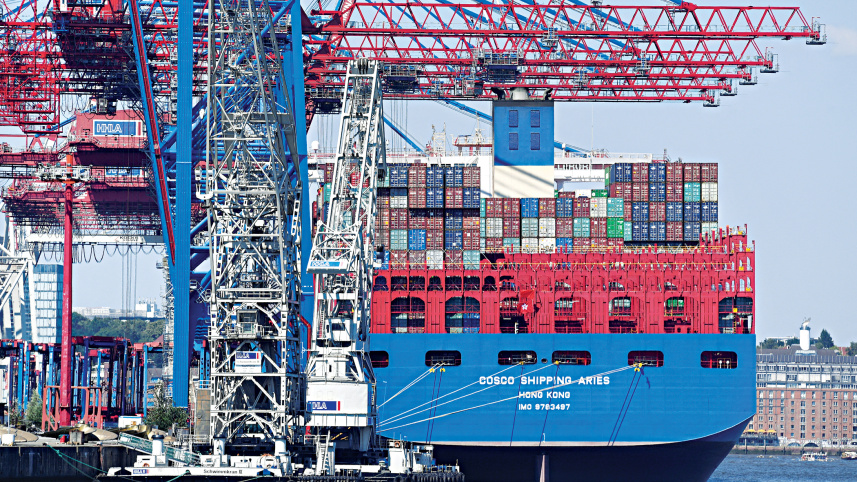
China’s Cosco Shipping Lines may not have intended to send a geopolitical message. Yet its decision on Wednesday to restart bookings to the Middle East looks like a referendum on whether crucial maritime lanes through the Strait of Hormuz are reopening. Whether they do so on the United States’ preferred terms is another matter.
Joint American-Israeli strikes on Iran have engulfed the region in a conflict that has effectively blocked the Strait, through which a fifth of the world’s oil and gas ordinarily transits.
 For all latest news, follow The Daily Star's Google News channel.
 The $33 billion state-backed shipping firm has not taken any chances on braving passage, even as other vessels gamble that Iranian forces and their proxies will treat Chinese ships with deference, according to the Financial Times. It halted services to the Middle East on March 4, citing escalating tensions.
Its subsequent reversal, covering routes from the Far East to Gulf hubs such as the United Arab Emirates and Saudi Arabia, therefore carries weight. Granted, this is just for ordinary freight cargoes, not energy shipments that are the fulcrum of Iran’s leverage. But container shippers are acutely sensitive to risk: they move only when insurers, counterparties and, crucially, governments signal it is safe enough. Cosco’s return suggests that threshold has been met, at least as far as it is concerned.
This is a material measure of reopening, much more so than muddled talks of efforts to end the war. True, Brent crude oil futures fell as much as 5 percent after the United States proposed a ceasefire, as the New York Times reported. But markets have been wrong-footed before, and Iran has repeatedly denied that it’s in talks with Washington.
The catch is that what’s viable for ships flying under the flag of Beijing, Tehran’s closest major partner, might not be for everyone else. Iran has charged fees of as much as $2 million to allow passage for some commercial vessels, Bloomberg reported while officials have said that “non-hostile” fleets may pass, so long as they coordinate with authorities. This raises the specter of either Tehran or local Revolutionary Guard elements essentially operating a tolling system over some of the most valuable water in the world.
That would presumably be anathema to Washington, and much worse for Western carriers than the pre-conflict status quo. Any move in this direction is still very tentative. Cosco’s bookings are one-way, and vessels diverted earlier will still take two to three weeks to return, according to Niels Madsen of shipping data provider Sea-Intelligence.
In that sense, Cosco’s ships might map out a new order in Hormuz. The waterway may be poised to reopen, but not like before, and not for everyone — at least not yet.
China’s Cosco Shipping Lines, a subsidiary of state-owned giant COSCO Shipping, announced on March 25 that it has resumed new booking services for ordinary freight containers from the Far East to the Middle East, including the United Arab Emirates, Saudi Arabia, Bahrain, Qatar, Kuwait, and Iraq, effective immediately.
It had previously suspended these services on March 4, citing escalating conflict in the region and resulting restrictions on maritime traffic through the Strait of Hormuz.
Chinese Foreign Minister Wang Yi urged Iranian counterpart Abbas Araqchi in a phone call to engage in negotiations as soon as possible with the United States to end the war between the two sides, according to a Chinese government statement on March 24.
Oil prices sank 5 percent on March 25 after reports the United States had sent Iran a 15-point proposal aimed at ending the conflict. Iran denied that direct talks had taken place, Reuters reported.




Comments