


Reform key to cutting logistics bottlenecks
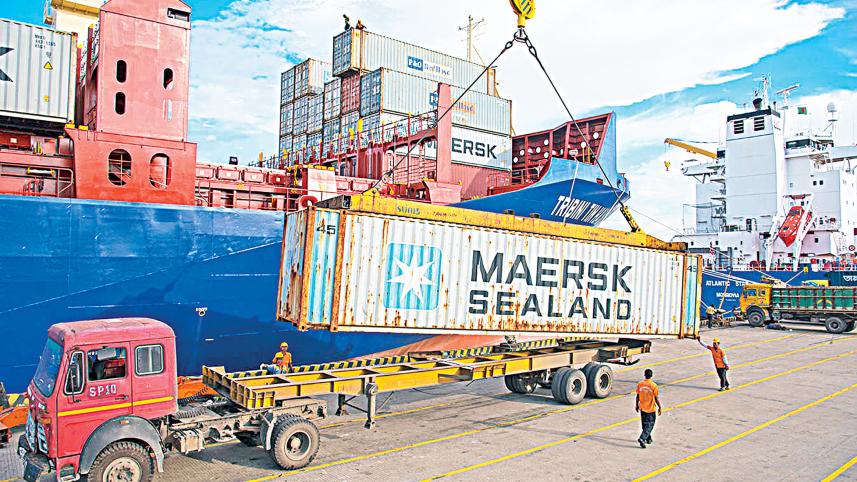
Structural reforms are required to mitigate key bottlenecks of the domestic logistics system as most private sector entities suffer for a lack of adequate facilities, according to business leaders.
"The government should declare logistics as a high-priority thrust sector and provide enough incentives to attract both local and foreign investment," said Abul Kasem Khan, chairperson of Business Initiative Leading Development (BUILD), a public-private dialogue platform.

Most developing countries invest 9 per cent to 10 per cent of their gross domestic product to improve their local logistics environment. Success stories of China, India and Vietnam set the perfect example for the benefits of maintaining the best practices in logistics, he said. "The return on investments in the sector is one of the highest in the world," he added.
These comments came at a virtual discussion on the national logistics strategy, jointly organised by BUILD and the Prime Minister's Office yesterday.
Syed Ershad Ahmed, president of the American Chamber of Commerce in Bangladesh, urged for the proper utilisation of the Pangaon port and Dherasram project, which should be linked with temperature-controlled logistics.
Some 98 per cent of the country's freight forwarding operators suffer from a lack of modern technology and equipment, he added.
Mahbubul Alam, president of the Chattogram Chamber of Commerce and Industry, said there was no policy focusing time schedules for the movement of container trucks in Chattogram.
So, establishing a central truck terminal may reduce the traffic congestions that stem from this issue. Additionally, water connectivity may reduce over-dependency on road transport, Alam added.
The formulation and implementation of a National Integrated Logistics Policy could help attract investment and increase the country's export competitiveness to realise the targets of its eighth Five-Year Plan and Perspective Plan 2041, said Ferdaus Ara Begum, chief executive officer of BUILD.
Kabir Ahmed, president of Bangladesh Freight Forwarders Association, urged for proper utilisation and equipping of Hazrat Shahjalal International Airport, one of the most important gateways for local exports.
In her keynote paper, Tatiana Peralta Quiros, senior transport specialist of World Bank Group, said logistics costs increase the overall production and business operation cost by 4.5 per cent to 4.8 per cent.
"The implementation of just three initiatives, such as reducing dwell times in Chattogram port and congestions on national highways with the initiation of a national logistics strategy, could increase Bangladesh's overall exports by 19 per cent," she added.
Masrur Reaz, chairman of the Policy Exchange of Bangladesh, said after the country graduates from the United Nation's least developed grouping, it would have to face a most favoured nation duty of about 12 per cent if it was unable to secure GSP Plus status.
He focused on the need to initiate and implement a national logistics policy and identify the logistics demand from production houses, economic zones and priority sectors such agriculture and pharmaceuticals, and trade gateways.
Md Tofazzel Hossain Miah asserted that Bangladesh cannot move forward without supporting the private sector during this global economic transition period as it was the country's engine for economic growth.
 For all latest news, follow The Daily Star's Google News channel.
Comments