


Why rawhide prices fall after every Eid

As people return to the capital after the Eid holidays, the Dhaka-Mawa-Bhanga Expressway is greeting travellers not with its usual green surroundings and fresh earthy air, but with an unmistakable stench: rotting rawhides.
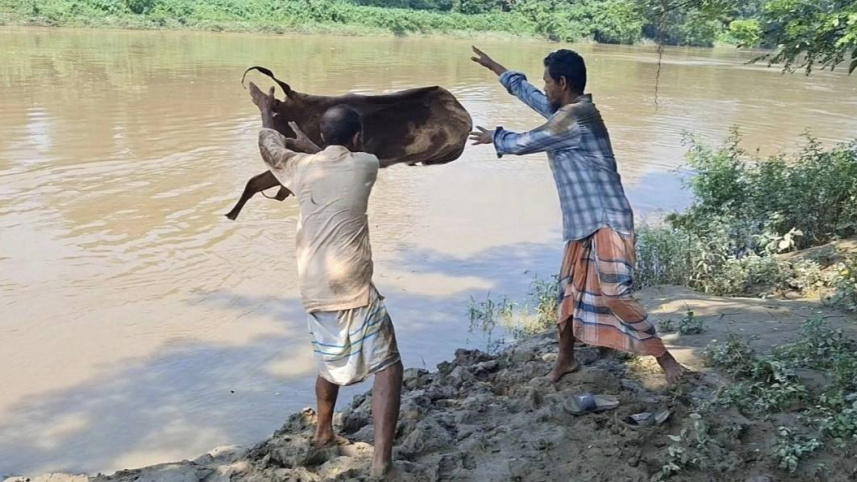
After sacrificing cattle on Eid day, many people have dumped hides along the highway this year as prices continued their long decline.

Images of discarded hides, hides buried in the ground, and rawhides thrown into rivers first made national headlines in 2017, when tanneries began relocating from Dhaka’s Hazaribagh area to the Savar Tannery Estate. Nearly a decade later, the same scenes continue to recur with little sign of improvement.
The relocation from Hazaribagh, on the banks of the Buriganga river, came after years of delays by tannery owners and repeated government deadlines. International buyers had increasingly raised concerns about the industry’s environmental record. At Savar, tanners were supposed to receive a fully functional central effluent treatment plant (CETP), but the facility remains underperforming almost a decade after the move.
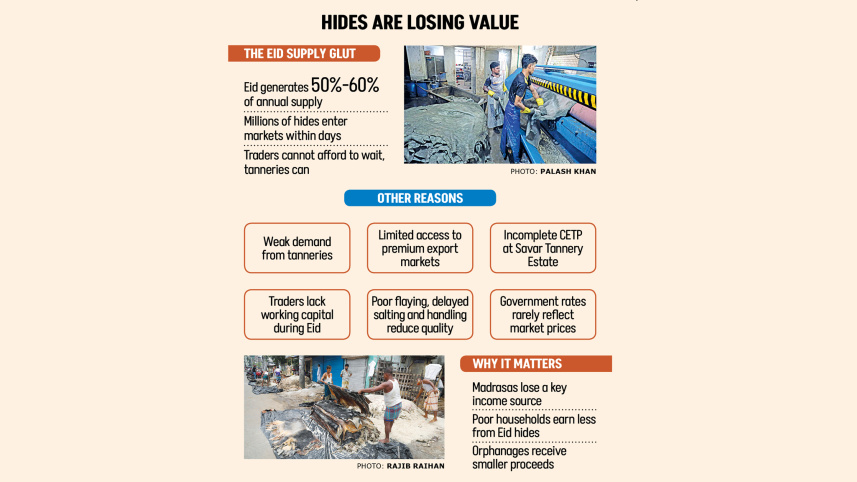
The Eid-ul-Azha season provides around 50-60 percent of the rawhide local tanneries need for production throughout the year. Proceeds from the sale of sacrificial animal hides traditionally go to charities, madrasas and orphanages.
For years, the government has fixed prices at which small traders are meant to buy hides from the public. Yet those rates have done little to change the overall picture.
Apart from official prices largely remaining on paper and the CETP incomplete, at least half a dozen other factors help explain why rawhides continue to rot each year.
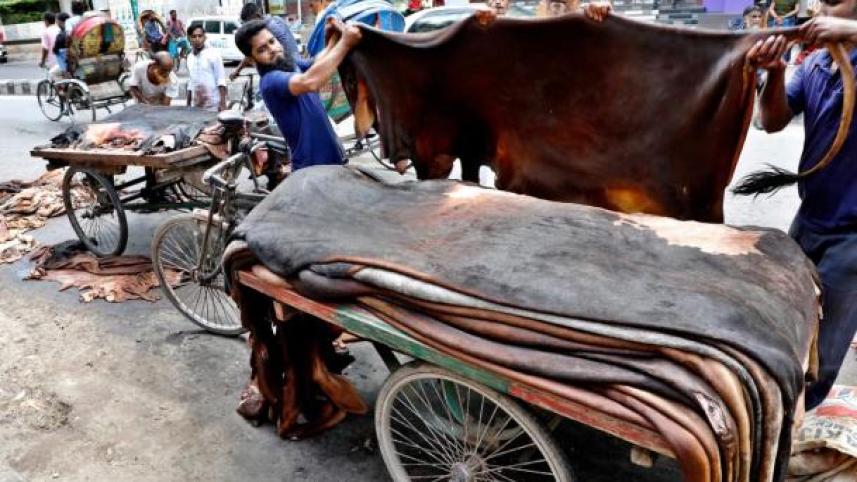
They include a surge of rawhide supply arriving within a few days of Eid-ul-Azha, weak demand, a tannery sector struggling with environmental compliance, softer global demand for leather, cash shortages across the supply chain, poor preservation practices that reduce quality, and allegations of price manipulation by a small group of tannery owners.
Md Shaheen Ahamed, chairman of the Bangladesh Tanners Association, said the leather sector has been in decline since the relocation of tanneries to Savar.
There are now more than 115 operational tanneries in Savar estate, but only five hold Leather Working Group (LWG) certification.
The LWG is a global body that sets environmental and compliance standards for the leather sector. Certification is required for access to markets in Europe, the United States and parts of developed Asia.
Most local tanneries do not have this certification, due mainly to compliance issues and the underperforming CETP.
Ahmed said the industry cannot grow while it fails to meet international environmental and quality standards.
With most tanneries lacking certification, rawhide demand remains weak this year as usual, according to small and medium traders.
Md Anwar Hossain, a rawhide trader in the Posta area of Dhaka, said demand from tanneries is currently low.
He said the prices traders can offer are dictated by what tanneries are willing to pay.
“That is just how the chain works. An official price does not change that,” Hossain said, adding that markets do not move simply because the government puts out a number.
Tipu Sultan, general secretary of the Bangladesh Hide and Skin Merchants’ Association, said rawhide collection this year is around 20 percent below expectations, and trading has not followed the government’s price announcement.
 For all latest news, follow The Daily Star's Google News channel.
 In his view, the core problem is cash.
He said businesses do not have sufficient working capital to buy at the government fixed rates during the peak collection period.
Mohammed Abu Eusuf, professor of development studies at Dhaka University, said Bangladesh’s leather sector is trapped in a cycle of low prices, weak demand and missed export potential.
He said the country stays in the loop because the compliance and governance problems have not been addressed.
Government price-setting has not been effectively enforced, he said, leaving seasonal traders to absorb losses. Unless the sector generates stronger demand and meets international environmental standards, conditions are unlikely to change.
He noted that tanneries with LWG certification are picking up solid export orders. However, much of the industry is excluded from such opportunities because the Savar Tannery Estate remains non-compliant, leaving most leather produced there tied to lower-priced markets, including China.
Md Mizanur Rahman, professor and director of the Institute of Leather Engineering and Technology at Dhaka University, traced the pressure on rawhide prices back to 2012, when international buyers began enforcing stricter environmental and compliance requirements.
Before that, Bangladeshi tanneries exported wet blue leather with fewer restrictions. As buyers in Europe and North America tightened standards, access to those markets increasingly depended on certification and environmental performance.
Rahman said the government moved tanneries from Hazaribagh to Savar to address environmental concerns, but the CETP has not delivered the level of compliance required by global buyers. As a result, many tanneries have shifted towards lower-priced markets, limiting what they can pay for rawhides.
The main driver of falling rawhide prices is weak tannery demand, not a cartel, Rahman said. “If there were strong demand, prices would naturally rise.”
Md Abdur Rahim Khan, additional secretary and head of the Export Wing at the Ministry of Commerce, said price issues in the rawhide market are mainly linked to quality, handling and coordination across the supply chain rather than administrative factors.
He said that during Eid-ul-Azha, large-scale slaughtering by unskilled butchers often leads to torn or damaged hides, reducing their value even when salt is applied.
He added that salt-treated hides generally receive government-fixed prices, but unsalted or poorly handled hides do not fetch expected rates.
Commerce Minister Khandakar Abdul Muktadir said the decline in rawhide prices in recent years is mainly due to structural problems within the industry.
He said the relocation of tanneries from Hazaribagh was the right decision, but the process was poorly managed, leaving many tanneries unable to restart operations properly.
He pointed out that the CETP at Savar, designed for a capacity of 25,000 cubic metres, is currently operating at only 14,000 to 17,000 cubic metres, around 60 percent of capacity.
According to the commerce minister, this shortfall, combined with limited processing and compliance infrastructure, has weakened overall efficiency in the sector.
Muktadir said compliance has become essential for accessing better international prices, measured through the LWG certification.
“Without this certification, factories are considered non-compliant and are excluded from reputable international buyers, including those purchasing finished leather goods and crust leather.”
He added that compared with the Hazaribagh period, there are now fewer processors and manufacturers. As a result, the sector cannot absorb the large volume of hides generated during Eid-ul-Azha, creating a supply and demand imbalance and pushing prices down.
He explained that while CETP capacity constraints prevent immediate full-scale processing, there is no major issue if leather is processed gradually over six to eight months.
The minister said an Italian company is studying the CETP to identify technical solutions for its underperformance. A report is expected in June or early July, after which corrective steps will be taken to restore full 25,000 cubic metre capacity.
Besides, individual effluent treatment plants will become mandatory for large tanneries, with government support through technical assistance and loans, said Muktadir.
Comments