


Veon eyes satellite-based call service in Bangladesh
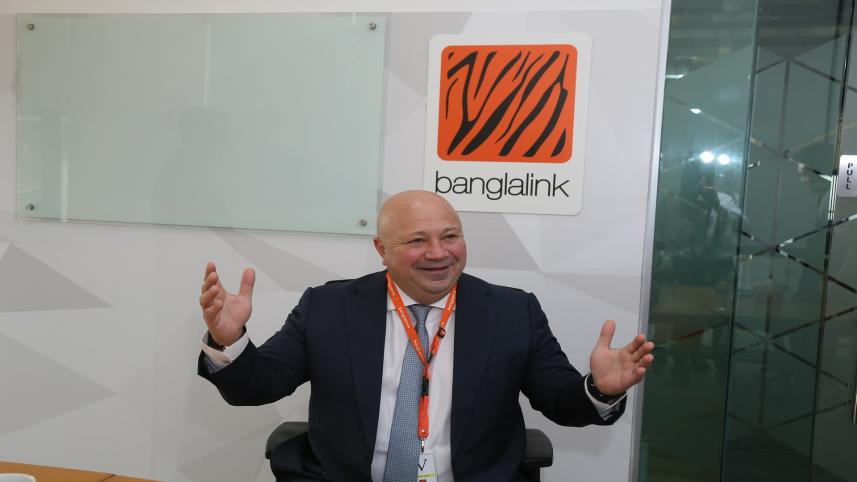
Global telecom investor Veon plans to introduce direct-to-cell satellite connectivity in Bangladesh, allowing smartphones to connect straight to satellites through a partnership with Starlink and its subsidiary, Banglalink.
Kaan Terzioglu, chief executive officer of Veon, told The Daily Star recently that the company aims to replicate the same technology it is already using in Ukraine and Kazakhstan.

“We want to provide direct-to-device connectivity like in Ukraine, so every 4G-capable phone can link to satellites orbiting more than 400 kilometres above,” Terzioglu said.
Unlike traditional mobile networks that rely on ground-based towers, Starlink’s direct-to-cell technology uses satellites as cell towers in space. This allows ordinary mobile phones to connect directly, expanding coverage to areas with little or no ground infrastructure.
Terzioglu told Reuters that Veon is Starlink’s largest partner by customer base for direct-to-cell services.
In Ukraine, the technology has already served nearly five million users in just four months, sending more than seven million messages through the network.
Ukraine’s top operator, Kyivstar, also owned by Veon, signed an agreement with Starlink in 2024 to launch the satellite-to-phone service. In December, Veon said its operator Beeline had successfully trialled the service in Kazakhstan.
“Bangladesh will be next for the rollout, followed by Uzbekistan and Pakistan,” Terzioglu added.
Officials at Banglalink said the company is progressing in discussions to finalise a partnership with Starlink for Bangladesh.
“We are working on an agreement with Starlink to bring direct-to-cell connectivity to Bangladesh,” a Banglalink official said. “This technology could greatly improve coverage, especially in underserved and disaster-prone areas.”
CHALLENGES FOR BANGLALINK IN THE MARKET
The development comes as Banglalink struggles to strengthen its market position, despite conducting business in the country for over two decades and investing around $2.5 billion.
Bangladesh’s third-largest telecom operator has yet to reap profits, while market leader Grameenphone continues to dominate earnings, and Robi Axiata has started turning profitable in recent years.
Banglalink serves about 3.75 crore subscribers, holding a 20.18 percent market share, but has lost roughly 60 lakh users over the past three years.
According to Bangladesh Telecommunication Regulatory Commission data, as of December 2025, Grameenphone led the market with 8.41 crore subscribers (45.27 percent), followed by Robi Axiata with 5.74 crore subscribers (30.86 percent) and state-owned Teletalk Bangladesh with 68 lakh subscribers (3.66 percent).
Despite these challenges, Terzioglu has repeatedly told The Daily Star that Veon will continue investing in Bangladesh, in both telecommunications and the digital sector.
Veon recently partnered with Bangladeshi conglomerate Square and applied for a digital banking licence, following the example of Malaysia’s Axiata, which holds a majority stake in Robi Axiata.
Industry experts say rolling out satellite-to-phone services in Bangladesh would face major hurdles due to strict centralised telecom regulations.
Current rules limit public use of satellite telephony, require traffic to pass through local gateways, and impose conditions on lawful interception, shutdown authority, spectrum licensing, and device approval.
The framework also protects existing mobile operators with heavy licensing requirements, creating significant barriers.
 For all latest news, follow The Daily Star's Google News channel.
 However, experts add that the service could revolutionise connectivity in Bangladesh, particularly in rural and disaster-prone coastal areas, where floods and cyclones often cut off networks, leaving entire regions disconnected for days.
Comments