


Tea industry advances but workers left behind
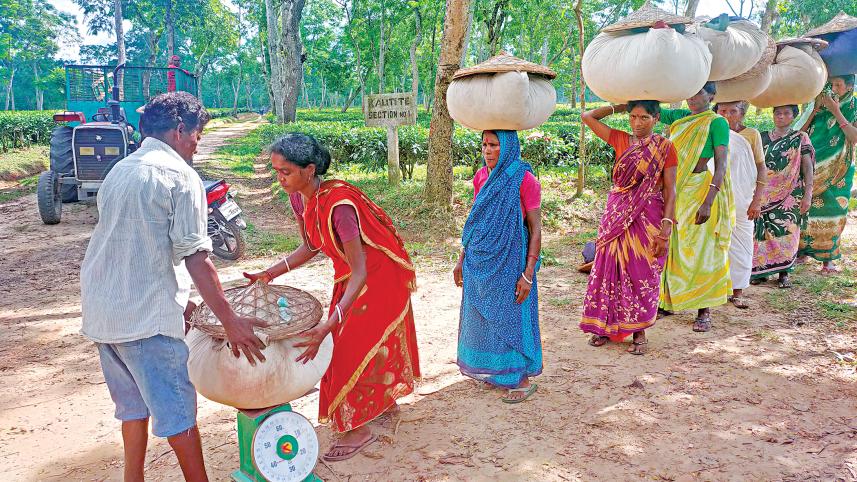
The tea industry in Bangladesh has made significant advancements but the tea workers still have to deal with several challenges concerning socioeconomic and human rights, and unfair wages, said speakers at a dialogue yesterday.
They have to bear substandard living circumstances, including having to do with inadequate nutrition, healthcare services and education. These workers are persistently underpaid, they said.

All stakeholders, including the entrepreneurs and the government, will need to step forward to improve the living standards of the tea workers from the perspectives of the implementation of Sustainable Development Goals in Bangladesh, they added.
The issues were discussed at a dialogue on "Why are the Tea Plantation Workers Left Behind in Bangladesh?" organised by the Citizen's Platform for SDGs, Bangladesh, Manusher Jonno Foundation and Nagorik Uddyog at BRAC Centre Inn, Dhaka.
Debapriya Bhattacharya, convener of the Citizen's Platform for SDGs, Bangladesh and a distinguished fellow of the Centre for Policy Dialogue (CPD), said one of the guiding principles of the global agenda was that no one should be left behind.
But tea workers are one of the most "backward communities", he said.
He hopes for conditions to improve of the workers through the strengthening of the relationship between owners and workers and reduction of their "psychological distance".
Bhattacharya said the Citizen's Platform for SDGs, Bangladesh would move forward with information and recommendations obtained from this dialogue and would try to have it reflected in the national policy.
Raising wages of tea workers will not be helpful if it is not adjusted with the high increases in the prices of goods, said Khairun Akhter, president of workers' platform Cha Konya Nari Songothon.
She said only four months of maternity leave was given to expectant mothers, which was directly a discriminatory practice, there were no toilet facilities in tea gardens for women, and women often suffer from diseases for having to use unhygienic sanitary products.
Zakir Hossain, chief executive of Nagorik Uddyog, said in spite of the presence of quota privileges, the tea workers mostly fail to join the mainstream because they do not have sufficient opportunities to fulfil the admission or employment criteria.
Tuomo Poutiainen, country director of International Labour Organization Bangladesh, said, "One of the issues we really need to investigate is how the tea garden community members, along with the workers, will be able to access the right kind of, sort of protection services which is their right."
"It is important to take care of the broader holistic view of this sector," he said.
He said, "I think the government has a certain role to play, such as looking at the modernisation of the financing and addressing those challenges of looking at the working conditions and wages and productivity and, more broadly, towards community development."
Gwyn Lewis, United Nations resident coordinator in Bangladesh, said, "It is important that we look into the framework of the Sustainable Development Goals and ensure that no one is left behind."
"We should look at the development issues of tea workers from the historical marginalisation perspectives and address the structural challenges," she said.
Golam Mostafa, chief operating officer, tea estate, Ispahani Group, acknowledged that the facilities that were supposed to be provided to the tea workers were not being provided.
However, the tea gardens are surviving due to the efforts of the owners and the workers, he said.
Mustafizur Rahman, a distinguished fellow at the CPD, said not only the owners but also the state has a responsibility to protect the rights of the tea workers.
Firstly, the matter should be looked at from the point of view of overall industrialisation, he said.
 For all latest news, follow The Daily Star's Google News channel.
 He said the impact of the global climate on tea plantations and the effectiveness of related policies should be investigated. "We should work to ensure quality education (for workers' children)," he said.
The tea workers should be brought to the mainstream, and an opportunity should be created to present their demands on a larger scale ahead of the upcoming elections, he added.
According to businesspeople in Bangladesh, 45 per cent of the tea produced in Bangladesh was consumed at the household level while the rest at tea stalls, restaurants and offices.
According to Bangladesh Tea Association, the 166 tea estates in the country account for almost 280,000 acres of land.
Comments