


Strong legal system needed to end default loan culture

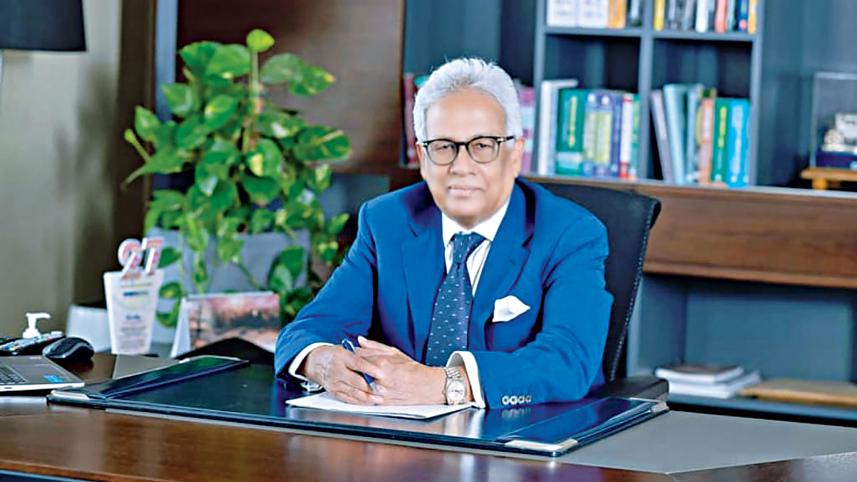
A strong legal system is required to end the default culture and stop defaulters from using writs to defer loan repayments and secure fresh credits, said Abdul Hai Sarker, chairman of Dhaka Bank Ltd.
He said when a bank takes steps to sell collateralised assets of defaulters, they go to courts and file a writ.

"Then the banks can't do anything and such a process binds our hands."
He said entrepreneurs may incur losses and default on their loan payments, but most of the default loans are coming from willful defaulters.
"But if we have a strong legal system, willful defaulters will not be able to save themselves. Then, the volume of the bad loans will be lower."
The noted industrialist shared his thoughts during an interview with The Daily Star recently, on the occasion of the private commercial bank's 28th founding anniversary.
Opened in 1995, Dhaka Bank started its journey with a branch in Motijheel.
Currently, it has 113 branches all over Bangladesh, which includes 71 urban and 42 rural outlets. It has two shariah-compliant branches as well.
According to Sarker, if the banking sector of a country is burdened with a large volume of defaulted loans, it certainly impacts the economy.
"So, the government should emphasise bringing down default loans."
Default loans increased by Tk 10,964 crore to Tk 131,621 crore in the first three months of 2023, according to Bangladesh Bank data.
The ratio of non-performing loans stood at 8.8 per cent in March, up from 8.16 per cent in December.
Sarker said default loans eat away profits and force banks to keep higher provisions against NPLs, depriving general investors and shareholders of due benefits.
According to the founding chairman of Dhaka Bank, banks have the responsibility to pick the right borrowers through a rigorous process with a view to ensuring that dishonest people don't get a chance to take loans in the first place.
"The financial behaviour of a borrower, the cash flow and prospect of businesses and the successor of businessmen should be reviewed before sanctioning a loan."
In the last 28 years, Dhaka Bank supported many industries to grow by financing them and created more than 2,000 jobs at the bank, he said.
Its consolidated profits dropped 21 per cent year-on-year to Tk 167 crore in 2022.
"The profit fell as the central bank ordered to keep provision against the rescheduled loans even though the borrowers are paying back," the chairman said.
The net interest income dropped due to the narrowing of the spread – the difference between the lending and deposit rates – driven by the lending rate ceiling.
In April 2020, the BB capped the interest rate at 9 per cent and banks had to maintain the ceiling as of last month.
 For all latest news, follow The Daily Star's Google News channel.
 Though the central bank has introduced a new interest rate-setting mechanism, the spread may remain low, said Sarker, also the chairman of Purbani Group, one of the largest and oldest export-oriented textile manufacturers in Bangladesh.
He said if several indicators of a free-market economy are regulated, the system becomes complex and the automatic adjustment process faces disruption.
"The ceiling ultimately impacted the business of banks and their liquidity."
Sarker said if the government continues to borrow from commercial banks or the central bank keeps printing money to help the government meet expenses, the private sector will be impacted.
He urged the government to look for ways to cut expenditures so that it does not need to rely heavily on the central bank and commercial banks. If the government can do so, the exchange rate will not see additional volatility, which will give more breathing space to the economy.
"To meet the financing demand for development projects, the government can go to the stock market and issue bonds."
The entrepreneur thinks the stock market can be a good source of funding for both public and private sectors if good governance can be insured.
Sarker, also a former president of the Bangladesh Textile Mills Association, says there are many ways to reduce the cost of doing business, other than maintaining a ceiling on the lending rate.
"Infrastructure should be up to the mark and energy supply should be uninterrupted."
Dhaka Bank has placed emphasis on lending to small enterprises and the agricultural sector since they don't default usually.
The bank's SME financing rose around 11 per cent year-on-year to Tk 2,869 crore in 2022 while farm loan disbursements surged 86 per cent to Tk 828 crore.
"If large borrowers default on their loans, it has a huge impact on banks as the amount is large," Sarker said.
Dhaka Bank's classified loans increased to Tk 1,218 crore last year, up from Tk 714 crore in the previous year.
"As businesses passed a tough period in 2022 due to the war between Russia and Ukraine and it emerged just after the coronavirus pandemic had improved, classified loans rose," Sarker said.
Moreover, he said, the massive depreciation of the local currency against the US dollar inflicted suffering on import-based businesses.
"If businesses suffer, it ultimately hit banks. We are taking preparation so that we can survive if the business situation deteriorates."
Dhaka Bank's deposits grew 5.65 per cent to Tk 24,342 crore in 2022. Loans rose 11.24 per cent to Tk 23,968 crore.
He also talked about new banks, saying the number of lenders in Bangladesh is quite high and no bank licences should be given on political consideration.
"This is because if a bank licence is given on political consideration, they suffer. Some of the new banks are already suffering."
Dhaka Bank plans to widen its footprint outside of the country as well.
But Sarker said: "It will be successful only when the image of the financial sector of the country brightens."
Comments