


SMEs’ struggles running rampant for economic instability
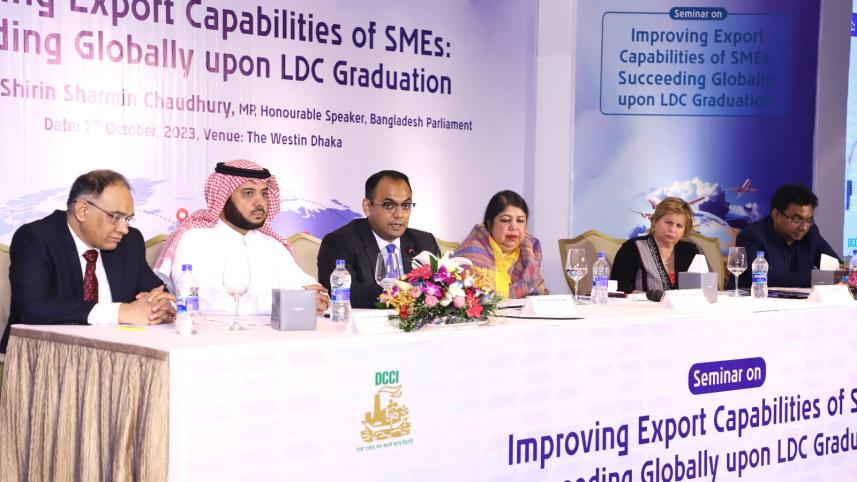
The current macroeconomic instability in Bangladesh is presenting disproportionate challenges for small and medium enterprises (SMEs) compared to larger firms, according to an economist.
For example, SMEs are suffering from capacity constraints, policy and regulatory issues, a lack of financing, inadequate infrastructure and a skills gap, said Selim Raihan, executive director of the South Asian Network on Economic Modeling.

He was speaking at a seminar on improving the export capabilities of local SMEs at The Westin Dhaka yesterday. The event was organised by the Dhaka Chamber of Commerce and Industry (DCCI).
Raihan, also a professor of economics at the University of Dhaka, said the lengthy customs and trade regulations in place are impeding business prospects.
With this backdrop, he suggested reforms in both tax and trade policies and better implementation to support SMEs in the country.
"The tax system in Bangladesh lacks proper policy reforms and is not private investment friendly," he said.
Raihan also pointed out the problem of high default loans and other concerns in the banking sector.
"We have to address the high rate of non-performing loans, weak capital market, high operational cost of SME financing and weak integration with the financial system," he said.
DCCI President Sameer Sattar said despite having the potential to help boost the country's exports and overcome its foreign exchange shortage, SMEs are not getting adequate financing for foreign trade.
A recent study by the Bangladesh Institute of Bank Management on international trade finance and SME reported that SMEs are often not properly catered to by banks due to various reasons.
This includes their lack of collateral, lack of previous transaction information, high risk and lack of sufficient documents, he said.
Besides, the high bank interest rates deter SMEs from borrowing.
"So, Bangladesh Bank could instruct and monitor all commercial banks to ensure the establishment of a SME cell in all branches so that SMEs can be better served," Sattar said.
Banks also need to provide export financing tailored for SMEs, including credit insurance, export development funds and working-capital loans, to address their related financial challenges, he added.
Shirin Sharmin Chaudhury, speaker of the national parliament, said local SMEs are resilient enough and contribute more than 30 percent to the country's gross domestic product (GDP).
Chaudhury said the SME sector still faces various challenges and she hopes the policymakers will try to address these issues.
She added that despite the Covid-19 pandemic and Russia-Ukraine war, Bangladesh has been able to continue its commendable progress, securing 6.5 percent GDP growth in fiscal 2022-23.
Chaudhury informed that women entrepreneurs can take collateral free loans of up to Tk 10 lakh.
"Policymakers could also think about lessening the customs duty for the import of raw materials that are needed for SMEs," she said.
Canadian High Commissioner to Bangladesh Lilly Nicholls said Canada has underscored the need to sign free trade agreements with potential trading partners for furthering its economy.
 For all latest news, follow The Daily Star's Google News channel.
 With this backdrop, she emphasised on more research so that local SMEs can add value to their products and enhance their capacity in the export market.
Saudi Ambassador to Bangladesh Essa Yousef Essa Alduhailan said Saudi Arabia is putting more emphasis on developing its own SMEs as well.
Bangladesh has a strong and diversified export market with jute, shrimp, vegetables, pharmaceuticals and garments being some major products of the country.
Bangladesh will soon graduate to a middle-income country and this transition needs more investment in education, technology and innovation, Alduhailan said.
"If Bangladesh can take similar policies and programmes for SMEs like the ones in Saudi Arabia, then they would benefit," he added.
Comments