


Remove AIT, end harassment by taxmen
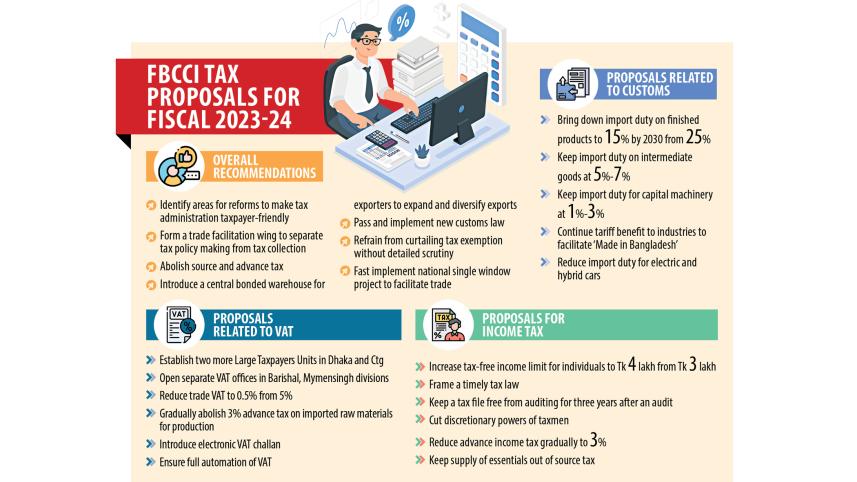
Businesses yesterday urged the government to bring an end to the harassment by revenue officials and remove advance income tax and advance tax against the imports of raw materials for domestic manufacturing in the next fiscal year.
The demands are aimed at helping them stay competitive and overcome the fallout of the Russia-Ukraine war and Covid-19.

The demands were placed at the consultative meeting jointly organsied by the National Board of Revenue (NBR) and the Federation of Bangladesh Chambers of Commerce and Industry (FBCCI) at the Pan Pacific Sonargaon hotel in Dhaka.
The discussion was organised to hear the issues of the businesses ahead of the formulation of tax measures for 2023-24.
Entrepreneurs said they would face challenges following Bangladesh's graduation from the grouping of the least-developed countries to a developing nation in 2026 and urged the government to take actions to reduce the cost of doing business.
They also demanded the government increase the tax-free income ceiling to Tk 4 lakh for individuals from Tk 3 lakh to raise the disposable incomes of people amid soaring inflation.
Entrepreneurs called for reducing the source tax on export receipts and introducing bonded warehouse facilities for non-RMG sectors and providing incentives to some export-oriented sectors in FY24, beginning in July, with a view to expanding and diversifying exports.
Businesses also wanted the NBR to expand the tax net and reduce the value-added tax on house rent for business purposes.
Regarding the harassment at the hands of VAT officials, Obaidur Rahman, a former director of the FBCCI, alleged that a few days ago, VAT officials went to his office and searched it thoroughly.
Md Helal Uddin, president of the Bangladesh Dokan Malik Samity, said the VAT machine is like adding insult to injury as it is being introduced at a time when sales have declined significantly amid the economic slowdown.
He said Tk 5 crore has been deposited by different quarters of the society to help rehabilitate the traders whose shops were burnt to ashes in a fire on April 4.
There is nothing to be worried about the next budget. You [the businesses] will not be losers. The government will also not be a loser.
Kazi Belayet Hossain, president of the Bangladesh Frozen Foods Exporters Association, demanded the withdrawal of the 10 per cent AIT from the sector as sales declined to Tk 3,500 crore from Tk 6,000 crore because of the impacts of the war and the coronavirus pandemic.
Mohammad Ali Khokon, president of the Bangladesh Textile Mills Association, suggested scrapping all kinds of taxes on manmade fibre and sought a 15 per cent VAT exemption on recycled fabrics.
"If the VAT is waived, the cotton import will go down by 15 per cent."
Md Shahidullah Azim, vice-president of the Bangladesh Garment Manufacturers and Exporters Association, said the government should reduce the source tax on export receipts to 0.50 per cent from 1 per cent.
Shomi Kaiser, president of the e-Commerce Association of Bangladesh, demanded the government withdraw the VAT on house rents and delivery of goods to retain the momentum of the thriving e-commerce sector.
According to Newaz Chowdhury, president of the Bangladesh Embroidery Association, the government should cut the taxes on locally made inks, papers and yarns.
"This will add value to our garment shipments."
Shaheen Ahmed, chairman of the Bangladesh Tanners' Association, urged the government to remove the taxes on cottage, micro, small and medium enterprises in the tannery sector so that they can contribute to the export of the second-largest export-earning sector after the garment industry.
 For all latest news, follow The Daily Star's Google News channel.
 He requested the government to make the central effluent treatment plant at the Savar Tannery Industrial Estate fully functional so that the tannery sector can tap its potential.
Ahmed demanded the government impose higher duties on the import of rawhides from China and neighbouring countries.
Sameer Sattar, president of the Dhaka Chamber of Commerce and Industry, sought a reduction of corporate taxes by 2.5 per cent as the rate is one of the highest in Bangladesh compared to competitors.
In his budget proposal, FBCCI President Md Jashim Uddin, who also moderated the discussion, suggested the government remain cautious while withdrawing taxes from different sectors considering the ongoing difficult time.
He called for the rationalisation of taxes to save the local industry.
The business leader urged the government to cut the cost of doing business by developing infrastructures, providing protection to investments, improving the efficiency of ports, and reducing shipping costs.
He also suggested prioritising the energy and power sector in the upcoming budget.
NBR Chairman Abu Hena Md Rahmatul Muneem said: "Bangladesh needs to be more competitive to face the challenges that may stem following the country's graduation from the LDC group. This is because the budgetary support will decline following the graduation."
The manufacturing and export of high-end items will help face the post-LDC challenges, he said.
"Following the graduation, Bangladesh will have to remove trade barriers."
Finance Minister AHM Mustafa Kamal said: "There is nothing to be worried about the next budget. You [the businesses] will not be losers. The government will also not be a loser."
He said Bangladesh hopes to be a member of the G-20 by 2041 on the back of growing wealth.
"Nothing will be added in the next budget that may pile pressures on the people. In the next budget, there will elements that will take the country forward."
Comments