


Remittance rises in Feb year-on-year
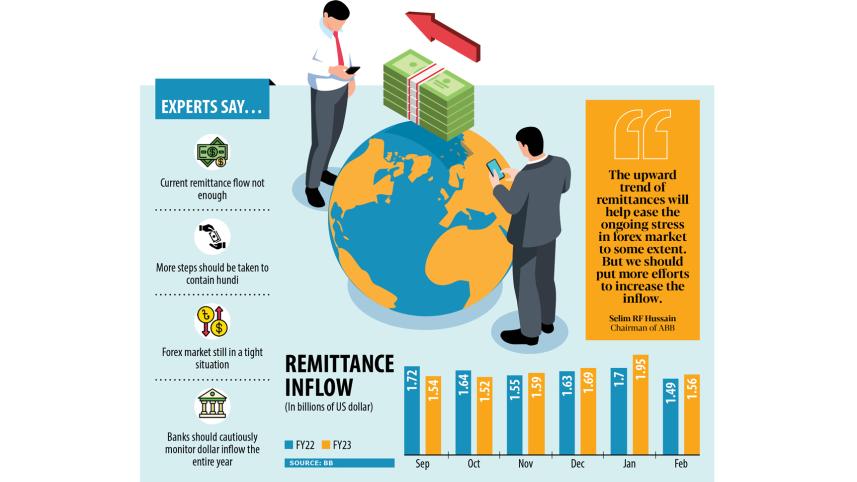
Remittance inflow has increased 4.46 per cent year-on-year to $1.56 billion in February this year as expatriate Bangladeshis have been opting to use the legal channel in the last couple of months to send their hard-earned money.
Both banks and Bangladesh Bank have recently taken various measures to encourage expatriate Bangladeshis to send their money through the banking channel, which is now paying off, said a central bank official.

Experts, however, say that the current inflow of remittance was not enough to tackle the erosion of the country's foreign exchange reserves.
Ahsan H Mansur, executive director of the Policy Research Institute of Bangladesh, said the inflow should have crossed $2 billion each month given the human resources being exported abroad.
"But we can't maintain the ceiling thanks to the dominance of the hundi cartel. Although remittances have increased a bit in recent months, this is not enough to tackle the stress that is prevailing in the economy," he said.
More than 11.35 lakh Bangladeshis left the country for jobs abroad last year, the highest in history, data from the Bureau of Manpower Employment and Training showed.
Remittances in February, however, declined 20.3 per cent from that in January when expatriate Bangladeshis sent home $1.95 billion, according to data from the central bank.
A Bangladesh Bank official said the month of January contains 31 days whereas February was of 28 days, so it was logical for a lower amount of remittance to come last month.
Between July and February of this fiscal year, remittance inflow stood at $14.01 billion, down 4.27 per cent year-on-year, data from the Bangladesh Bank showed.
Mansur said the foreign exchange reserves would fall remarkably as the central bank within next week would clear import payments to Asian Clearing Union (ACU), an arrangement to settle payments for intra-regional transactions among member countries including Bangladesh.
India, Bhutan, Iran, the Maldives, Myanmar, Nepal, Pakistan and Sri Lanka are other members of the Tehran-headquartered ACU.
The member countries of the ACU clear their payments every two months.
Bangladesh Bank paid $1.12 billion to clear payments for its imports from other member countries of the ACU in January.
The country's foreign exchange reserves stood at $32.44 billion on February 23 in contrast to $45.84 billion a year ago.
Mansur said the country's export shipments to the US has decreased recently, which was alarming considering the vulnerability in the foreign exchange market.
He reckons that Bangladesh may face a tight situation in the foreign exchange regime throughout the entirety of this year.
The upward trend of inflow of remittances will help the forex market tackle the ongoing stress to some extent, said Selim RF Hussain, the chairman of the Association of Bankers, Bangladesh, a platform of managing directors of banks.
"But we should give more effort to increase the inflow given the existing tight situation in the market," he said.
Syed Mahbubur Rahman, managing director of Mutual Trust Bank, said banks were still facing difficulties in opening letters of credit due to the dollar shortage.
"If we manage to draw more remittance, the difficult situation can be tackled efficiently," he said.
 For all latest news, follow The Daily Star's Google News channel.
Comments