


Oil hovers around four-month high
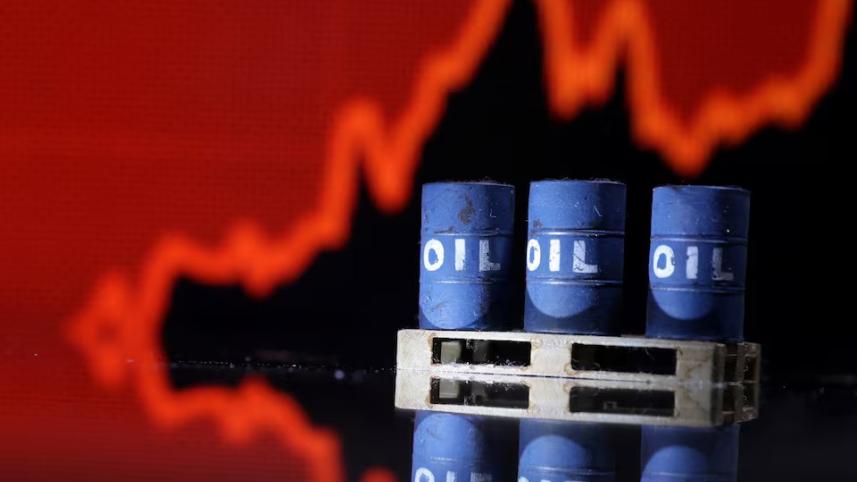
Oil prices rose to their highest since late September on Wednesday on looming Iran concerns while a weak US dollar lent further support.
Brent crude futures settled up 83 cents, or 1.23 percent, to $68.40 a barrel. US West Texas Intermediate crude closed 82 cents, or 1.31 percent, higher at $63.21.
 For all latest news, follow The Daily Star's Google News channel.
 Both benchmarks were headed for their biggest monthly rises in percentage terms since July 2023, with Brent set to rise around 12 percent and WTI around 10 percent.
US President Donald Trump urged Iran on Wednesday to come to the table and make a deal on nuclear weapons or the next US attack would be far worse, but Tehran said that if that happened it would fight back as never before.
A US aircraft carrier and supporting warships arrived in the Middle East, US officials said earlier this week.
“The markets were up on concerns about the US’ armada, but they pulled back on the possibility of peace (between Russia and Ukraine),” Phil Flynn, senior analyst at Price Futures Group.
Trilateral negotiations between Russia, Ukraine and the US are set to resume in Abu Dhabi on February 1, Russia’s Interfax news agency cited the Kremlin as saying.
The US Energy Information Administration said on Wednesday the country’s crude oil inventories fell by 2.3 million barrels to 423.8 million barrels in the week ended January 23, compared with analysts’ expectations in a Reuters poll for a 1.8 million-barrel rise.
“A solid report, with a modest gasoline and distillate build and a larger crude draw. Strong crude exports and lower imports helped to see another crude draw. The next report will be more interesting, to see the impact of the cold weather on the data,” said Giovanni Staunovo, UBS analyst.
A winter storm swept across much of the US over the weekend, straining energy infrastructure and power grids. US oil producers were bringing wells back online on Wednesday. Domestic crude output was estimated to be down around 600,000 barrels per day, roughly 4 percent of total output.
Germany, Britain, Denmark, and other European nations signed a clean energy pact at the North Sea Summit in Hamburg on Monday.
A weak US dollar kept the prices elevated. The greenback is hovering near four-year lows against a basket of other currencies, making dollar-denominated commodities such as oil cheaper for those holding other currencies.
The US Federal Reserve held interest rates steady on Wednesday, citing still-elevated inflation alongside solid economic growth, and giving little indication in its latest policy statement of when borrowing costs might fall again.
Comments