


No EU-Bangladesh FTA in foreseeable future
There is no possibility of signing a free trade agreement (FTA) with Bangladesh in the foreseeable future because of the complexity related to the issue as well as bloc's lack of interest, said Charles Whiteley, head of the delegation of the European Union to Bangladesh, yesterday.
This is not going to happen because of the degree of complexity, and the trade relations between the two sides are not yet at the stage where "we would be genuinely interested on the EU side to negotiate an FTA", he said.

The ambassador was speaking at an event titled "Strengthening Bangladesh-EU Trade and Economic Cooperation: Issues and Policy Priorities" at the Sheraton hotel in Dhaka.
The Research and Policy Integration for Development (RAPID), a think-tank, and FES Bangladesh, the country office of the private German non-profit organisation, jointly organised the event.
Bangladesh will have to sign deals with trading partners to ensure preferential market access following its graduation to a developing nation from a least-developed country (LDC) in 2026 since Dhaka is expected to lose duty benefits after the change in status.
The potential of Bangladesh to sign an FTA emerged after the EU inked a similar deal with Vietnam.
But Whiteley said the EU's FTA with Vietnam is expected to bring down tariffs in many areas, but it will also bring massive benefits for European businesses, including in the service sector.
He expected the bilateral trade relations between the EU and Bangladesh to become more balanced and more wide-ranging.
That means there has to be an objective assessment, on the Bangladesh side, on how to make it easier for the EU to do business in the country.
"Our Spanish friends in the EU are quite frustrated about how their companies are treated here. When you have the mentality among the members of the European Parliament, it means we have a bigger hurdle to clear when we talk about making life easier for Bangladesh in the EU market."
Already, there is a psychological shift, according to the diplomat.
Many European parliamentarians think that since Bangladesh will no longer be an LDC after 2026, there is no question of treating the country as an LDC.
"They also think that the three-year transition is long enough for the government and businesses of Bangladesh to adjust to the realities of not being an LDC," said Whiteley.
Since Bangladesh will not automatically qualify for duty-free, quota-free market access in the EU, the entire focus has to be on making the GSP Plus politically, financially and economically, he said.
Bangladesh will have to ratify 32 international conventions and implement them in order to qualify for the GSP Plus.
Whiteley also talked about the safeguard issue, a concern for Bangladesh.
This is because if the share of a product from a country exceeds 6 per cent of the total EU imports of the same product, safeguard measures would be triggered to remove duty-free market access for these items.
Bangladesh's garment exports have exceeded the threshold.
This will have a profound impact on Bangladesh if not addressed properly, said the diplomat.
"But Bangladesh's voice is being heard in the European parliament and there is good awareness about the impacts this could have on Bangladesh. I do believe a fix will be found."
 For all latest news, follow The Daily Star's Google News channel.
 "I am optimistic on that front. There is awareness and sympathy on the EU side of what needs to be done for Bangladesh."
There is a need for a sustained focus on trade diversification, said the EU delegation chief.
"More needs to be done on the policy level in Bangladesh by the government to encourage diversification."
Sharifa Khan, secretary of the Economic Relations Division, said if the Doha Development Round of the World Trade Organisation is delivered and the most-favoured-nation (MFN) tariffs become effective, duty will not be a major issue.
She also questioned why the duty on textile items was higher compared to other products.
The MFN tariff for non-agriculture products is only 2.8 per cent whereas it is nearly 12 per cent for apparel products.
"Garments are produced by poor countries or LDCs. But they face higher tariffs. This needs to be considered," said the secretary.
"If tariffs come down to zero, there will be no need to go for signing any FTA."
She urged the EU to conclude the Doha round and bring down the MFN rate to zero.
"There should be a rule-based multilateral system for all the member countries."
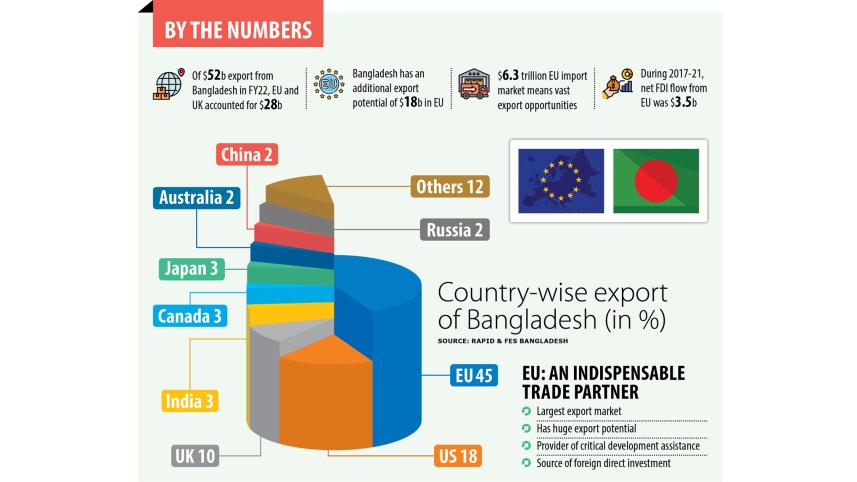
The EU is by far Bangladesh's largest export market, accounting for over half of all merchandise exports. Besides trade, the bloc has been one of the major development partners.
Bangladesh still has enormous export potential in the EU, with just 60 per cent of export capacity now being used, said M Abu Eusuf, executive director of the RAPID.
"Bangladesh has an additional export potential of $18 billion in the EU. This will rise further," said Mohammad Abdur Razzaque, chairman of the RAPID, during his presentation.
He said the Bangladesh-EU relationship is facing emerging developments such as the LDC graduation and changes in the EU GSP regime, other countries' trade agreements with the EU, the EU Green Deal and its Carbon Border Adjustment Mechanism, and the Environmental, Social and Governance Compliance.
He said policy options for Bangladesh include establishing a domestic carbon market, improving firm-level competitiveness, adopting sustainable production practices, attracting investment, and addressing the high cost of doing business.
Comments