


NBR misses Jul-Feb revenue target by 28% despite growth

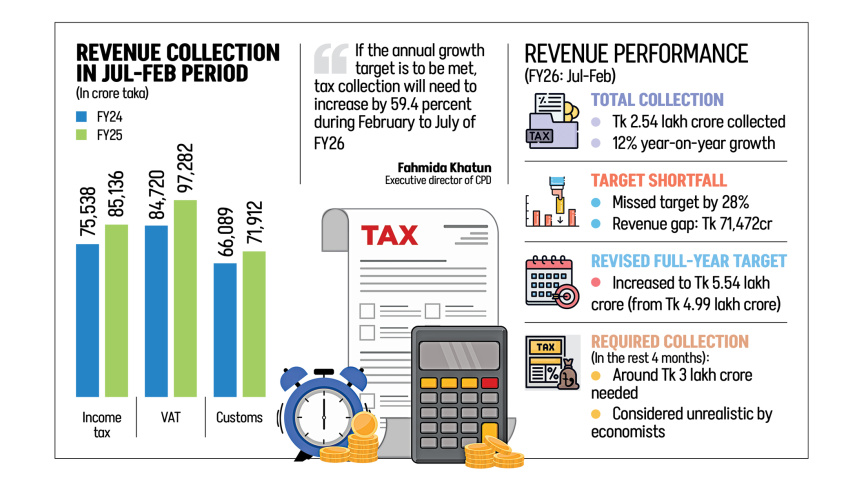
The National Board of Revenue (NBR) fell short of its revenue target by 28 percent during July-February of fiscal year 2025-26 (FY26), leaving a gap of Tk 71,472 crore.
As per provisional data released yesterday, the shortfall came despite a 12 percent year-on-year rise in collections to Tk 2.54 lakh crore, buoyed largely by robust VAT (value-added tax) receipts from domestic trade and economic activity.

The deficit underscores the widening gap between the tax authority’s ambitions and ground reality. The board has consistently missed its target over the last decade.
Yet, in late November, the previous interim government had revised the NBR’s full-year target upward to Tk 5.54 lakh crore from Tk 4.99 lakh crore, following strong first-quarter collections.
Meeting that goal would now require mobilising around Tk 3 lakh crore over the remaining four months of the fiscal year, an outcome economists say is highly unrealistic given persistent inflation, sluggish development spending, and broader economic weakness.
Amid this sluggish revenue performance, the government is increasingly turning to borrowing to finance its expenditures.
According to provisional data from Bangladesh Bank, net borrowing from the banking sector crossed Tk 48,800 crore by January 25, nearly five times higher than the Tk 10,558 crore borrowed during the same period a year earlier, highlighting the growing fiscal strain.
The Centre for Policy Dialogue (CPD) has warned that Bangladesh’s revenue targets for the current fiscal year are getting increasingly out of reach, urging a shift toward more realistic planning and stronger domestic resource mobilisation.
According to a paper by Towfiqul Islam Khan, additional director (research) at CPD, the total revenue shortfall for FY26 will likely exceed Tk 1 lakh crore, much like what was recorded in FY25, The Daily Star reported in February.
According to the think tank, the annual revenue growth target for FY26 was set at 34.5 percent over the previous year’s actual collection, an ambitious benchmark from the outset. But with collections lagging in the first half, the pressure has now shifted sharply to the remaining months.
“If the annual growth target is to be met, tax collection will need to increase by 59.4 percent during February to July of FY26,” said Fahmida Khatun, executive director of CPD, at a briefing on FY27 budget recommendations this month.
“This appears highly unlikely given the current pace of revenue collection.”
Against this backdrop, CPD has emphasised the need to strengthen domestic resource mobilisation without placing an excessive burden on citizens. The call comes as the current ruling party has set an ambitious goal of raising the country’s tax-to-GDP ratio to 15 percent by 2035, up from 6.8 percent in FY25.
However, CPD cautioned that such a target must be backed by a comprehensive and well-sequenced action plan, alongside consistent implementation and strong political commitment -- areas where Bangladesh has historically struggled.
To expand the revenue base, the think tank suggested exploring new avenues of taxation, including meaningful levies on wealth and property, as well as capturing revenue from the rapidly growing digital economy.
The government’s manifesto also includes proposals to introduce a modern property and wealth tax regime, which CPD sees as a step in the right direction if properly designed and enforced.
At the same time, CPD called for a rationalisation of tax incentives.
“Starting in FY27, all ad hoc provisions of tax incentives should be discontinued,” Khatun said, stressing the need for transparency and predictability in the tax system.
Yet, the think tank acknowledged the political and economic realities ahead. With businesses facing a challenging environment, demand for incentives is likely to rise in FY27.
In this context, CPD urged the NBR to exercise greater caution and selectivity in granting tax breaks.
 For all latest news, follow The Daily Star's Google News channel.
 A medium-term strategy to gradually phase out existing tax exemptions should also be put in place, it added, to avoid sudden shocks while improving revenue efficiency over time.
Another critical area highlighted by CPD is the large volume of disputed tax claims stuck in the system. Accelerating their resolution through the Alternative Dispute Resolution (ADR) mechanism could unlock significant revenue, the think tank noted.
Within the July-February tax receipts, VAT from domestic activity was the largest contributor, accounting for 38 percent of total collection, rising 14.83 percent year on year to Tk 97,281 crore.
Direct taxes -- income and corporate -- accounted for 33.5 percent, climbing 13 percent to Tk 85,136 crore. Import tariffs grew more modestly, up 8.8 percent to Tk 71,912 crore.
Comments