


‘Minimum tax provision discriminatory’
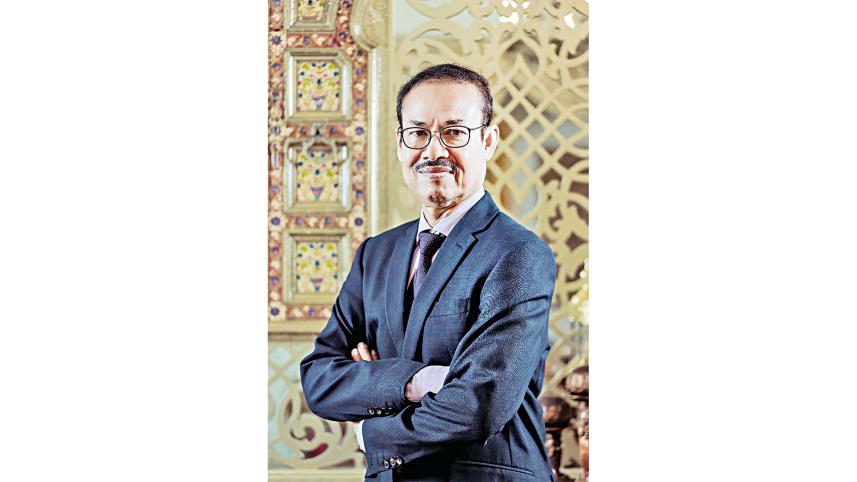
The provision of minimum tax is detrimental to businesses as many companies are forced to bear it even though their actual payable tax is less than their respective minimum tax, said a top official of Crown Cement PLC.
Masud Khan, chief adviser to the board of Crown Cement PLC, shared the observation citing some tax rules.

Citing section 52 of the income tax ordinance which is related to the deduction of tax on payments to contractors and others, he said the provision requires companies to deduct tax at source on supply of goods when making the payments.
"This becomes the minimum tax payable if the tax payable on actual income is less than the tax deducted at source," said Khan, also a chartered accountant, in an interview with The Daily Star.
For example, if advance tax of Tk 1,000 is initially deducted but actual tax on profit earned by the company subsequently amounts to Tk 500, the tax payable is Tk 1,000, he said.
At present, the highest rate of withholding tax is 7 per cent and on payments to contractors and in many othercases, companies are unable to make adjustments such as claiming refunds of payments made in excess, Khan said.
The cement and steel industries in Bangladesh are reliant on imported raw materials since Bangladesh does not have mineral deposits, he said.
"Currently, advance income tax is being deducted at source at the rate of 2 to 3 per cent on all imports," he said.
At the import stage, the assessment of the value of raw materials by customs officials is generally around 25 per cent higher than the reported rate. Hence the effective advance income tax comes to around 4 per cent, he added.
In addition, tax is being deducted at source on practically all purchases of goods and services at varying rates with the highest tax rate being 7 per cent, he said.
If tax at source on sales to customers and tax at source on exports are considered, the effective advance tax rate will be around 11 per cent, he added.
And this tax is treated as minimum tax for the cement and steel industries and ferroalloy producers, said Khan.
"It is highly discriminatory," he said, adding that this minimum tax cannot be adjusted against profits.
As a result, the effective tax rate goes up, which sharply erodes the profits of companies, often taking them to the red, he added.
The tax authorities should allow any excess minimum tax to be carried forward to be adjusted against future years, added Khan.
He also spoke of another provision introduced this fiscal year.
The new rule requires payments to be made through bank transfers, which is "impractical" in the industry's current ecosystem which heavily relies oncash transactions, he said.
"Many suppliers do not have bank accounts. Emergency cash purchases are often required for factory spares and other supplies that are not stock items. This is a common practice across both locals and to some extent, multinationals," he said.
"It is highly impractical to insist that our business ecosystem has to transform overnight from a cash society to a cashless society," he said.
The official of Crown Cement PLC was also critical of the arbitrary fixation of gross profit by the tax authorities without the actual gross profit ratio, a measure of the gross profit as a percentage of net sales, being taken into consideration.
 For all latest news, follow The Daily Star's Google News channel.
 Khan also spoke of a provision requiring a deposit to be made in case any company seeks to appeal against the tax claim of the field offices of the National Board of Revenue.
At present, companies have to deposit 10 per cent of the disputed tax into the state coffer to appeal with the tax tribunal against the tax claims. Firms have to deposit 25 per cent of the disputed amount if they want to file an appeal with the High Court.
Khan said value added tax authorities often make arbitrary demands to increase revenue. "Also, this is against the fundamental right to be entitled to the free access to the judiciary," he said, demanding removal of this provision.
Comments