


Low maize prices shrink profits for char farmers


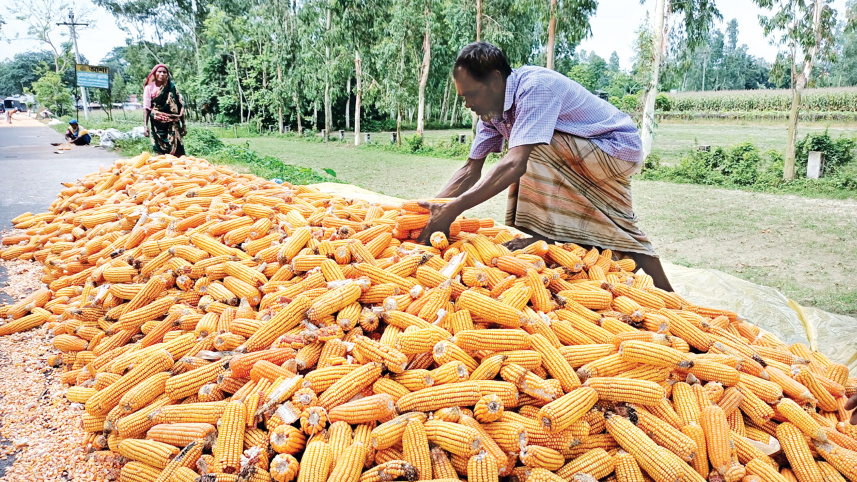
- Maize acreage expands across Rangpur char regions
- Rising production costs squeeze local farmers' profits
- Lower market prices disappoint growers despite yields
In the once-barren northern chars of Rangpur, maize has become a lucrative cash crop. But low market prices this year have left farmers disappointed despite expanded cultivation.
Maize growers in the Rangpur char region said rising costs of seeds, fertiliser, diesel, and labour increased production expenses by Tk 2,000 to Tk 2,500 per bigha, while lower-than-expected prices brought down profit margins.

According to the Department of Agricultural Extension (DAE), projected nationwide maize acreage and production for the current fiscal year are lower than last year’s. In contrast, cultivation has expanded in the Rangpur region.
A DAE official agreed that higher production costs have discouraged farmers. While many maize growers reported that nor’westers and hailstorms damaged their crops, the official added that the overall impact of the disasters was not severe.
Meanwhile, maize traders have said prices may go up if the demand at feed mills rises, advising farmers to store their harvest for now.
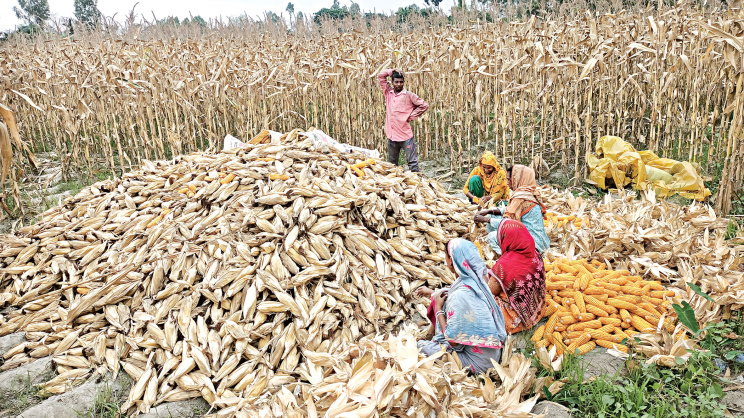
HIGH HOPES DASHED
DAE data show maize has been cultivated on 666,000 hectares nationwide this fiscal year, with a production target of 7.079 million tonnes. In the previous fiscal year, maize was grown on 678,000 hectares, producing 7.399 million tonnes.
In the five districts of Rangpur region -- Lalmonirhat, Kurigram, Rangpur, Nilphamari, and Gaibandha -- maize has been cultivated on 127,230 hectares this year, with a production target of 1.329 million tonnes.
Farmer Shamsul Alam, 65, from Char Goddimari on the Teesta River in Hatibandha upazila of Lalmonirhat, cultivated maize on 22 bighas this year, up from 20 bighas last year.
“Other crops do not generate enough profit, but maize makes up for those losses. However, because of lower market prices this year, profits have dropped significantly,” he said.
According to Alam, the cost of cultivating maize on one bigha rose to Tk 20,000 this year from Tk 17,500 last year due to higher fertiliser, diesel, and labour costs.
He had hoped to sell maize at Tk 31 to Tk 32 per kilogramme, but current prices have fallen well below expectations.
Farmer Sekendar Ali, 65, from Char Karai Barishal on the Brahmaputra River in Chilmari upazila of Kurigram, said he was forced to sell 5,000 kilogrammes of maize at Tk 27 per kilogramme.
“I still have more than 18,000 kilogrammes stored at home. I am holding onto them in the hope that market prices will rise,” he said.
Farmer Ruhul Amin, 60, from Rasulpur Char in Fulchhari upazila of Gaibandha, said yields also declined this year.
“Last year, yields were 35 to 40 maunds per bigha, but this year they did not exceed 30 maunds,” he said.
Untimely hailstorms, diesel shortages, and high fertiliser prices affected production, he added.
PRICE RECOVERY EXPECTED
Maize traders said prices have declined because of higher supply in the market, although they expect rates to improve in the coming weeks.
Nazrul Islam, a maize trader in Chilmari upazila, said warehouses are still holding unsold stocks from last year, while feed mills are purchasing less aggressively than before.
 For all latest news, follow The Daily Star's Google News channel.
 “So, we are purchasing maize from farmers at Tk 27 to Tk 28 per kilogramme,” he said.
“Although market demand is somewhat down now, prices may increase soon. If demand rises at feed mills, farmers will also get better prices.”
Nibarun Chandra Sen, a maize trader from Baura in Lalmonirhat, said farmers are still making profits, though margins have narrowed considerably.
Delwar Hossain, manager of a maize procurement centre in the same area, said farmers who are not in urgent need of cash may benefit by storing maize for some time.
Abdullah Al Mamun, deputy director of the Kurigram DAE, said maize cultivation began in the Teesta char areas around 30 years ago and has expanded rapidly in the Brahmaputra chars over the past five years.
“Maize has now become the most important crop in the agricultural economy of the char regions,” he said.
He acknowledged that higher production costs and lower market prices have disappointed farmers, though storm-related damage was not severe overall.
Sirajul Islam, additional director of the Rangpur Regional Agricultural Extension Department, said around 90 percent of maize in the Rangpur region is grown in char areas along 26 rivers, helping improve local livelihoods.
Besides grain sales, farmers also earn Tk 3,000 to Tk 4,000 per bigha from selling maize cobs, he added, expressing hope that prices would improve if demand rises in the coming days.
Comments