


Logistics policy needs to consider global best practices
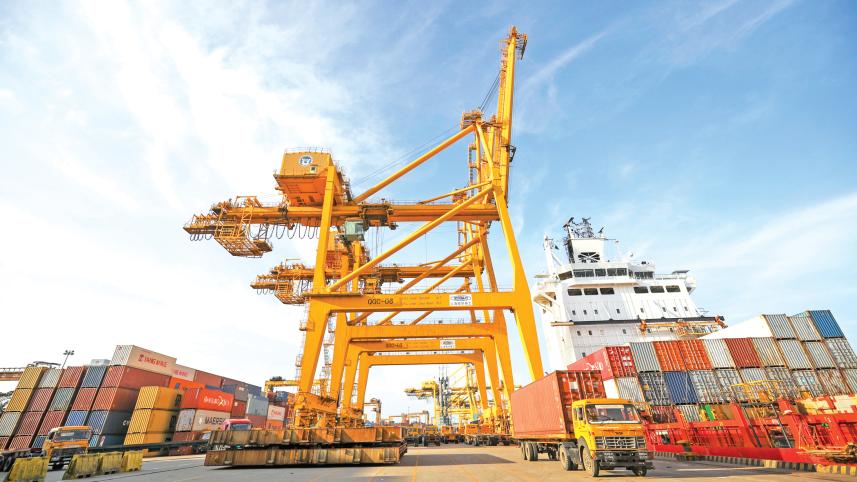
Policymakers should take global best practices and strategies into consideration to formulate the nation's logistics policy, said experts yesterday.
Necessary policy reforms need to be ensured through the removal of regulatory bottlenecks to attract domestic and foreign investment in the logistics sector, said Abul Kasem Khan, former president of the Dhaka Chamber of Commerce and Industry.

"And we should follow the best practices of India, China, Singapore, Hong Kong, etc to formulate Bangladesh logistics policy," he said.
He said the Indian government invested Rs 99,000 crore through Sagarmala, an initiative to develop efficient port, road and rail infrastructure along the country's coastline to harness their economic growth potentials.
Khan was addressing a workshop on "Formulating National Logistics Development Policy for Bangladesh: Experience from Global Good Practices" jointly organised by the industries ministry, BUILD and World Bank Group at InterContinental Dhaka.
The workshop was a part of the first public-private interaction of a Logistics Infrastructure Development Working Committee (LIDWC) formed by the Prime Minister's Office and BUILD in 2020 to overcome barriers to logistics and attain economic development.
Following a request of the PMO, the LIDWC, which is under the industries ministry, prepared a draft "National Logistics Development Policy Framework" this year.
A "National Forum for Formulating National Logistics Industry Development Policy" will be formed where the LIDWC will provide research assistance with the support of World Bank Group, said Khan, who is also co-chair of the LIDWC.
Martha B Lawrence, global lead of Regional Connectivity and Logistics Knowledge Group at World Bank, highlighted the importance of being comprehensive when focusing on logistics efficiency, quality and infrastructure improvements and regional connectivity.
This must be ensured during the formulation of the National Logistics Industry Development Policy to develop a balanced multimodal transport system.
Md Mostafa Kamal, secretary to the shipping ministry, said the government has taken up several mega projects considering improvements in logistics as one of the key priorities.
But without the full automation of procedures of customs and the National Board of Revenue, all initiatives will be in vain, he added.
He said harmonised coordination among public, private and development partners was the single key to bringing about a multimodal logistics management system of a global standard.
Railways Minister Md Nurul Islam Sujan said there was no alternative to a modern railway system when it comes to ensuring efficiency in transport costs.
Ongoing projects of the Ministry of Railways will connect Bangladesh to Trans-Asian Railway Network and that will lead to exploration of new export markets with a diverse range of products, he added.
He said the Ministry of Railways would extend all possible assistance in a coordinated manner to turn Bangladesh into a multimodal logistics hub of South Asia.
Shomik Raj Mehndiratta, practice manager, Transport, South Asia, World Bank; Martin Holtmann, country manager (Bangladesh, Bhutan, and Nepal), International Finance Corporation, and Ferdaus Ara Begum, CEO, BUILD, also spoke.
 For all latest news, follow The Daily Star's Google News channel.
Comments