


Leather goods makers seek environmental clearance quickly
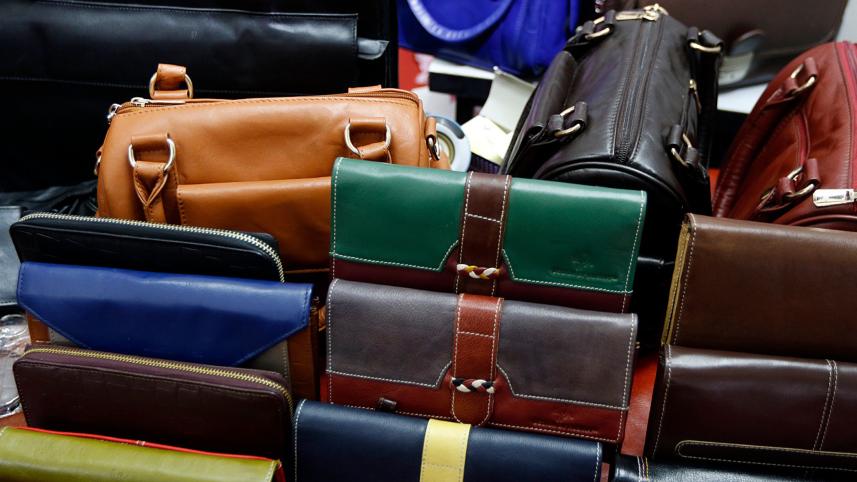
Leather goods manufacturers based in the capital's Hazaribagh have urged the government to simplify the process of issuing environmental clearance certificates so that they can tap export opportunities easily.
They made the plea at a discussion on the prospects of the leather product cluster in Hazaribagh and the task ahead, organised by the SME Foundation at the Parjatan Bhaban in Agargaon yesterday.

Tania Wahab, an entrepreneur of the cluster and managing partner of Karigar, said leather goods and footwear are the most promising industry in Bangladesh after garments.
"So, the sector should be given more priority."
She said several entrepreneurs have been supplying products to big bands of Bangladesh for many years. Many are exporting in small volumes as well.
Wahab, also the president of the Leathercraft Association, a platform representing leather goods makers, recalled when she started business in Hazaribagh 18 years ago, landowners were not encouraged to rent out to a showroom to sell leather products.
"Now, the situation has changed."
At the discussion, a number of entrepreneurs said the Department of Environment (DoE) took a long time in issuing the environment clearance certificate. As a result, they could not tap the export opportunities.
Syed Nasim Manzur, managing director of Apex Footwear Limited, and president of the Leathergoods and Footwear Manufacturers and Exporters Association of Bangladesh, questioned how would Bangladesh survive in the competition with other countries if the lead time can't be reduced?
"The Hazaribagh cluster can play a big role if the lead time can be shortened. This is because many people have gained skills by working in the cluster for a long time," he said.
Mirza Nurul Gani Shovon, president of the National Association of Small and Cottage Industries of Bangladesh, said entrepreneurs in the cluster are facing various obstacles when it comes to foreign trade.
"These problems must be resolved."
According to Mafizur Rahman, managing director of the SME Foundation, the cluster has the ability to meet the demand of the domestic market as well as earn a huge amount of foreign exchanges.
He said if the government and the SME Foundation took coordinated initiatives for the development of the cluster, the growth of the zone would be accelerated.
"Then, this will play an important role in bringing about socio-economic change in the area."
Abdul Hamid, director general of the DoE, said the government is trying to make it easier to obtain environmental clearance for factories in the cluster.
"The government also plans to allocate space to leather goods manufacturers besides the Savar Tannery Industrial Estate."
Hazaribagh has transformed itself into a leather products manufacturing hub from a tannery zone in a span of six years since rawhides processors were shifted to Savar, logging an annual trade of Tk 60 crore.
More than 400 shops and showrooms have been set up in different places in the area, including around the Institute of Leather Engineering and Technology, Hazaribagh Bazar and Dhanmondi 15.
They produce products such as leather belts, wallets, shoes, parts and official bags for both local and export markets.
 For all latest news, follow The Daily Star's Google News channel.
 The number of factories, big and small, in Hazaribagh would be about 1,200, employing 55,000 to 60,000 people, according to the SME Foundation.
Comments