


Leather footwear exports fall to five-year low
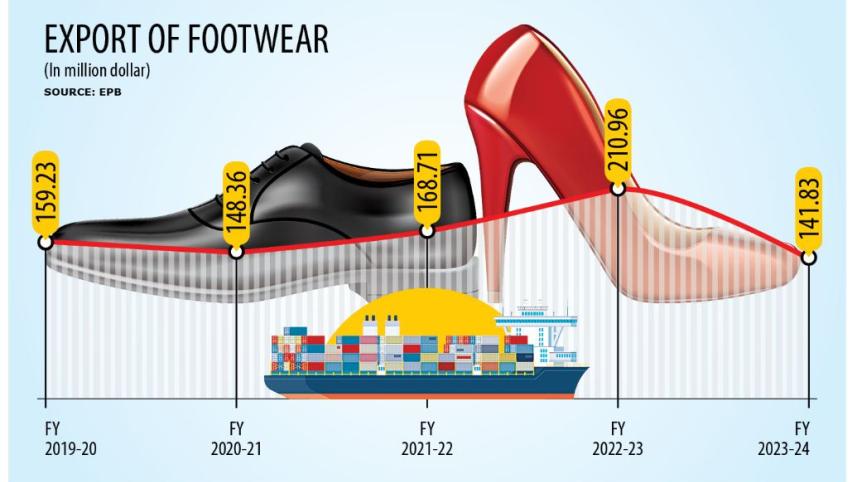
Bangladesh's leather footwear industry saw its export earnings fall to a five-year low of $141.83 million in the first quarter of the current fiscal year due to a decline in export orders from the Eurozone in the face of the ongoing economic crisis.
According to data from the Export Promotion Bureau, there was a 32.77 percent decline in year-on-year export earnings.

The leather footwear industry shipped goods worth $210.96 million in the corresponding period of the last fiscal year. Even during the Covid-19-affected period between July and September of FY 2020-21, $148.36 million worth of shipments were made.
"The new fiscal year started with negative growth of leather footwear as export orders are declining," said Dilip Kajuri, chief financial officer of Apex Footwear Limited.
According to Kajuri, Apex's exports fell by 58 percent in September and 37 percent in August compared to the same months last year.
"We do not know how much it will decline in October," he noted.
He added that there was usually a rush of shipments around this time, especially in the pre-pandemic period, but the scenario was quite different now since there were no export orders in hand for the next three months.
Regarding the continuous decline of export orders, Kajuri blamed economic conditions in the Eurozone, which is vulnerable due to the impact of the Russia-Ukraine war.
"We are worried about how the factory will run if the situation does not improve," he said, adding that they had already shuttered their non-leather shoe manufacturing unit due to a lack of export orders.
According to Kajuri, around 5,500 workers are employed at their export-oriented factory.
"We do not know what is going to be the fate of the workers," he lamented.
Against this backdrop, the government's imposition of a pre-profit source tax of around 77 percent on export-oriented products is an added burden.
Kajuri said that companies were willing to pay taxes, but the government should think about how to keep such businesses alive.
Abdus Samad, assistant general manager of Akij Footwear Ltd, said their orders were stable despite growth being slightly slow.
"As a medium-scale company, we are managing exports at any cost. But big companies are facing trouble due to export orders declining," he noted.
Mohammed Nazmul Hassan Sohail, senior vice president of Leathergoods and Footwear Manufacturers & Exporters Association of Bangladesh (Lfmeab), said exports declined as people in the Eurozone were reluctant to purchase luxury items such as leather shoes.
He added that global brands did not acceptlocal leather as the non-functional Central Effluent Treatment Plant (CETP) in the Savar Tannery Industrial Complex does not have a Leather Working Group (LWG) certificate.
He also alleged that unnecessary harassment and anti-export policies of the National Board of Revenue (NBR) created a hurdle to shipping leather footwear, which deterred new investors.
He further noted that high interest rates on bank loans led to an increase in overhead costs, which is also hampering exports.
 For all latest news, follow The Daily Star's Google News channel.
 "If these challenges can be dealt with, the leather footwear sector will be able to export goods worth at least $5 billion by 2026, creating at least one lakh employment opportunities," Sohail stressed.
Md Akter Hossain, vice president of Tannery Worker Trade Union, Dhaka division, alleged that tannery owners focused solely on profits and did not pay heed to workers' welfare.
He also alleged that the government had failed to address major problems despite frequently committing to resolving them.
Comments