


Inflation eases to 9.16% in June

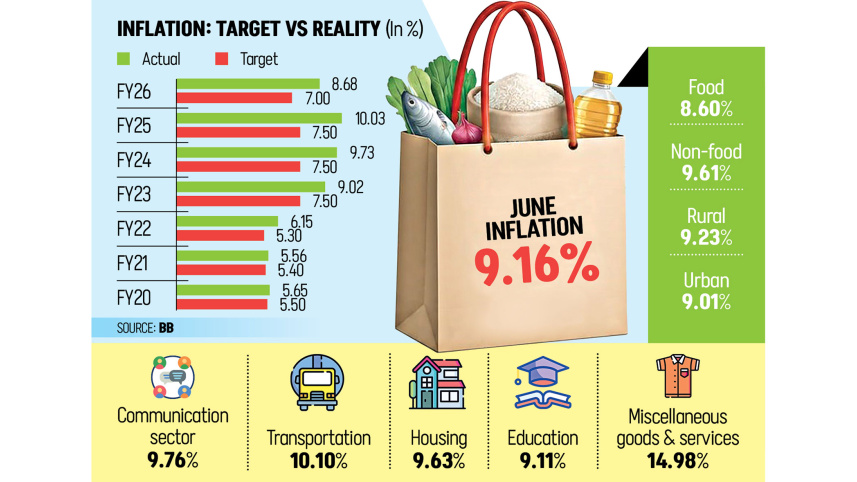
The country ended fiscal year 2025-26 with a slight easing in inflation, as lower food prices helped slow overall price growth in June.
However, the average inflation rate for the full fiscal year remained far above the government’s target, showing that cost-of-living pressures continued to weigh on households and complicate economic management throughout the year.

Inflation fell to 9.16 percent in June from 9.42 percent in May, according to Bangladesh Bureau of Statistics (BBS) data published yesterday.
Food inflation eased to 8.60 percent from 9.06 percent, driving the overall decline.
Non-food inflation also edged down, to 9.61 percent from 9.71 percent. Even so, it remained elevated, reflecting continued price pressures in areas such as housing, transport, healthcare and education.
The June figures suggest inflationary pressures are easing gradually. But they also mark the end of a fiscal year in which average inflation stood at 8.68 percent, well above the government’s 7 percent target.
This mismatch raised fresh questions about the effectiveness of tighter monetary policy, exchange rate reforms and import measures in bringing prices under control.
“The government’s inflation target has proved wrong,” said Mustafizur Rahman, distinguished fellow at local think tank Centre for Policy Dialogue (CPD).
When the government set its revised budget target of 7 percent, average inflation had already climbed above 8.6 percent, he said. “There was no realistic way to bring it down.”
Mustafizur said that the same challenge now confronts the government’s 7.5 percent inflation target for the current fiscal year 2026-27.
Whether that target can be achieved, he said, will depend on several factors, including whether investment-friendly budget measures lead to stronger domestic supply, how much further the taka depreciates, and how effectively the government uses programmes such as Open Market Sales (OMS) to ease pressure on marginal communities.
“The biggest issue, however, is employment,” he said. Stronger job creation and rising incomes would improve purchasing power and help people cope with higher prices.
Mustafizur also talked about the difference between inflation and the price level.
“Even if inflation falls, prices don’t return to where they were -- they just rise more slowly. The price level remains permanently higher.”
An item that rose from Tk 100 to Tk 110 does not return to Tk 100 when inflation slows, he explained. Instead, prices continue to increase, but at a slower pace from a higher base.
He argued that policymakers need to focus not only on reducing inflation but also on addressing the elevated price level, particularly for lower-income households through stronger social safety nets and food distribution programmes.
He also said reductions in import duties have too often failed to reach consumers because lower import costs are not fully reflected in retail prices. “We won’t bring inflation down meaningfully unless market management improves.”
CONFLICTING STEPS WEAKEN INFLATION FIGHT
Prof AKM Waresul Karim, dean of North South University’s School of Business and Economics, took a more measured view.
 For all latest news, follow The Daily Star's Google News channel.
 An average inflation rate of 8.68 percent was “not particularly disappointing”, he said, considering that Bangladesh had recently experienced double-digit inflation. It is also the lowest annual average since 2024.
However, he questioned whether government policies are working towards the same objective.
“I don’t think the government is moving in a consistent direction. It is sending mixed signals,” said Prof Waresul.
The Bangladesh Bank (BB) is maintaining a high policy rate to tighten monetary conditions, he said, while the government is expanding spending and introducing stimulus packages.
“These policies work in opposite directions.”
He also said there is still little evidence of stronger production or a meaningful supply-side recovery that could help contain prices.
So, he does not expect inflation to fall much further this year.
Higher electricity and gas prices, together with increased government spending, are likely to keep inflation around 8.7 percent, he said. He also pointed to reports of around 5,500 job losses and continuing factory closures as signs that supply-side conditions are weak.
“We need to give the government more time,” he said, adding that a clearer assessment would be possible by December or January.
For now, he said, the economy is benefiting from strong remittance inflows and momentum carried over from the previous government.
“The more difficult period may come later,” he added.
A THREE-YEAR TIGHTENING CYCLE WITHOUT PAYOFF
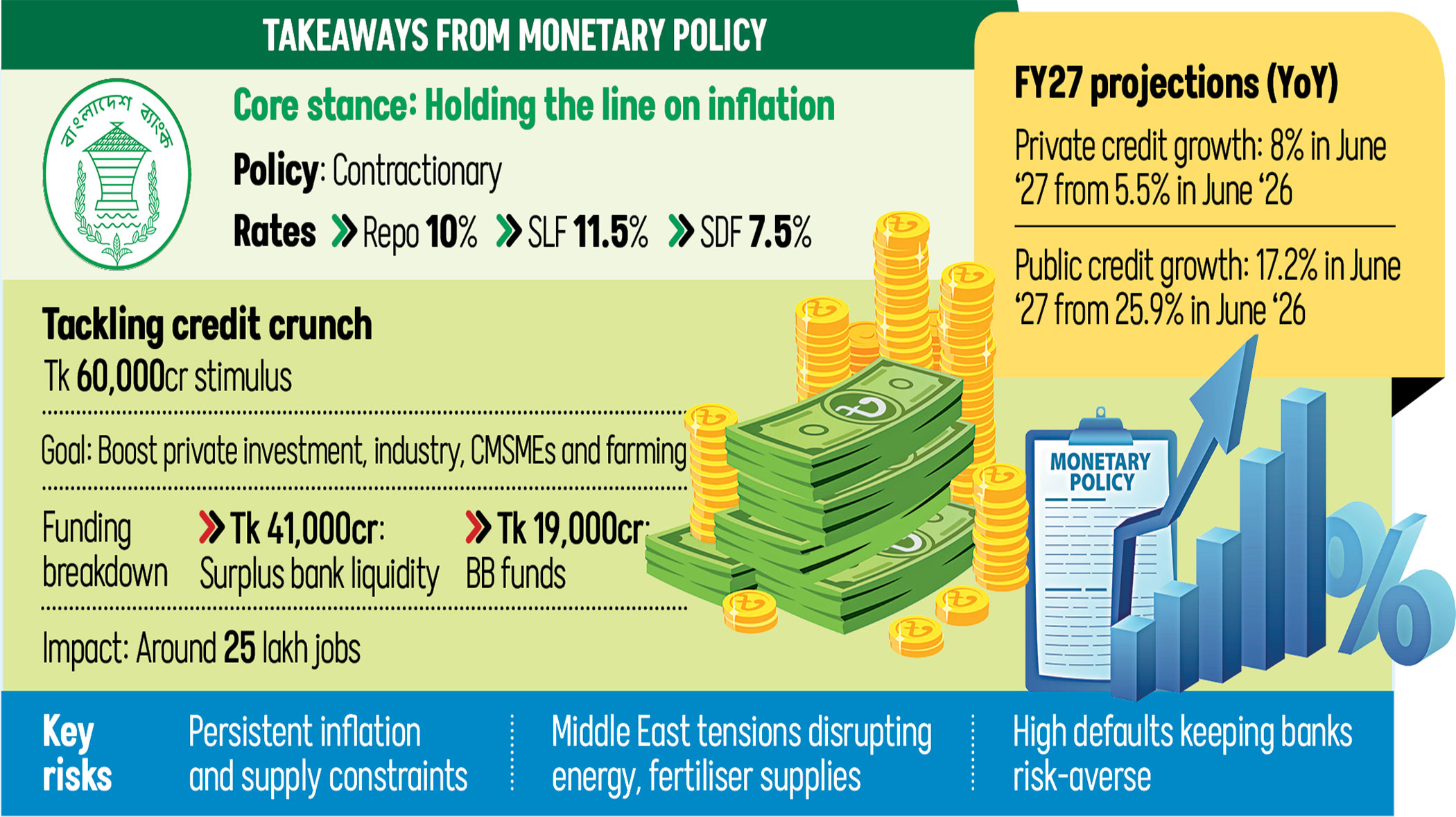
The BB has maintained a contractionary monetary policy since the first half of FY2023-24. It gradually raised the policy rate, reaching 10 percent in October 2024, where it has remained since. Despite that tightening cycle, inflation has stayed persistently high.
Mustafa K Mujeri, executive director of InM, said that Bangladesh remains trapped in a high-inflation environment.
The central bank has indicated it will maintain its contractionary stance through the first half of the current fiscal year, even as the government introduces measures to support economic growth.
Mujeri said continuing the contractionary monetary policy is the right direction, because controlling inflation is the primary responsibility of the central bank.
However, he said, tight monetary policy alone has failed to bring inflation under control despite being in place for more than three years. “If we want to reduce inflation to around 7.5 percent, relying solely on contractionary monetary policy will not be enough.”
Fiscal policy, market management, supply-side reforms and exchange rate policy must all work together, he said.
“Contractionary monetary policy alone did not succeed in the past, and it is unlikely to succeed in the future.”
He added that market management is particularly important, as weak competition allows some businesses to influence prices beyond normal supply and demand dynamics.
“Unless these structural weaknesses are addressed, it will be difficult to bring inflation down.”
The BB’s own projections also suggest inflation will remain well above its target.
According to a report by BRAC EPL Stock Brokerage, the central bank’s forecasting model projects inflation at 8.9 percent by December 2026 and 8.6 percent by June 2027, indicating that its 7.5 percent target remains an aspiration rather than its most likely outcome.
Comments