


Govt policies barely help SMEs fight pandemic: study
Government policies have not adequately addressed the mitigation of the pandemic's adversities faced by small and medium enterprises (SMEs), according to a study carried out by the Centre for Policy Dialogue (CPD).
The policies initially addressed issues of people or borrowers who are influential given their economic or social status. The government later laid emphasis on the financially insolvent but it was insufficient considering the dire situation they were in.

The CPD came up with the remarks while disclosing a study titled "Covid-induced Stimulus Packages for SMEs and Women-led Enterprises: Exploring Research-Policy Interlinkages", conducted in partnership with The Asia Foundation, through a discussion at The Westin Dhaka yesterday.
Both the government and central bank issued many guidelines for implementation of the stimulus packages but not the required emphasis to address the wish of the borrowers, especially the unbanked ones.
"In those circulars issued by the Bangladesh Bank, supply side issues (such as challenges of banking operations) have been more addressed compared to that of demand side issues (challenges of borrowers)," said the CPD.
The BB issued as much as 564 circulars related to the different stimulus packages, of which 38 were dedicated for the small and medium enterprise (SME) sector.
Khondaker Golam Moazzem, research director of the CPD, presented the keynote paper.
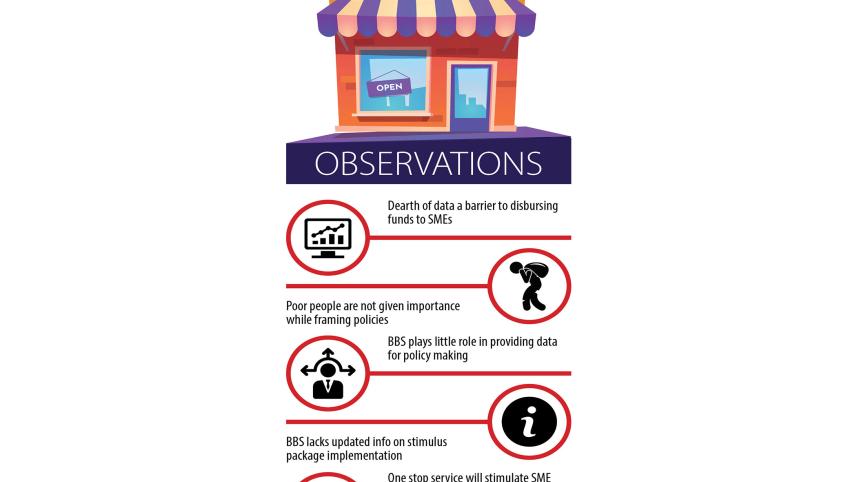
Availability of relevant data is a major requirement in setting targets, which is important for the formulation of stimulus packages.
But the data of prospective borrowers is not available with the banks, said Moazzem.
During the pandemic period, some 27 stimulus packages have been announced with a combined fiscal and financial support of Tk 1.29 trillion.
Considering the setbacks, the government decided on the targeted amount based on the previous year's disbursement.
The loan distribution packages were based on "banker-customer relationship", benefitting the existing borrowers and leaving the new ones behind, Moazzem said.
There is no comprehensive database on the SMEs and women-led enterprises, putting an adverse impact on both the policymaking process as well as undertaking in-depth research, he said.
M Abu Eusuf, professor of the Department of Development Studies at the University of Dhaka, said the Bangladesh Bureau of Statistics (BBS) contributed little during this pandemic.
The BBS did not provide adequate information to the government which would have enabled taking decisions based on the actual situation of the economy, he said.
The government earlier planned to provide direct cash support to the poor but it failed to provide the fund to every person targeted due to the lack of data.
"We do not have updated information on the implementation rate of the stimulus packages. We have urged the government to set up a dashboard," Eusuf said.
As per the SME policy 2019, 15 per cent of the total SME loans will go to the women entrepreneurs, but the guidelines of the stimulus packages mentioned that 5 per cent of the fund must be mandatorily provided to females.
This is a gap between the two policies, Eusuf said.
"There is a requirement of a huge number of documents in order to get loans from banks. So, it is difficult for women and micro enterprises to avail the fund," he said.
 For all latest news, follow The Daily Star's Google News channel.
 The government is now trying to reach the micro entrepreneurs but discrimination exists, he said.
Clients are able to take out loans from banks paying interest at 4 per cent, a subsidised rate.
But they have to count interest between 9 per cent and 12 per cent if they want to take loans through microfinance institutions, Eusuf said.
As per the BB circular, some Tk 25 lakh can be provided to the SME borrowers without collateral but few clients have enjoyed the facility.
So there should be a one stop service to stimulate the SME sector as this is the lifeline of the economy, Eusuf said.
Sayema H Bidisha, professor of the Department of Economics at the University of Dhaka, said terms and conditions should be distinguished given the existing state of affairs of the women entrepreneurs.
She said building a database is important for identifying genuine entrepreneurs and vulnerable groups.
Local Government, Rural Development and Cooperatives (LGRD) Minister Tajul Islam said there was a lack of governance in society.
There have been allegations about the lack of knowledge and the funds of the packages not being provided to the targeted people.
But this is not the whole scenario as the packages have helped revive the economy, he said.
Alexandra Berg von Linde, Swedish ambassador to Bangladesh, said it was widely accepted that women participation in Bangladesh's labour market was improving.
But the working environment for women is poor and they are concentrated on low-paying jobs, she said.
The pandemic has severely affected microenterprises and their workers, many of whom chiefly depended on income derived from daily earnings.
They have become victims to a large extent for adversities stemming from the health and economic sector.
Mentioning a study, she said policies targeting vulnerable groups could be more efficient.
Fahmida Khatun, executive director of the CPD, moderated the workshop.
Even though it is much appreciated that a number of packages as well as circulars have already been issued from the government's end, complications are persistent regarding multiple factors, she said.
Among others, Kazi Nabil Ahmed, a member of parliament, Kazi Faisal Bin Seraj, country representative of The Asia Foundation, Saroja Thapa, associate director – programs of iDE Bangladesh, Liza Fahmida, a deputy general manager of the BB, Nasima Akter Nisha, joint secretary of the e-Commerce Association of Bangladesh and Farzana Khan, a general manager of the SME Foundation, addressed the event.
Comments