


Govt to focus on ICT as foundation for future growth

From economic growth to artificial intelligence adoption, the new government views telecom and ICT as the foundation for Bangladesh’s development over the next three decades, according to Prime Minister’s Adviser Rehan Asad.
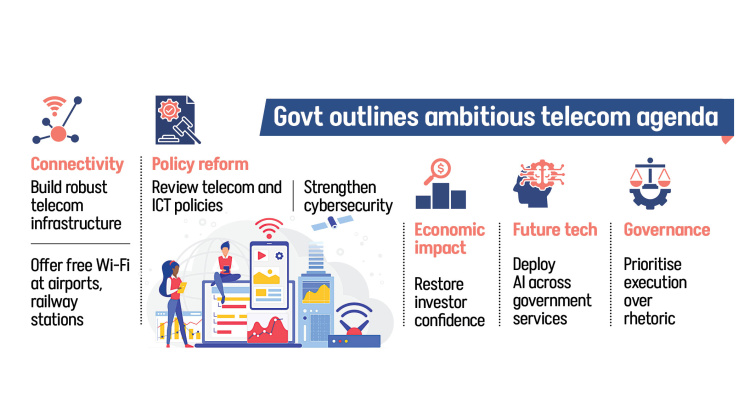
In his first interview after assuming office as adviser to the prime minister for telecom and ICT, Asad outlined an ambitious agenda focused on connectivity, investment, digital sovereignty, and rapid implementation.

“ICT and telecom are foundational thrust sectors in our manifesto. If we build the foundation right, it will support the country’s progress for the next 10, 20, even 30 years,” he told The Daily Star.
“We are committed to working with everyone -- mobile operators, broadband providers, fibre companies, software firms, journalists, and independent experts,” he said.
“We want to move forward based on informed consensus.”
The adviser’s own career reflects a blend of engineering, global policy, and corporate leadership.
Born and raised in Rajshahi, he completed his schooling there before pursuing higher studies abroad in telecommunications and communication engineering. He holds a dual master of Science degree in Engineering and Management from MIT.
“Over the past 22 years, about two-thirds of my career has been in technology, and one-third in foreign policy and humanitarian work.”
His international experience includes senior roles in global organisations, including serving as chief of staff at the World Food Programme, where he worked on humanitarian operations, as well as advisory roles in foreign policy.
Before returning to Bangladesh, he was vice president of global operations at Expedia Group.
CONNECTIVITY AS ECONOMIC BEDROCK
According to Asad, no country can achieve technological advancement without robust connectivity.
“The bedrock of technological progress is network connectivity,” he said. “Research worldwide shows that better speed and reliability directly correlate with higher GDP growth.”
He traced the evolution of internet infrastructure -- from copper telephone lines and dial-up connections to DSL, mobile broadband, and fibre -- to illustrate how foundational networks shape digital ecosystems.
Bangladesh, however, lags significantly in fixed broadband fibre deployment.
“If you look at neighbouring or comparable countries, our fibre penetration -- especially to homes and offices -- is still low,” he said. “Even in affluent areas of Dhaka, fibre may reach buildings, but speeds remain inconsistent.”
For him, ubiquitous high-speed connectivity is the central challenge.
Despite the ambitious goals, the adviser says his immediate priority is understanding the current situation before announcing sweeping reforms.
“In the first seven days, I focused on learning -- meeting officials from the ministry, regulators, operators, and private sector stakeholders,” he said. “Before planning the future, you must understand where you are and why.”
He indicated that decisions on whether to prioritise fibre, mobile broadband, or satellite connectivity may vary by region.
 For all latest news, follow The Daily Star's Google News channel.
 “In some areas, fibre may be economical. In others, mobile broadband or even satellite may be better,” he explained.
FREE HIGH-SPEED WI-FI AT TRANSPORT HUBS
One of the first initiatives of the government aims to dramatically improve connectivity at major transit points.
“We plan to deploy high-capacity, reliable Wi-Fi at airports and major railway stations before Eid,” he said.
The project will begin with the country’s three international airports -- Dhaka, Chattogram, and Sylhet -- before expanding nationwide.
“If you go to Dhaka airport today, multiple providers offer Wi-Fi, but users struggle to log in or get usable speed,” he said.
“During peak hours, up to 70,000 passengers pass through the airport,” he said.
“We are designing the network assuming that 50-80 percent of them may connect simultaneously.”
The service will be free but financially sustainable through advertising.
Asked about what the government would do regarding the telecom and ICT policy reforms introduced by the interim government, Asad said that these would undergo a comprehensive review.
“Our manifesto clearly states that the telecommunications network and licensing policies adopted in 2025 will be fully reviewed,” he said. “Positive elements will be retained, while controversial aspects will be reassessed.”
One pressing issue is the widespread use of illegal or counterfeit mobile devices.
“This is not just an economic issue -- it is a national security concern,” he warned. “If a criminal clones your phone’s identity, you or your family could face serious consequences.”
He said major global manufacturers are interested in investing locally but demand stronger enforcement.
“They all say the same thing: stop illegal phones, and we will invest,” he said.
The government plans public awareness campaigns to explain the benefits of regulation.
TELECOM AS CRITICAL NATIONAL INFRASTRUCTURE
The adviser said his vision is to redefine telecom networks as national assets rather than merely a revenue source.
“Telecommunications should be treated like highways,” he said. “Without a strong road network, trade cannot move. Without robust digital connectivity, the economy cannot grow.”
“Whether someone lives in Dhaka, Khulna, Rajshahi, or Teknaf, they should have comparable connectivity,” he stressed. Cybersecurity and data protection are equally vital.
“Connectivity without security is dangerous,” he warned. “We must protect national data, personal information, and digital sovereignty.”
Foreign direct investment in telecom and ICT has declined in recent years, partly due to slowing revenue growth and market uncertainties.
“FDI is critical for Bangladesh at this stage,” Asad said. “In many countries, ICT contributes 8-10 percent of GDP. In Bangladesh, estimates range from less than 1 percent to about 1.5 percent.”
Investors now evaluate digital readiness differently.
“Twenty years ago, mobile penetration mattered. Ten years ago, data penetration mattered. Today, investors want fast, reliable broadband, advanced networks, and future readiness.”
When asked how he would navigate the challenges stemming from digital trade rules embedded in Bangladesh’s new agreement with the US -- rules that many experts fear could deprive Bangladesh of tax revenues and potentially limit the expansion of its digital economy -- he said he believes these concerns will not pose any real obstacle.
PREPARING FOR THE AI ERA
The adviser sees artificial intelligence as the next major technological shift -- one that Bangladesh must embrace quickly.
Asked how BNP would fulfil its manifesto pledge to directly create 200,000 ICT jobs and indirectly 800,000 more despite AI-driven job cuts, he said the government has begun identifying challenges of freelancers and people working in the digital economy and will be facilitating easier payment access, regulatory support, and improved availability of essential digital tools and platforms.
“I would like children from primary school onward to start learning AI concepts,” he said. “It should not be seen as rocket science -- it is becoming a basic tool.”
He also called for practical AI deployment across government services.
Throughout the interview, the adviser repeatedly stressed execution over rhetoric.
“Policy without implementation does not change anything,” he said. “Successful countries design policies, implement them, measure outcomes, and correct course.”
He cited international examples where governments link policy goals directly to measurable outputs in sectors such as healthcare, education, and urban development.
“Ultimately, citizens judge us not by documents but by results,” he said.
Asad said one of the main goals is nothing less than preparing the nation for the next generation of digital development.
“This is not about five years,” he said. “It is about building the base for the next 30 years.”
Comments