


Govt bets on investment-led growth to create jobs
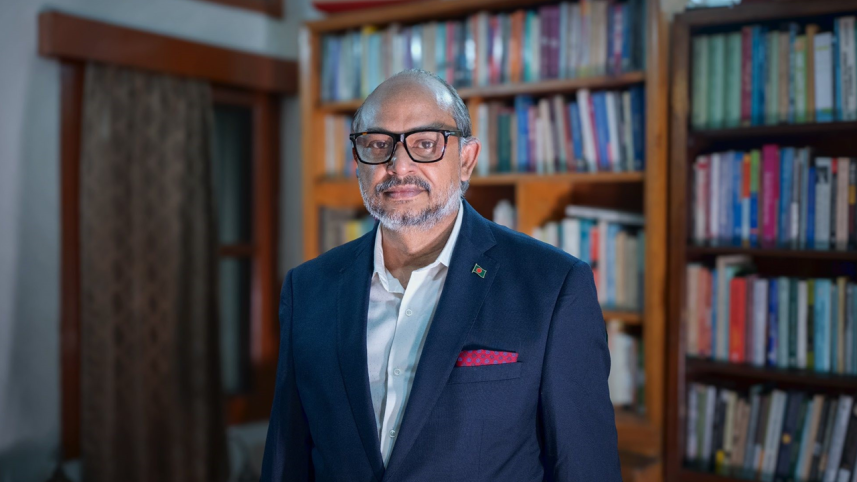
The government has adopted an investment-led economic strategy aimed at creating jobs, boosting production, and raising revenue without increasing tax rates, Finance and Planning Adviser to the Prime Minister Rashed Al Mahmud Titumir said today.
Speaking at a session titled Economic Plan and Investment at the Bengal Delta Conference 2026, organised by the DACCA Institute of Research and Analytics at InterContinental Dhaka, Titumir said the government was pursuing a development model centred on investment, employment, and stronger public services.

The session was moderated by Mushtaq Khan, professor of economics at SOAS University of London, who noted that Bangladesh’s pressing challenge was generating private-sector jobs while improving industrial competitiveness.
Titumir said the government inherited a fragile economy and was seeking to translate its political mandate into policies suited to Bangladesh’s realities and an increasingly uncertain global environment.
“The model is straightforward -- investment in production leads to employment, employment generates higher revenue mobilisation without raising tax rates, and that revenue finances education, health, and social protection,” he said.
He added that the government eventually wants to raise spending on education, health, and the social sector to around 5 percent of GDP as part of its vision of building a democratic welfare state.
One immediate priority is addressing rising poverty through a universal life cycle-based social security system designed to prevent people from falling back into poverty during economic shocks. Titumir said the Covid-19 pandemic and recent geopolitical crises had shown that uncertainty has become the new normal, making stronger social protection essential.
He also outlined plans to overhaul education and healthcare. Education reforms will focus on developing skills, strengthening citizenship and civic values, and promoting innovation at the tertiary level. In healthcare, the government plans to establish a national health system with stronger primary services, saying existing facilities are no longer adequate to meet changing disease patterns.
Khan cautioned that higher social spending alone would not deliver sustainable growth unless Bangladesh expanded its productive capacity. Without stronger domestic industries, increased household demand would fuel imports, putting pressure on foreign exchange reserves and the balance of payments.
He also questioned whether traditional policy tools such as tax rebates, export subsidies, and fiscal incentives could improve productivity in an economy where politically connected businesses often receive benefits without facing enough competitive pressure.
In response, Titumir said the government’s focus was on improving governance and reducing corruption rather than raising taxes.
He noted that stronger enforcement against tax evasion, unnecessary exemptions, and rent-seeking had already improved revenue collection. Revenue growth accelerated sharply after mid-February of the last fiscal year and is expected to reach 9-10 percent, compared with about 2 percent previously.
Task forces have been formed to plug leakages in tax collection, with Titumir arguing that reforms would fail unless they reflected how Bangladesh’s institutions and patronage networks actually function.
He said the government was also addressing long-standing weaknesses in the financial sector, including non-performing loans and bank recapitalisation, while preparing an industrial policy to expand productive capacity, attract domestic and foreign investment, strengthen energy security, and improve competitiveness as Bangladesh moves beyond its least developed country status.
 For all latest news, follow The Daily Star's Google News channel.
Comments