


Ginger prices spike before Eid as importers delay port release

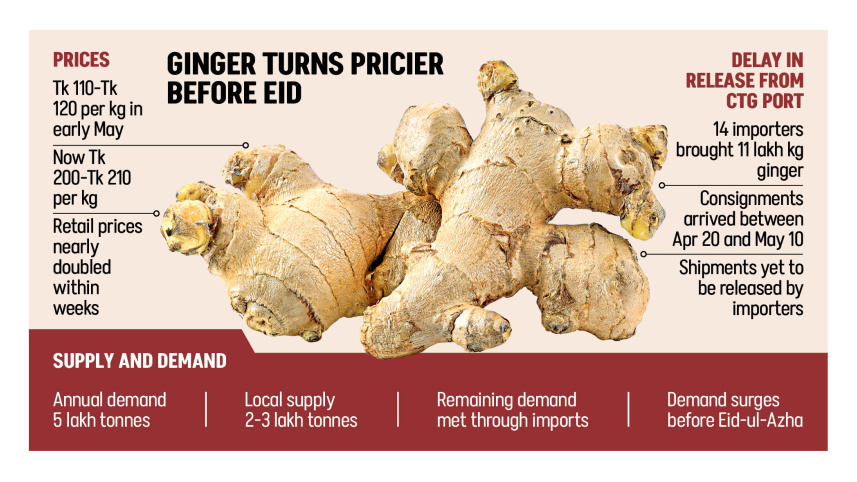
Ginger prices have nearly doubled in a matter of weeks ahead of Eid-ul-Azha, as importers left up to 11 lakh kg of the spice stranded for as long as a month at Chattogram port.
The spice -- essential for cooking meat -- that sold for Tk 110 to Tk 120 per kg in early May is now retailing at Tk 200 to Tk 210 per kg across the country.

Market insiders and consumer rights activists say the use of Chattogram port as storage by traders to manipulate prices is not new. They say the authorities should take stricter action against such practices.
Importers, however, say the delay is due to documentation issues.
Bangladesh consumes around 5 lakh tonnes of ginger a year. Of this, local production meets around 2 lakh to 3 lakh tonnes, with the rest imported, according to the Department of Agricultural Extension (DAE).
Traders say demand for ginger usually rises ahead of Eid-ul-Azha, the second biggest religious festival for Muslims.
According to sources at the Custom House, Chattogram, 14 importers brought in around 11 lakh kg of ginger in 41 containers between April 20 and May 10, but the consignments are yet to be released from the port.
Customs and district administration officials have issued an ultimatum for importers to clear the consignments by Saturday, warning of legal action if they fail to do so.
Nazmul Hossain, assistant commissioner of Chattogram Customs House, told The Daily Star that C&F agents involved in the clearance process were summoned on Tuesday to explain the delay.
“After contacting the importers, their agents assured us that the consignments would be cleared by Saturday,” he told The Daily Star.
Mohammad Zahidul Islam Miah, deputy commissioner (DC) and district magistrate of Chattogram, said he took steps after receiving allegations that importers were holding consignments at the port to create an artificial crisis in the market.
“We contacted the customs commissioner, and they are taking necessary measures. We hope the issue will be resolved quickly,” he told The Daily Star.
He said market monitoring had been intensified ahead of Eid-ul-Azha to prevent excessive pricing and artificial shortages of essential commodities. “If evidence is found of market manipulation or hoarding, legal action will be taken,” he added.
According to National Board of Revenue (NBR) data, Bangladesh imported around 77,000 tonnes of ginger between January and May 18 this year, slightly lower than the 79,000 tonnes imported during the same period last year.
Customs data show importers who have delayed clearance include Brothers Trade, Ifti International, Sourav International and Nayeem Traders. The consignments of these companies are being handled by Marco International C&F Limited.
Md Ekramul Haque Bhuiyan, managing director of the C&F company, denied allegations of intentionally creating a supply shortage.
“Clearance was delayed due to documentation issues. Discussions have already been held with all importers, and the nine consignments under our responsibility will be cleared by Saturday,” he said.
He claimed that ginger-laden containers were being released each day gradually, and the remaining consignments would be cleared in phases.
Under port regulations, importers do not pay additional charges if goods are cleared within four days of arrival. After that, demurrage charges are imposed. Customs authorities can also auction goods if they remain uncleared for more than 30 days.
 For all latest news, follow The Daily Star's Google News channel.
 SM Nazer Hossain, vice-president of Consumers Association of Bangladesh, said the practice of using the port as a warehouse by delaying clearance of imported goods is not new.
“Despite various initiatives by port and customs authorities, the practice continues,” he said, adding that punitive action, including confiscation of goods, should be taken against those found to be creating artificial shortages without valid reasons.
Comments