


First commercial crocodile farm gasping for survival
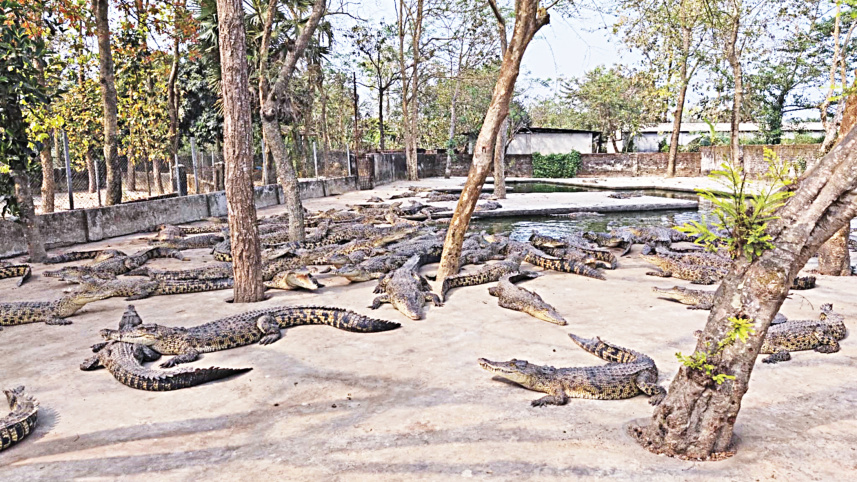
The country’s first-ever commercial crocodile farm, established around 22 years ago, is on the verge of closing due to frequent changes in ownership and a long and persistent history of neglect.
At present, the Reptiles Farm Ltd is as good as abandoned, farm sources say.

Established on 15 acres of land at Hatibeer of Mymensingh’s Bhaluka upazila, the farm has been handled by four different managements since 2004, failing to achieve any significant growth over the two decades.
During the pandemic years, the farm suffered a heavy blow. Many crocodiles died from neglect, and the export of crocodile skins came to a standstill.
“The pandemic was a nightmare, especially for businesses around the world, and we were also affected,” said Dr Abu Syem Muhammad Arif, the farm’s manager.
The number of crocodiles at the farm is around 4,000, including 100 at the breeding stage. Around 300 of them can be harvested for skin, he said. A crocodile reaches maturity for skins in three years, while 10 to 12 years are needed to reach its breeding stage.
However, the present stock of crocodiles is far below the farm’s capacity.
“The farm has a capacity of stocking around 40,000 crocodiles,” Dr Arif said.
“We had a target to enrich the farm with a stock of 20,000 crocodiles, but it has yet to be fulfilled.”
The farm could not fulfil its pending order to export 400 skins in 2022, and also failed to export 500 skins early in 2023, farm sources said. The last shipment was made in 2019, before the pandemic hit.
The farm made its maiden skin export to Japan in 2014 when it shipped 430 crocodile skins for around $200,000, said farm sources.
Until 2019, the farm exported a total of 1,507 pieces of skin. This falls way below the farm’s initial target to export 1,000 per year, hoping to expand the volume gradually. Instead, the number of annual exports has fallen to zero, Dr Arif said.
On average, each piece of skin fetches $600 to $700 in the international market. Crocodile leather is used for making luxury handbags, wallets, belts, boots and so on, Dr Arif explained.
A TURBULENT JOURNEY
Mushtaq Ahmed, a late writer, and Mesbahul Hoque, an entrepreneur, started working on crocodile farming in 2002. They jointly launched the farm, investing Tk 5 crore with 49 percent financial support from the Equity and Entrepreneur Fund (EEF) of the government in the form of an interest-free loan after getting approval from the Forest and Environment Ministry in May 2004.
The farm was later sold to PK Halder in 2012. In 2020, Halder’s involvement in graft came to light, following which his ownership was cancelled.
Amid the legal debacle, the farm remained abandoned for nearly two years. Then, the High Court formed a committee to run the farm in 2022.
International Leasing and Financial Service Ltd (ILFSL), to which the farm owed more than Tk 100 crore, sold the farm at auction in 2023 to recover the money.
The farm is now owned by Uddipan, a non-governmental organisation. The new owner has so far been unable to get the farm’s business rolling anew, yet continues to incur losses as the farm’s operational costs remain high.
Mir Khairul Alam, adviser (Programme Development and Resources Management) of Uddipan, spoke of several obstructions in the way of resuming the farm’s business.
 For all latest news, follow The Daily Star's Google News channel.
 As the ownership of the farm has changed hands, the new owners need to acquire fresh certification for crocodile skin export from the authorities concerned. They need to secure approval from the Forest and Environment Ministry.
Uddipan is also working towards registering the farm as a joint-stock company, he said.
“The farm remains stagnant,” the adviser added. “We are also bearing the extra maintenance costs for the crocodiles as we are unable to do business without the proper certification and approvals at present.”
POTENTIAL OVERLOOKED
Prof Dr Md Rafiqul Alam of the Department of Surgery and Obstetrics of the Faculty of Veterinary Science at Bangladesh Agricultural University (BAU) said the sector has great prospects. However, it needs to be handled with proper management to achieve the desired goals.
The professor stressed the need to focus not only on the major export product -- skin -- but also on the by-products, and even crocodile meat.
By-products such as skull, bones, nails, and scrap leather could be sold in both domestic and international markets, potentially fetching an additional $700 to $800 from each crocodile. Charcoal made from crocodile bones is used in manufacturing perfumes throughout the world, the expert said.
The reptile’s meat shouldn’t be overlooked, he said. It is consumed widely in Australia, Japan, Singapore, China and the US, where each kilogram of crocodile meat is sold between $30 to $35, he added.
As the export of crocodile meat is not allowed in Bangladesh, it is simply dumped after harvesting the skin. In this situation, the meat could be supplied to the country’s high-end hotels, which can prepare meals for foreign visitors. The farm will benefit well from selling five to six metric tonnes of meat per year, he said.
The estimated cost for rearing a crocodile for three years until its maturity is $300, and it is expected to bring in $600 to $700 in revenue from the export of its skin, Dr Alam added.
Comments