


Explore avenues to tax digital economy: CPD
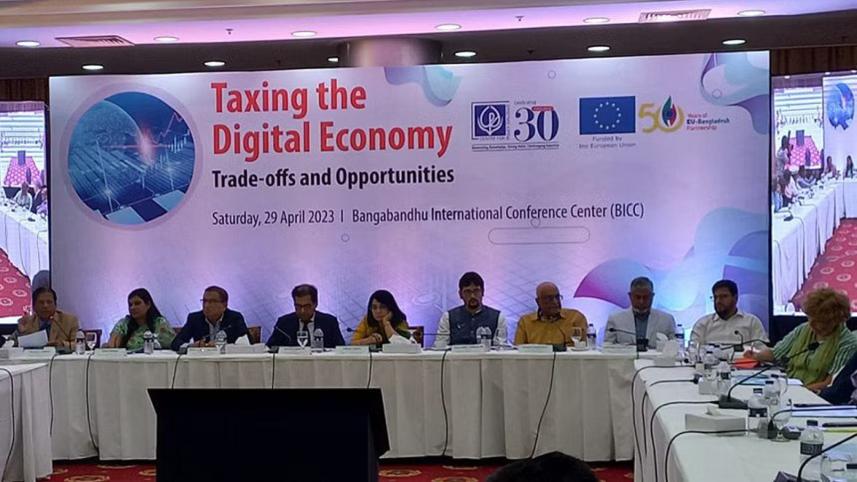
Bangladesh should explore avenues on how to tax the country's growing digital economy so that it can increase spending on urgent development needs and allocate more resources for priority sectors such as health and education, according to the Centre for Policy Dialogue (CPD).
In a paper, styled "Taxing the Digital Economy: Trade-offs and Opportunities", the private think-tank said Bangladesh should take advantage of digitalisation to enhance its opportunities for fiscal mobilisation.

In addition, the government should bring an increasingly larger part of the digital economy under the tax net for higher domestic resource mobilisation.
"But it should not be done in a way that kills the expanding sector through heavy taxation," said Professor Mustafizur Rahman, a distinguished fellow of the CPD.
"We should definitely keep giving tax exemptions and incentives to certain segments of the digital sector.
However, our expectation is that these benefits, which would help generate income and employment, will prepare the ground for increased taxes after a certain period," he added.
Rahman then suggested the National Board of Revenue (NBR) could think of introducing sunset clauses with respect to existing tax-exempted digital sectors and also in case of implementing new exemptions.
He was speaking while presenting the paper during a dialogue at the Bangabandhu International Conference Centre in Dhaka. The event was organised by the CPD in partnership with the European Union.
The paper outlined some points on why taxation of the digital economy is becoming increasingly important for Bangladesh.
As is well-known, Bangladesh has the lowest revenue-GDP ratio and tax-GDP ratio in South Asia as well as among other countries of the developing world.
Consequently, the public-expenditure-GDP ratio has also remained at low levels, underpinning Bangladesh's low capacity to spend money for urgent development needs and sectors such as education and health.
Besides, as part of an IMF programme, Bangladesh will be required to raise the tax-GDP ratio from the current 7.8 per cent to 9.4 per cent over the next three years (requiring an additional tax mobilisation of about Tk 234 thousand crore by FY 2026).
This will demand an energetic search for new avenues of taxation.
In Bangladesh, over 28 types of IT enabled services (ITES) have been exempted from paying direct tax on any type of income derived from the ITES business of a person being a resident or non-resident Bangladeshi. This is to be in place till June 30, 2024.
However, there is a lack of clear-cut and precise definitions in regards to ITES and the 28 exempted businesses. As a result, there are instances of misuse by companies disguised as ITES to evade taxes such as VAT, the paper said.
Before granting tax exemption, the following factors should be considered: development status of the specific sector, maturity of the industry, number of years the exemption has been in effect, the rationale for the protection and justification of extension of exemptions or new exemptions.
"A detailed assessment of tax expenditures, including an appropriate definition and a methodology for measuring tax expenditure, needs to be developed in view of restructuring existing tax expenditure measures," it added.
The CPD also urged the NBR to bring non-resident tech giants such as Facebook, Google, and Netflix under taxation.
"Legal provisions will need to be put in place for non-resident businesses to get taxpayer identification numbers in order for them to submit tax returns," Rahman said.
This should be addressed by taking the required initiative in the upcoming finance act for fiscal year 2023-24, he added.
 For all latest news, follow The Daily Star's Google News channel.
 Rahman went on to say that at present, non-resident digital service providers are not under the tax net and hence are not liable to submit tax returns in Bangladesh.
As there is a disparity between the reported export proceeds of the Export Promotion Bureau (EPB) and actual proceeds reported by ICT trade bodies, the paper suggests taking steps to capture reliable export data.
"Bangladesh Bank and the EPB should put in place appropriate tools to encourage and incentivise sending of these earnings through formal channels. In view of the current pressure on forex reserves, this has become even more urgent," Rahman said.
There should be five principles to follow for a business policy, namely transparency, neutrality, fairness, efficiency and simplicity, said Debapriya Bhattacharya, another distinguished fellow of the CPD.
"We cannot fix the digital economy only by dealing with e-commerce issues, and the framing of the issue cannot be so narrow," he added.
Lawmakers Kazi Nabil Ahmed and Ahsan Adelur Rahman, and CPD Executive Director Fahmida Khatun also spoke at the event.
Comments