


Eid revives Ctg’s fading handmade shoe industry

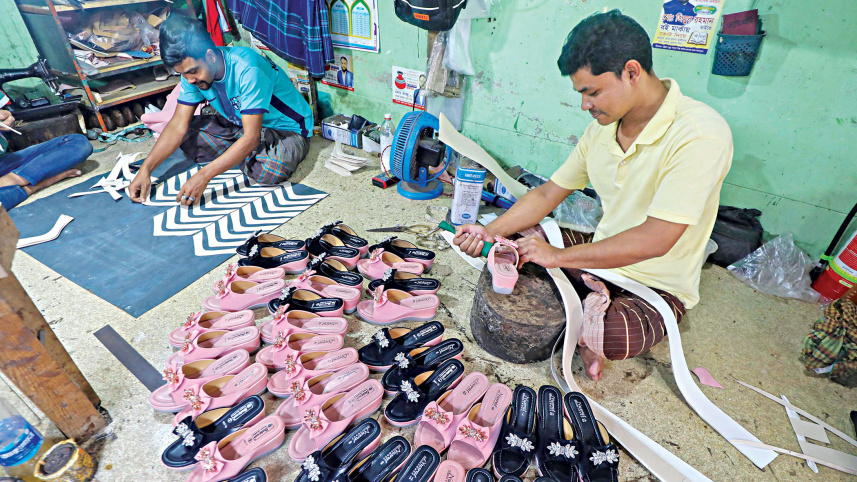
A nearly tangible sense of urgency permeates the air as workers focus on a variety of tasks. A group of them are cutting leather pieces while others attach soles with glue. Some focus on decorative designs while another group packs finished shoes for delivery.
This scene has become common in Chattogram’s handmade shoe factories as Eid-ul-Fitr approaches.
 For all latest news, follow The Daily Star's Google News channel.
 For most of the year, the industry remains slow. An uptick in demand before Eid brings momentary relief to small factories and the seasonal workers they employ, industry stakeholders say.
Most of these factories are located in the Madarbari, Nalapara, and Kamal Gate areas under the Sadarghat police station. Visiting them, this correspondent found workers rushing to complete orders.
“Usually, we work eight to ten hours a day. But now we are working extra hours to deliver orders before Eid,” said Mohammed Mizan, a shoemaker at a small factory in Madarbari
A large portion of the orders -- marketed towards Eid shoppers -- has been delivered already, factory owners say. However, some people wait till the last few days of Ramadan to purchase footwear. The last of the orders made in these factories will be picked up to accommodate such eleventh-hour shopping.
“Usually, we work eight to ten hours a day. But now we are working extra hours to deliver orders before Eid,” said Mohammed Mizan, a shoemaker at a small factory in Madarbari.
His colleague, Jasim Uddin, said that workers do not get daily wages-- they are paid based on production.
“If a team produces one dozen pairs of shoes, we may receive around Tk 2,000 as payment. We divide the money among ourselves,” he said.
Unlike in other sectors, wages in this profession have not increased, Jasim said.
This traditional trade has been on the decline for years, owners and workers say.
“The golden age of the handmade shoe industry is over. We have not received the expected number of orders this year,” said Mohammed Sadek, owner of Tarik Shoe Factory.
Nowadays, the trade is kept alive by a loyal group of customers who continue to buy handmade shoes as part of tradition, he said.
According to the Chattogram Khudro Paduka Shilpo Malik Group, around 150 handmade shoe factories are currently operating in the port city, a sharp drop from the 400 factories active in the late 1990s.
Tarek Haider, general secretary of the group, said the market is now dominated by cheaper, machine-made shoes imported from China and India.
“Handmade shoe factories are struggling to compete. Although business remains slow throughout the year, sales increase before Eid. The profit we make during this time helps us cover losses from other months,” he said.
He urged the government to impose proper duties on imported shoes and reduce VAT on raw materials, adding that local factories must adopt modern machinery alongside traditional craftsmanship to remain competitive.
Comments