


Eid, approaching summer boost Rajshahi silk sales

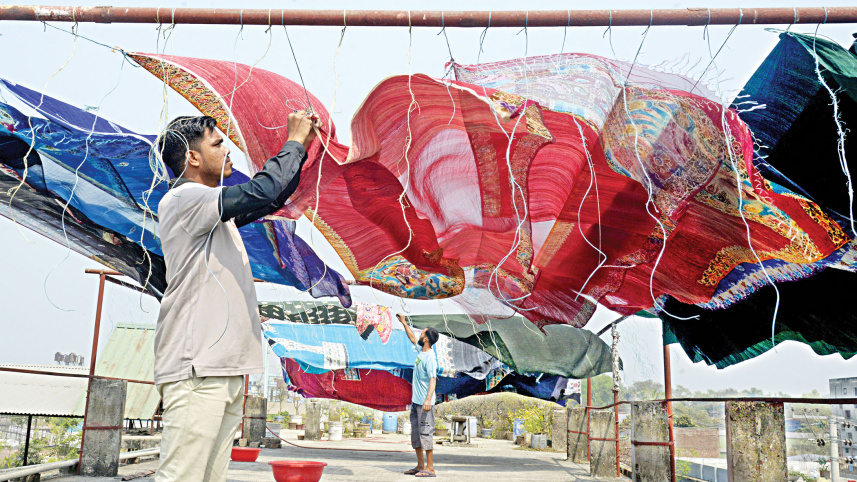
The words Rajshahi and silk remain nearly inseparable in the culture of Bangladesh. Ahead of Eid-ul-Fitr -- which coincided with the stuffy mid-spring weather this year -- the appeal of Rajshahi silk has surged. Factories across the city are busy with work, while seasonal shopping gains momentum.
Rajshahi silk was officially registered as a Geographical Indication (GI) product in 2017, reinforcing its prestige. For many buyers, wearing silk is not merely a fashion statement -- it is about embracing a legacy passed down through generations.

Every year, Eid, puja and other celebrations bring renewed demand for the city’s iconic fabric. The Eid shopping rush is especially visible in the silk showrooms of the Bangladesh Small and Cottage Industries Corporation (BSCIC) industrial area, where several privately owned silk mills operate their retail outlets alongside production units.
NO REST FOR LOOMS
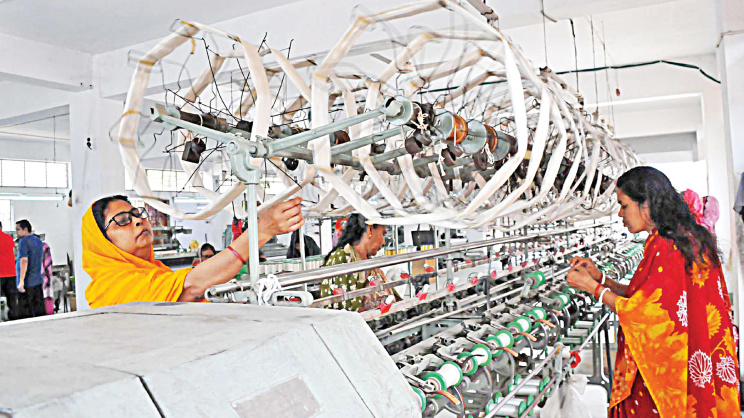
As Eid draws near, an energetic clatter of looms fills the air at Sopura Silk Mills Limited. Looms run at one side of the compound, while artisans remain busy dyeing threads, weaving saris and adding delicate handwork on the other side. The showroom has been operating since 1980.
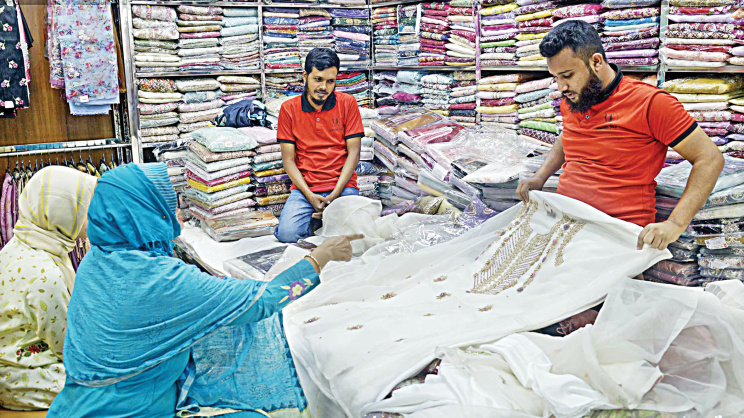
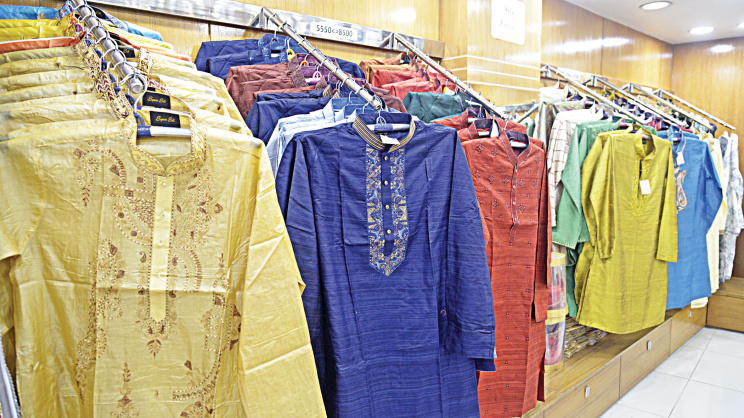
An expansive showroom is also housed in the compound, where shoppers browse through rows of vibrant garments -- traditional saris, panjabis, sherwanis, three-piece outfits, shirts, and scarves of various types and lengths.
According to Saidur Rahman, manager of the company, the Eid season always brings a surge of customers.
“Both Eids are busy, but this Eid [Eid-ul-Fitr] usually sees even larger crowds,” he said. “We offer a wide variety of fabrics, including Balaka silk and raw silk.”
The price of silk garments varies widely depending on quality. “Our saris start from around Tk 3,000 and can go up to Tk 50,000 or Tk 60,000,” he added.
“Rajshahi silk is traditional, and that is why it continues to have strong demand.”
Nasima Khanam, a customer searching for a suitable Eid outfit at Sopura Silk Limited, said silk remains her preferred choice for special occasions.
“It is part of our heritage. Silk is completely different from other fabrics,” she said, adding that the fabric is exceptionally comfortable.
“Even though the price is a bit higher, I still prefer it.”
Another shopper, Tasnia Hosne Afrin, said this year, Eid coincided with mid-spring. Winter has ended, and the season is starting to warm up. In this weather, silk clothing offers optimal comfort.
“Silk is very comfortable to wear in warm weather. People prefer comfort,” she said.
PRODUCTIVITY WHITTLED DOWN AT STATE-RUN FACTORY
While private showrooms enjoy a festive uptick in business, the scenario remains different at the government-run Rajshahi Silk Factory, located near the Railgate area of the city.
The factory was originally established in 1961 and was later brought under the Bangladesh Silk Development Board in 1978.
In its prime, the facility played a major role in meeting the country’s demand for silk yarn, which currently stands at about 300 tonnes annually.
However, the factory was shut down in 2002 due to sustained losses, and has remained closed for years before reopening on a limited scale in 2018. At the time of closure, it had 63 looms and produced about 116,000 yards of silk fabric annually.
 For all latest news, follow The Daily Star's Google News channel.
 At its peak, the factory employed nearly 600 officials, staff and workers, but now only 20 daily wage labourers keep the operations running. Currently, 20 power looms are in operation, producing around 6,000 metres of silk fabric each year.
Abul Kalam Azad, former manager of Rajshahi Silk Factory, said the factory is back to producing a range of silk products.
“After the factory restarted, we began producing and selling Garad saris, printed saris, two-piece outfits, scarves, shawls, Motka fabric, Dhupian fabric, Balaka fabric and printed fabrics,” he said.
He added that the factory once operated showrooms in several divisional cities across the country, but now only one sales centre remains active.
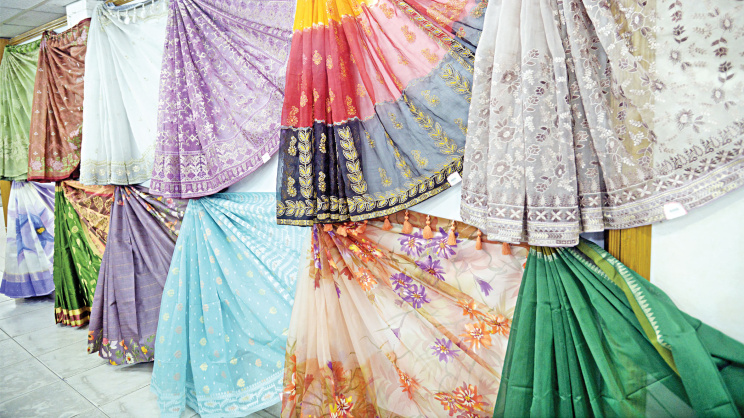
Much like the Sopura compound, the Rajshahi Silk Factory premises also have a small sales centre. However, customer turnout remains quite low due to a lack of publicity. Despite the disappointing sales, the factory continues to trudge along, keeping alive a legacy that dates back decades.
DOMESTIC YARN PRODUCTION SUFFERS
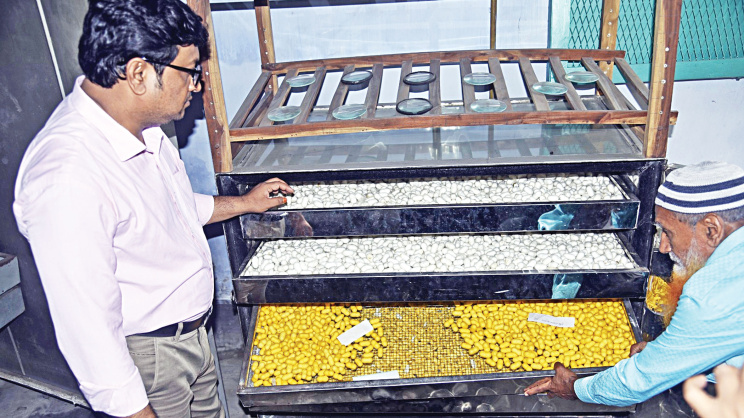
Silk threads are produced by silkworms, locally known as polu poka. Producing silk requires the sacrifice of large numbers of these insects. For example, more than 250 silkworms are needed to produce enough silk for a single tie. A sari requires about 5,000 silkworms, while producing enough silk for a shirt requires roughly 2,500.
Till 1991, the demand for silk yarn in Bangladesh was around 200 tonnes, half of which was produced domestically, while the rest was imported, said Liakat Ali, president of Bangladesh Silk Industry Owners’ Association.
Currently, the country’s demand for silk yarn has risen to about 500 tonnes, but only around four tonnes are supplied by domestic producers, with the remaining demand met through imports. Lower tariffs have made yarn imported from China cheaper and more widely available, which now dominates the local market.
As Chinese yarn floods the market, demand for local silk yarn has consequently dwindled. It has also affected mulberry nurseries.
Silkworms are fed mulberry leaves, so mulberry nurseries are set up exclusively to facilitate sericulture. Such nurseries have dwindled significantly, with many privately run nurseries shutting down, affecting thousands of silk farmers who have since shifted to other crops, while only 11 government-run nurseries are now operating in different parts of the country.
Comments