


Bangladesh FDI rises 45% but still trails major regional peers
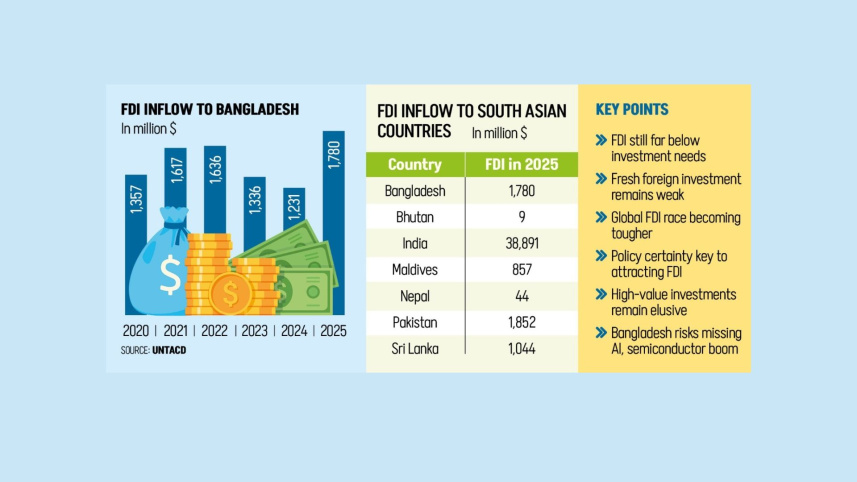
Bangladesh recorded a strong rebound in foreign direct investment (FDI) in 2025, ending two consecutive years of decline, but the gains were not enough to close the gap with regional players.
The country remained the third-largest recipient of FDI in South Asia after India and Pakistan, according to the World Investment Report (WIR) 2026, released yesterday by the UN Conference on Trade and Development (UNCTAD).

As per the report, FDI inflows into Bangladesh rose 45 percent to $1.78 billion in 2025 from $1.23 billion a year earlier.
Separately, Bangladesh Bank data showed a similar trend, with FDI rising 45.5 percent to $1.79 billion, which it attributed to higher reinvested earnings from existing foreign investors.
Earlier in mid-May, the Bangladesh Investment Development Authority (Bida) said FDI inflows increased 39.36 percent year-on-year to $1.77 billion in 2025.
“A series of measures to improve investment facilitation and bring greater discipline to the approval process contributed to last year’s rebound,” said Nahian Rahman Rochi, executive member (investment) at Bida.
“All three components of FDI -- equity investment, reinvested earnings and intra-company loans -- posted positive growth last year. Although equity investment declined globally, Bangladesh recorded around 8 percent growth in equity inflows, which is encouraging given the country’s political transition,” he said.
Rochi said Bida also maintained regular communication with existing and prospective investors. “That engagement gave them confidence, and we believe it contributed to the recovery in FDI.”
He, however, said the growth remained well below Bangladesh’s investment needs.
Rochi said Bida has an investment pipeline worth about $1.5 billion that could materialise over the next 18-24 months.
GLOBAL FDI RECOVERY UNEVEN
Globally, FDI rose 6 percent to $1.6 trillion following two years of decline, though UNCTAD said the recovery was “fragile and uneven”. Inflows rose 11 percent to $723 billion in developed economies and 2 percent to $901 billion in developing economies.
Developing Asia remained the largest recipient among developing regions, at $644 billion, though trends diverged within it: inflows declined in East Asia, including China, but rose in South-East Asia, South Asia, West Asia and Central Asia.
S ASIA GETS $46b
Total inflows into South Asia climbed to $46.1 billion in 2025 from $34.1 billion a year earlier.
India remained the region’s dominant investment destination, attracting $38.9 billion in 2025, up 44 percent from $27.1 billion in the previous year, supported by strong investments in manufacturing, services and supply-chain diversification.
Pakistan received the second-highest amount in the region, $1.85 billion, though inflows fell from $2.67 billion in 2024; it remained marginally ahead of Bangladesh.
Among smaller South Asian economies, the Maldives attracted $857 million, up from $806 million, largely on tourism projects; Nepal’s inflows fell to $44 million from $57 million; Bhutan received $9 million, unchanged.
China remained one of the world’s largest FDI recipients despite a decline from about $116 billion to $105 billion, continuing to draw higher value-added investment in R&D and pharmaceutical manufacturing.
ASIA SHAPING FUTURE, BUT OUTLOOK CLOUDED
 For all latest news, follow The Daily Star's Google News channel.
 The WIR report said Asia is increasingly shaping where future industries are being built, even as investment patterns within the region evolve.
The report noted that investment worldwide is increasingly flowing into semiconductors, digital infrastructure, artificial intelligence, advanced manufacturing and energy-transition technologies.
Many Asian economies are entering this period with important advantages, including established manufacturing capacity, supplier networks, large consumer markets, growing industrial ecosystems and deep integration into regional production networks, it added.
“But these advantages are uneven, and not all economies can compete for the same projects,” UNCTAD said, adding that competition for global capital is becoming more intense.
The report said success in attracting investment is becoming harder to take for granted as governments increasingly use industrial policies and incentives to attract projects linked to future growth industries, while investors become more selective about where they commit long-term capital.
Comments