


ADP spending in Jul-May lowest in 5 years
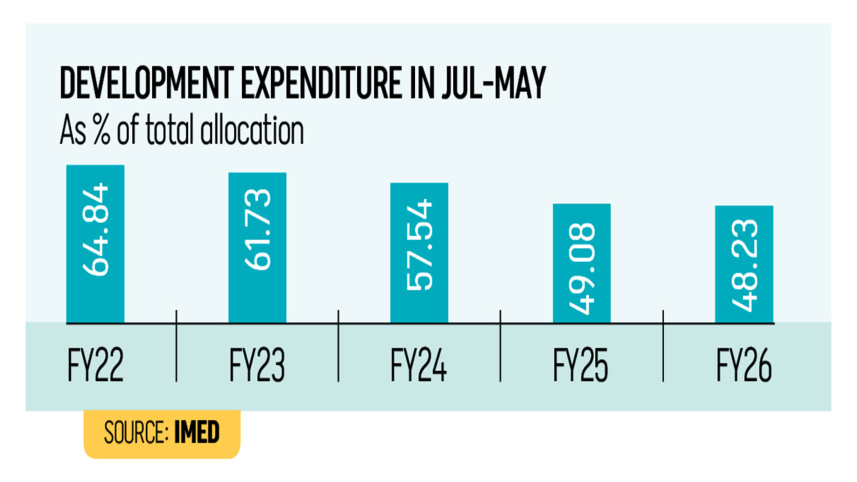
Bangladesh’s Annual Development Programme (ADP) expenditure fell to a five-year low of 48.23 percent in the July-May period of the current fiscal year due to poor project readiness, procurement and land acquisition delays, and weak coordination among implementing agencies.
During the period, ministries and divisions spent Tk 100,763 crore out of the Tk 208,935 crore allocated for the first 11 months of the fiscal year, meaning less than half of the allocation was utilised.

In the same period a year earlier, development expenditure stood at 49.08 percent of the Tk 226,166 crore allocation.
This is the fifth consecutive year that ADP spending has declined since the July-May period of fiscal year 2021-22, when the implementation rate was nearly 65 percent.
Analysts said the low implementation rate leads to time and cost overruns, a higher debt burden and delayed service delivery, preventing the economy from receiving the intended benefits on schedule.
During the first 11 months of the fiscal year, spending under both government- and foreign-funded projects remained below half of the allocated amounts. The implementation rate stood at 49.3 percent for foreign-funded projects and 46.7 percent for government-funded projects, according to the Implementation Monitoring and Evaluation Division.
“The recent implementation slowdown reflects a combination of factors, including insufficient project readiness at the approval stage, delays in procurement and land acquisition, weak coordination between executing and implementing agencies, cost revisions and design changes, and cash-planning constraints,” said the Finance Division in the Medium-Term Macroeconomic Policy Statement (MTMPS) FY2026-27 to FY2028-29, published this month.
The political transition in August 2024, along with the economic and political uncertainty that followed and fiscal constraints, affected the implementation of development programmes.
The Finance Division said a tighter macro-fiscal environment has also led to greater scrutiny of low-priority projects.
“While such scrutiny is necessary to improve expenditure quality and fiscal discipline, it may reduce the implementation rate in the short run when the development project pipeline contains a large number of slow-moving projects,” it added.
IMED data showed that six of the 15 ministries and divisions receiving the largest allocations failed to spend even half of their allocations.
The Health Services Division recorded the lowest implementation rate at 26 percent during the period, followed by the Ministry of Primary and Mass Education at 35 percent and the Ministry of Railways at 42.4 percent.
The Technical and Madrasah Education Division, the Roads and Highways Division, and the Secondary and Higher Education Division also recorded implementation rates below 50 percent of their revised ADP allocations, according to data released yesterday by the Implementation Monitoring and Evaluation Division under the Planning Ministry.
The Ministry of Science and Technology recorded the highest implementation rate at 83.3 percent, followed by the Energy and Mineral Resources Division at 79.4 percent and the Ministry of Agriculture at 69 percent.
The Finance Division said improving implementation will require a stronger project-gate system that permits only mature projects into the ADP, along with realistic annual work plans, early procurement preparation, stronger contract management, and regular monitoring of large and strategically important projects.
 For all latest news, follow The Daily Star's Google News channel.
Comments