


ADB cuts growth forecast to 4.5% on energy, banking concerns
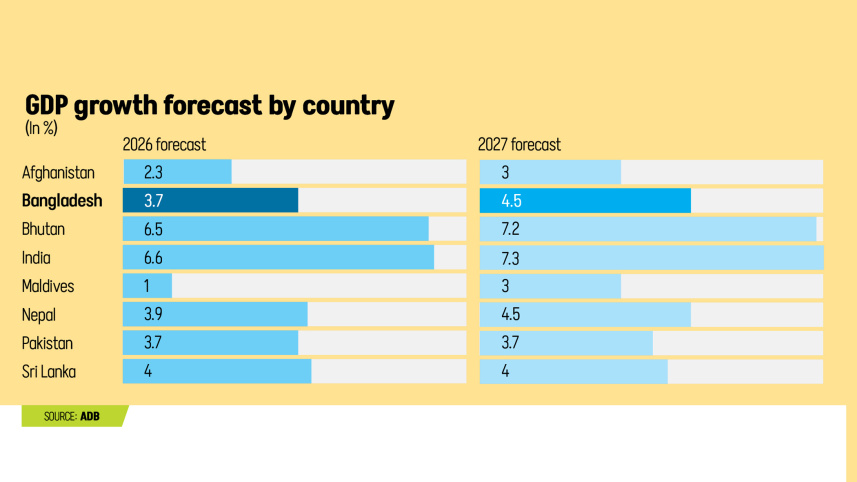
The Asian Development Bank (ADB) has cut its forecast for Bangladesh’s economic growth to 4.5 percent for the current fiscal year, down from its April projection of 4.7 percent, citing energy supply constraints and vulnerabilities in the banking sector.
The Manila-based lender also raised its inflation forecast for fiscal year 2026-27 to 8.8 percent from the 8.5 percent projected in April.

It said second-round effects from higher energy and transport costs, exchange-rate pass-through, and persistent inflation in food and services are likely to slow the pace of disinflation.
“High inflation continues to erode real purchasing power and constrain private consumption,” the ADB said in its flagship report, the Asian Development Outlook (ADO) July 2026.
The revised inflation forecast comes days after the Bangladesh Bureau of Statistics (BBS) said inflation averaged 8.68 percent in the recently concluded fiscal year 2025-26, well above the government’s target of 7 percent.
The government targets to reduce annual inflation to 7.5 percent in the current fiscal year while achieving GDP growth of 6.5 percent.
The ADB estimated Bangladesh’s economy grew 3.7 percent in FY26, below the BBS provisional estimate of 4.14 percent.
It attributed the weaker performance to softer exports, subdued private investment, high energy prices, persistent inflationary pressures and a more challenging external environment. The latest estimate is also lower than the ADB’s April forecast of 4 percent growth for the just-concluded fiscal year.
According to the report, weak export performance and moderate import growth point to subdued external demand and weak private investment.
“On the supply side, export-oriented manufacturing is likely to remain under pressure from high energy prices, subdued external demand, and structural bottlenecks, while agriculture faces risks from fertiliser shortages,” said the report.
Services are expected to provide some support to growth, helped by remittance-backed household income, it added.
“Bangladesh’s economy continues to show resilience amid a difficult global and domestic environment, supported by strong remittance inflows and steady services activity,” said Akira Matsunaga, officer-in-charge of the ADB’s Bangladesh Resident Mission.
The ADO July 2026 update said growth in FY26 was supported by strong remittance inflows, steady services activity and targeted credit easing for priority sectors, despite a generally tight macro-financial environment.
For FY27, the ADB expects moderate inflation, simpler business regulations, improved governance, tax administration reforms and continued remittance incentives to support consumption and investment, according to a statement.
However, it said that banking sector vulnerabilities, energy constraints and weak competitiveness are likely to keep the pace of economic expansion gradual rather than strong.
EXTERNAL SHOCKS REMAIN A CONCERN
The ADB said downside risks to the outlook remain significant.
“A further escalation of the Middle East conflict could raise energy and shipping costs, intensify external pressures, weaken growth through higher inflation, and soften remittance inflows,” it said.
Higher global oil prices could widen the import bill of Bangladesh and increase fiscal pressure through larger energy subsidies, the ADB said.
The report added that rising fuel costs could place substantial fiscal burdens on governments across developing Asia and the Pacific. For Bangladesh, fiscal exposure is estimated at 3 percent of GDP.
 For all latest news, follow The Daily Star's Google News channel.
 “Natural gas accounts for the largest share of subsidies, followed by petroleum and electricity, with most support directed to households and other consumers,” the latest ADO said.
Bangladesh, along with several fertiliser-importing countries, also faces the risk of higher fertiliser costs.
The report mentioned that higher tariffs, broader trade restrictions or weaker growth in major economies could further dampen export demand and prolong weakness in manufacturing. Persistent exchange-rate pressures, tight external financing conditions and climate-related shocks also remain key risks.
Akira said sustained reforms to strengthen macroeconomic stability, improve the investment climate, enhance financial sector governance, and address energy and infrastructure constraints will be critical to supporting a stronger and more inclusive recovery.
“These reforms will also be important to crowd in private investment, create quality jobs, and strengthen economic resilience,” he added.
SOUTH ASIA FORECAST TRIMMED
The ADB also lowered its 2027 growth forecast for South Asia to 6.7 percent after cutting projections for Bangladesh, Nepal, Pakistan and Sri Lanka.
Its forecast for India, the region’s largest economy, was unchanged from April, supported by improving global conditions and stronger export competitiveness driven by trade agreements with several partners.
The multilateral lender, however, raised its inflation forecast for South Asia to 5.7 percent in 2026 and 4.8 percent in 2027.
“Upward revisions reflect higher global energy prices from the Middle East conflict feeding through to fuel, transport, and food costs across the subregion,” said the report.
Comments