


2 out of 3 lightweight plastic items mismanaged
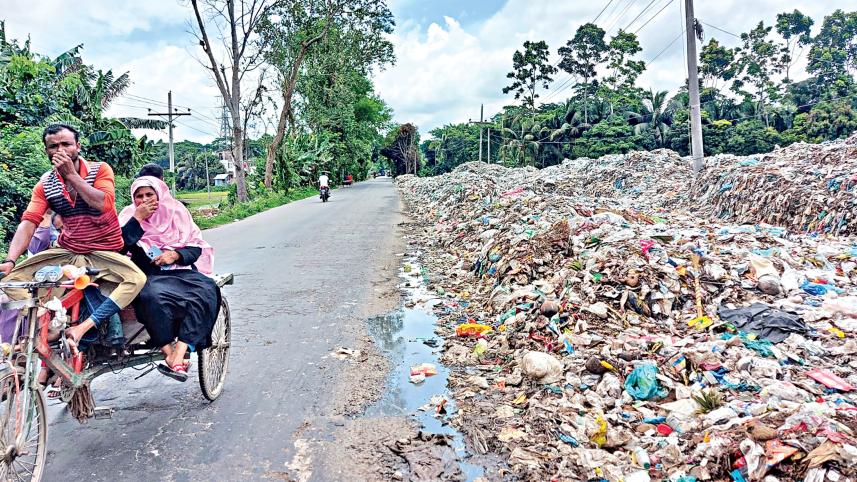
Two out of three lightweight plastic items used in Bangladesh end up mismanaged, mostly due to a lack of source segregation and household collection infrastructure, said an expert yesterday.
"Waste segregation at the household level, soiled plastic, the lack of knowledge and motivation for waste pickers, health and safety hazards, and not formalising the waste plastic collection industry all act as a barrier in creating a holistic ecosystem," said Ijaz Hossain.

The former engineering faculty dean of the Bangladesh University of Engineering and Technology was giving a presentation at a seminar "Enabling Policy for Sustainable Plastic Waste Management" at Sheraton Dhaka.
The Federation of Bangladesh Chambers of Commerce and Industry (FBCCI) and Unilever Bangladesh jointly organised the event.
In Bangladesh, the use of plastics has grown tremendously in recent years in line with rising per capita income and their affordability. The plastic industry's domestic sales amounted to around Tk 40,000 crore in 2021. More than two million people are employed in the industry, which consists of over 5,500 factories, said Hossain.
Though the government has taken up initiatives to address waste management, most remain as laws in paper and wish lists, he said.
"In order to build a sustainable ecosystem for plastic waste management, it is important to work in a multi-dimensional approach," he said.
Hossain's recommendations include developing the plastic waste collection capability and management infrastructure, enhancing plastic waste recycling capability, formalising segregation and value-addition in waste management and formally addressing waste management by municipalities.
He also urged the government to invest in technical capability development, learn from best practices and create a sustainable national policy.
"We will have to find innovative and smart solutions for waste management," said Tazul Islam, minister for local government, rural development and cooperatives.
"Moreover, waste collection is currently not considered to be sustainable as it is still not viewed as a business proposition," he said.
"An effective solution would be to follow the circular system which ensures that the consumption of plastic does not increase and moves towards a sustainable waste management model," he said.
"Waste management is a complex process as it has multiple industries and stakeholder involvement," said Shahab Uddin, minister for environment, forest and climate change.
"Our focus is to co-create policies that are practical and effective, in consultation with stakeholders, including brand owners, to intervene in the value chain," he said.
"It is very common that plastic usage will increase with per capita income and gross domestic product, so the use of more plastic is a good sign for the economy," said FBCCI President Md Jashim Uddin.
"Using more plastic is not the problem, rather, plastic waste management is the main challenge," he said.
"One key area for intervention is mass awareness creation about waste disposal," he said.
"If we could segregate waste at source like in developed countries by increasing the engagement of people, we would be able to implement a sustainable model for plastic waste management," he said.
"Waste segregation at source makes waste recycling viable. We need to create awareness among mass people about how to segregate and dispose of waste and that is the biggest challenge for us," he added.
"We have taken a few pilot projects in collaboration with city corporations," said Zaved Akhtar, managing director and CEO of Unilever Bangladesh.
 For all latest news, follow The Daily Star's Google News channel.
 "If our voluntary initiatives do not get proper facilitation, other organisations will not be encouraged to participate," he said.
"We must understand that one or two companies would probably not be able to solve the problem. It would require the whole business community to come forward and contribute," he said.
The seminar was moderated by Shamia Akther, director and head of communication and partnerships of Unilever Bangladesh.
Comments