


Next year’s budget may cross Tk 9,00,000cr

The budget for 2026-27 fiscal year is likely to exceed the Tk 9,00,000 crore mark, as the government moves to fulfil its electoral pledges, partially implement recommendations to raise salaries of its employees, and shield the economy from the fallout of the ongoing Middle East conflict.
The preliminary framework for the budget is expected to be finalised at a high-level meeting chaired by Finance Minister Amir Khosru Mahmud Chowdhury today.

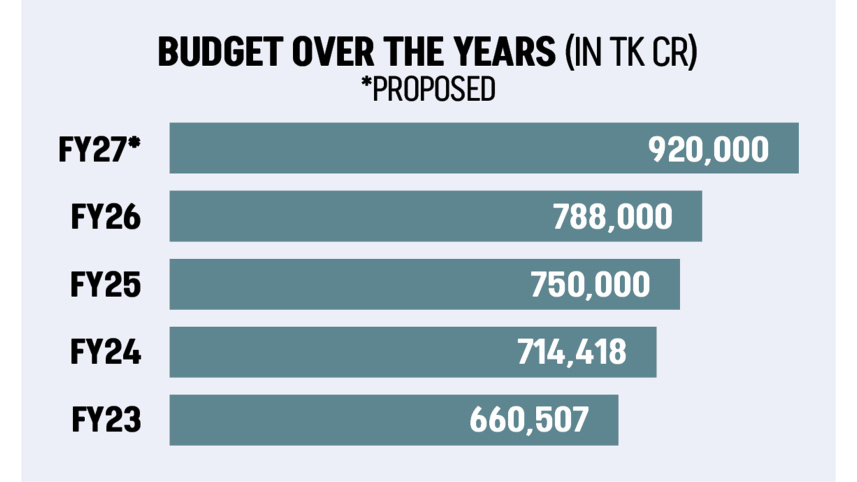
The original budget for the ongoing 2025-26 fiscal year was Tk 790,000 crore, which was later revised down to Tk 788,000 crore with sharp cuts in development spending but higher allocations for subsidies and non-development expenditure.

The new administration is preparing a significant expansion, with preliminary proposals reaching Tk 920,000 crore, marking one of the largest budget increases in recent history.
“This budget carries special weight as it is this government’s first. It will signal the administration’s priorities and lay the financial groundwork for delivering on its five-year commitments,” said a senior finance ministry official, requesting anonymity.
The planned expansion is largely driven by increased expenditure commitments, particularly in public sector salaries, subsidies and social protection, alongside the need to cushion external shocks from the US-Israel war on Iran.
The interim government had prepared a revised budget for this fiscal year and a draft proposal for the next, but the BNP government is introducing significant changes to both, finance ministry officials said.
Despite the ambitious expansion, revenue collection is unlikely to meet its target.
The revised budget had set revenue target at Tk 588,000 crore, including Tk 503,000 crore from the National Board of Revenue -- projections that officials acknowledge will fall short. The revenue collection target for the next fiscal year may be raised to Tk 650,000 crore.
Although the deficit target had been set at 3.3 percent of GDP in the revised budget, weak revenue performance and rising expenditure are likely to push it beyond 4 percent, putting further strain on fiscal management in the coming year.
The deficit for the next fiscal year is expected to be set at around 5 percent of GDP.
The interim government had set a GDP growth target of 5 percent and an inflation target of 7 percent in the revised budget. The new administration is likely to retain the growth target while revising inflation target upwards to 8 percent.
For the next fiscal year, the government is expected to set a higher GDP growth target of 6.5 percent and bring inflation down to 7 percent, banking on the assumption that the US-Israel war on Iran will not persist.
It also expects both public and private investment to gradually recover under an elected government.
Meanwhile, the government has begun piloting several electoral commitments, with full-scale implementation planned next fiscal year.
The flagship Family Card programme alone is expected to cost Tk 13,000 crore in its first year, targeting 40 lakh families.
The other promised initiatives will also require large sums, though the finance ministry plans to manage rising demands by consolidating existing social safety net schemes.
The Ninth Pay Commission estimated that an additional Tk 106,000 crore would be required annually to fully implement the new pay structure.
 For all latest news, follow The Daily Star's Google News channel.
 The government is now planning a phased rollout of the Pay Commission’s recommendations, officials said. However, a phased implementation would still demand a substantial outlay. A committee led by the cabinet secretary will draw up proposals on implementation.
A senior finance ministry official, requesting anonymity, told The Daily Star that the revised salary structure will not take effect this fiscal year.
For subsidies, the revised budget earmarked Tk 88,000 crore, but concerned ministries are now seeking additional allocations following the US-Israel war on Iran. As a result, subsidy spending could surpass Tk 100,000 crore.
The government has formed a committee to review the current Annual Development Programme.
Many projects launched by the previous governments will be scrapped, while new ones aligned with the ruling party’s election manifesto will be added.
The ADP size is expected to be set at around Tk 300,000 crore, according to finance ministry officials.
The government will need to allocate additional funds due to its electoral commitments and rising fuel prices, leaving very little room to cut revenue expenditure, said Mustafizur Rahman, distinguished fellow at the Centre for Policy Dialogue.
“In this circumstance, major initiatives must be taken to boost revenue.”
He stressed the urgency for reforms, particularly modernising the tax system, expanding digitalisation, curbing tax evasion and widening the scope of direct taxes without overburdening ordinary citizens.
On the development side, he urged reprioritisation of spending, including scrapping long-stalled “zombie projects” and exercising caution in approving new ones.
Mustafizur also warned that the budget deficit must be kept within 4 to 5 percent to avoid unsustainable debt pressure, noting that interest payments on domestic and foreign loans have already surpassed education as the largest item in the revenue budget.
Reducing reliance on borrowing, using foreign aid more efficiently, and making the ADP realistic are now critical, he said.
“While cutting expenditure will be difficult, failure to increase revenue flows risks pushing the budget deficit beyond control, and that is the government’s biggest challenge.”
Comments