


Budget of big ambition
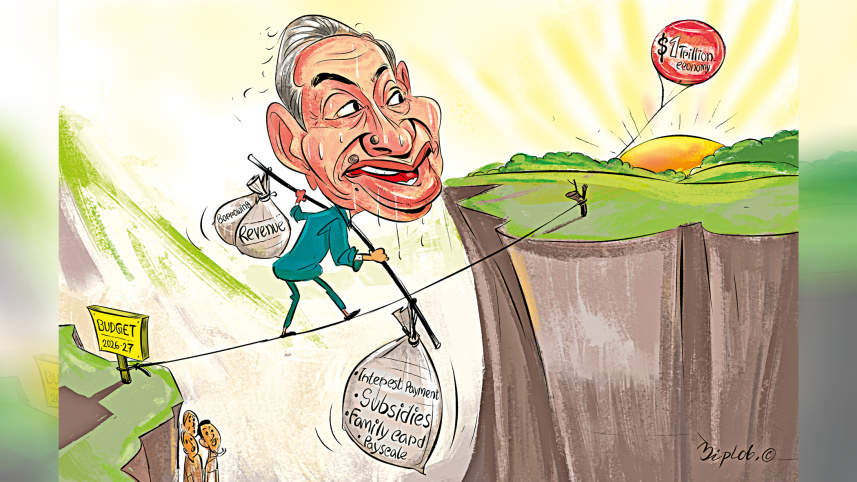
A record budget. The fallout of a distant war. A banking crisis. An imminent reckoning with the IMF. These are the notes Amir Khosru Mahmud Chowdhury must play, all at once, in his first budget as finance minister -- a job he has held for less than four months.
Every June, Bangladesh presents a budget. The outlay almost always gets bigger, the deficit rarely closes, and the annual ritual goes on. Arithmetically, this June is no different. But politically, it feels different. For the first time in 20 years, it is the BNP’s number to announce, the BNP’s deficit to explain, and the BNP’s promise to keep. It is a burden, an opportunity, and quite likely, a bit of both.

Prime Minister Tarique Rahman, exiled in London for 17 years, who had watched the economy from a distance, now sits at the centre of it, looking at the big number -- a budget of Tk 9.38 trillion for the fiscal year beginning July 1. This is a 19 percent increase over this year’s revised outlay and, in nominal terms, roughly 13 times larger than BNP’s last budget two decades ago.
It is also, by most reasonable assessments, unaffordable.
Welcome to Bangladesh’s budget season.
The country that built one of Asia’s great growth stories did so by collecting taxes at roughly 7 percent of GDP -- less than India, less than Vietnam, and less than almost any comparable economy. The global average for developing countries sits around 15 percent. Bangladesh, with an economy of half a trillion dollars, simply never built a state apparatus that could pay for its ambitions. That has always been the contradiction at the heart of its economic miracle, and this budget will not resolve it. Nor does anyone expect it to.
The National Board of Revenue has spent most of the current fiscal year missing its targets. By April, it was already more than Tk 1 trillion short, a shortfall expected to persist through June. The government’s planned response is a classic move: give the NBR an even larger target for next year, hope the economy overperforms, paper over the gap with borrowing, and move on. Every government in Bangladesh has done it.
Returning to office on a wave of democratic optimism, the BNP is discovering that the spreadsheets look considerably more alarming up close. While the latest data shows growth nudging upward, the broader economic engine is still sputtering. Exports have fallen, and private investment has declined. Khosru summarised it with typical bluntness during a recent pre-budget discussion: previous administrations left the BNP in a “fragile and precarious” situation. The metaphor he chose was a tubewell: pour water in when the water level drops. A broken economy demands no less.
There is a vast chasm between the nation’s grand ambitions and the realities of its purse -- a gap that stretches to roughly Tk 2.43 trillion. It keeps the fiscal deficit at less than 4 percent of GDP, safely beneath the globally accepted ceiling of 5 percent. Yet, to bridge this divide, the government must cast a heavy net, drawing deep from local banks and leaning on foreign creditors.
Economists in Dhaka point out that this domestic borrowing squeezes private sector credit at precisely the moment the economy desperately needs investment. Private investment as a share of GDP has been falling steadily and is now near historic lows. Borrowing more to fund a state machinery that cannot collect its own taxes is, in this reading, counterproductive.
What makes this strategy especially precarious is that one of its key pillars -- external multilateral financing -- is currently under negotiation rather than secured. In January 2023, Bangladesh secured an IMF loan package (later expanded to $5.5 billion) to address a widening balance of payments deficit, a sliding taka, and declining foreign exchange reserves. While five tranches have been disbursed, the IMF withheld the sixth in December 2025, stating it wanted to wait for an elected government. The BNP won the election in February, yet the money hasn’t arrived.
The delay stems from unmet conditions, including raising revenue collection as a share of GDP, enacting meaningful banking sector reform, and allowing a genuinely market-based exchange rate. The government has now asked for a new programme, with an IMF mission expected in Dhaka next month to negotiate terms. An active IMF programme acts as a seal of approval, unlocking parallel budget assistance from the World Bank and the Asian Development Bank.
Khosru has a theory about what went wrong with Bangladesh’s economy, and he isn’t shy about sharing it. He pushed for the “democratisation of the economy”. Economic output, he argued, does not only come from large factories and conglomerates; it also comes from rural women, blacksmiths, potters, weavers, and artisans. He believes these marginalised producers have been ignored. To change this, the new budget will feature direct allocations for the “creative economy”, alongside plans to connect grassroots producers to global platforms like Amazon and eBay through NGO and private sector partnerships.
He also intends to tear up the paperwork. In his telling, Bangladesh’s regulatory bureaucracy is a profound drag on growth. His solution is a single focal point for all government approvals with mandatory response deadlines. Furthermore, new projects will be approved only if they pass four strict tests: value for money, return on investment, job creation, and environmental sustainability. Everything inherited from the previous government that fails these tests will be scrapped.
To wean the economy off its dependence on bank lending, Khosru wants to rebuild the Securities and Exchange Commission and develop bond and capital markets. The previous chairman resigned, along with other commissioners. A new leadership is now in place, but whether it has the muscle to turn a market Khosru once called a casino into the capital engine remains very much to be seen.
Behind all of this sits an overarching ambition: transforming Bangladesh into a trillion-dollar economy by 2034. While the Boston Consulting Group previously estimated the country would hit that mark by 2040 at 5 percent growth, Khosru is aiming for it six years ahead. That would require almost double-digit GDP growth. Is it a concrete plan or merely an aspiration? The budget will need to begin answering that question and, for starters, the envisioned 6.5 percent growth falls drastically short.
Barely two weeks in office, the BNP government had to grapple with arguably the largest supply disruption in the history of the global oil market as Iran closed the Strait of Hormuz in retaliation for US and Israeli attacks. It choked off a fifth of the world’s oil and liquefied natural gas, pushing crude prices past $114 a barrel. Bangladesh, which imports 95 percent of its oil and LNG, had never planned for such a contingency. Khosru estimates the conflict adds almost $3 billion to Bangladesh’s energy import bill between March and June.
The cruel irony is that Bangladesh’s new government came to power on promises of economic renewal just as a geopolitical shock, entirely beyond its control, began destroying its room to manoeuvre. Khosru cannot control the price of oil, nor can he reopen the strait. All he can do is present a budget that honestly accounts for the damage, hoping the war ends before things get worse.
For the new government, the banking crisis is an inherited disaster, but it makes everything harder. Bangladesh’s non-performing loan ratio stood at 30.60 percent in December 2025, after peaking at 35.73 percent just three months earlier. It exceeded every other nation in South Asia, and most in the world. Five banks had NPL ratios above 90 percent. Some cannot, by any realistic assessment, be saved.
This creates a glaring tension: Khosru wants to develop bond markets as an alternative to bank financing, yet the upcoming budget must be financed partly through borrowing from the same struggling banking sector. This puts him in a difficult spot too, since the finance minister will have to be firm with reforms, tightening banking regulations and thereby steadying the economy.
 For all latest news, follow The Daily Star's Google News channel.
 More than anything else, this budget is a test of whether the new government can convert its rhetoric into plumbing. The soaring oratory of democratisation and transparency costs nothing. The plumbing -- the tax collectors who actually work, the permit approvals that arrive on time, the banking reforms that survive political pressure, and the social spending that actually reaches the vulnerable -- is much harder to build.
Khosru has asked the public for patience. It is the most honest thing a finance minister can say before presenting a budget.
When the budget speech is delivered today, the numbers will be large, round, and impressive-sounding. Khosru’s colleagues will applaud. Economists will issue politely worded concerns. But the hardest questions will not be answered in parliament. They will best be answered with new jobs and stable prices.
We all hope that it happens, but experience sings a different song.
Comments