


The poisonous promise that didn’t hold

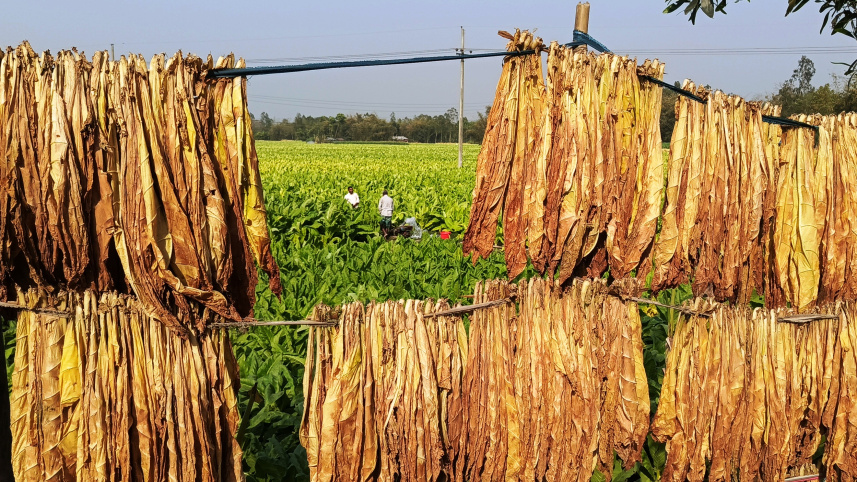
Abdus Sattar had never farmed so much tobacco in his life.
This year, the 35-year-old from Saptibari village in Lalmonirhat's Aditmari upazila converted all 18 bighas of his land to the crop -- up from 10 the previous season -- after company representatives assured him they would buy every kilogram he produced at Tk 220 per kg.

The math seemed simple. The promise seemed solid. He produced around 360 kg of tobacco per bigha. Now he stands in his field with nowhere to sell.
The companies have purchased barely 20 percent of his harvest, rejecting the rest as low quality. He is now selling the remaining produce in local markets for less than his production cost of Tk 100–110 per kg.
"For so long, we did not realise we were trapped in a cycle of deception," he said. "This year we have understood the reality."
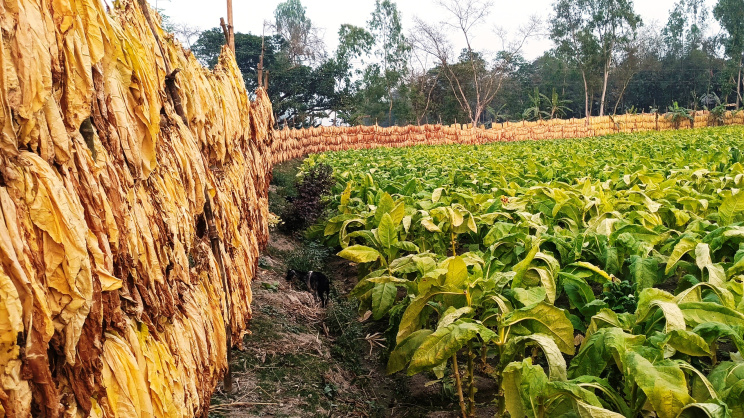
Across the Rangpur region, thousands of such tobacco farmers are reckoning with a collapse of trust -- and a season of serious financial loss -- after the companies that recruited them walked away from much of their harvest.
According to the Department of Agricultural Extension (DAE), nearly 50,000 farming families across the Rangpur region are directly or indirectly involved in tobacco cultivation, most as contract farmers holding company-issued identification cards.
This year, cultivation expanded to 21,290 hectares in five districts of Rangpur -- up from 18,734 last year -- with Lalmonirhat alone accounting for 18,225 hectares, followed by Rangpur with 1,810 hectares, Nilphamari with 1,210 hectares, Gaibandha with 35 hectares, and Kurigram with 10 hectares.
Farmers expanded their plots on the basis of company encouragement; now the companies say they cannot absorb the surplus.
A representative of one tobacco company operating in Rangpur offered a different framing.
Seeking anonymity, the representative told The Daily Star that the nine major companies -- seven domestic, two multinational -- have a combined demand of roughly 4.4 crore kilograms of leaves, and that farmers this year cultivated more than double the expected area without following company guidance.
Unusually high prices last year had encouraged overexpansion, he argued, and this year's excessive rainfall and hail further degraded leaf quality.
But Jahirul Islam, 55, from Sarpukur village in Aditmari, said he expanded from five bighas to 13 this season specifically on company advice. Ahad Ali, 65, from Mominpur village in Rangpur, went from seven bighas to 15 after companies guaranteed they would purchase all he produced at fair prices.
Both are now selling below cost and both say they will never grow tobacco again.
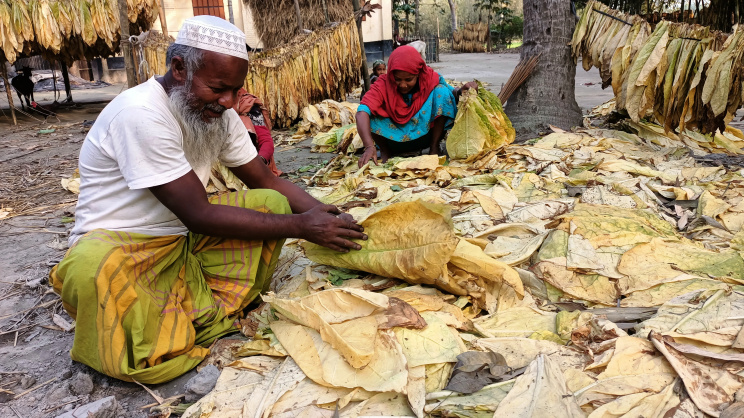
"We ignored the advice of agricultural officials and trusted the company representatives more," Jahirul said. "Now we realise they prioritise their business interests over our welfare."
The losses of this season have accomplished something years of official warnings could not. The DAE has long urged farmers away from tobacco, but Aditmari Upazila Agriculture Officer Omar Faruk acknowledged that company influence consistently outweighed government advice.
"This year, though, farmers have become more aware after failing to receive fair prices," he said, expressing cautious hope that many would switch crops next season.
For experts, the economic failure is inseparable from a wider crisis tobacco farming inflicts on the region.
Dr Safinur Rahman of the Rangpur Divisional Soil Resource Development Institute warns that tobacco plants strip soil of nutrients at a pace that degrades the productivity of all subsequent crops grown on the same land.
Sanzida Yasmin, fisheries extension officer of Lalmonirhat District Fisheries Department, warned that the excessive use of chemical fertilisers and pesticides in tobacco fields is threatening the reproduction and survival of indigenous fish species.
 For all latest news, follow The Daily Star's Google News channel.
 Rangpur Civil Surgeon Dr Shahin Sultana noted that women, children, and field laborers face regular health risks from direct leaf exposure, including nausea, dizziness, and fever.
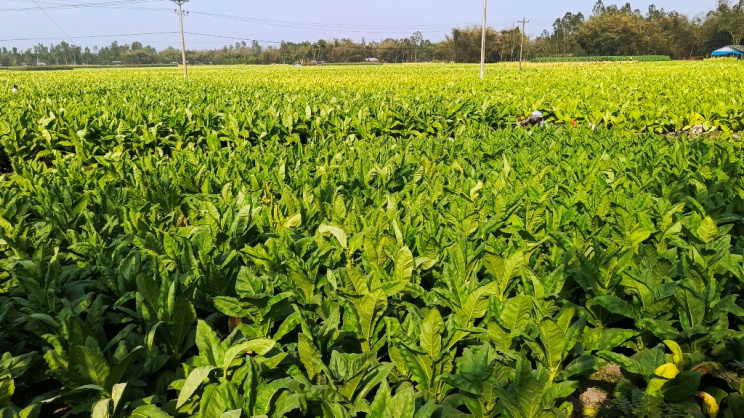
Khorshed Alam Sagar of the Anti-Tobacco Media Alliance (ATMA) argues the official cultivation figures likely understate the true area under tobacco, given how deeply company networks have penetrated farming communities.
Sirajul Islam, additional director of the Rangpur Regional DAE, said the department has already submitted legislative recommendations to the ministry.
Among them is a proposal to restrict tobacco company representatives from working directly at the field level, and to identify farmers engaged in tobacco cultivation so that their farmer cards can be cancelled, preventing them from accessing fertiliser through those cards.
"If the government enacts appropriate legislation, we will be able to take more effective measures at the field level," he said.
For Abdus Sattar, the legislation, if it comes, will arrive too late for this season. He has already made his decision. "I will not cultivate tobacco again," he said, "and I will also try to discourage my neighbors from doing so."
Comments