


Boro acreage rises for fifth consecutive year


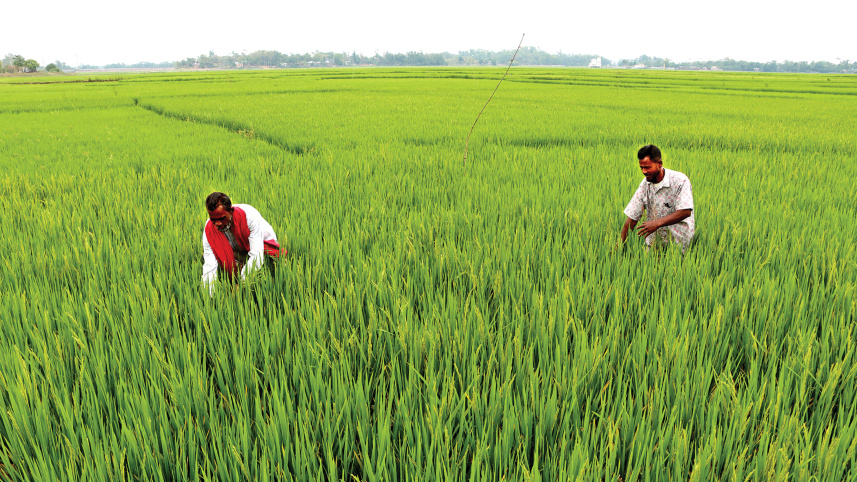
Boro paddy cultivation has gradually expanded over the years, thanks to factors including wider access to irrigation, supportive weather, better prices and the return of once fallow land to the farming of staple rice.
In the fiscal year 2021-22, the dry season crop, which accounts for more than half of annual rice output, covered 48.15 lakh hectares.

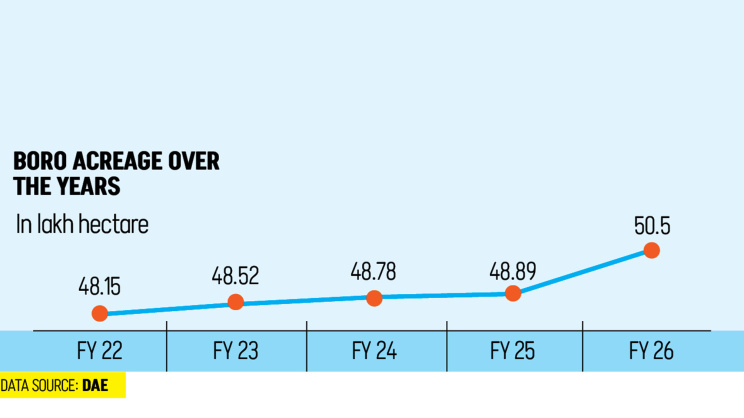
The acreage stood at 50.50 lakh hectares in the current fiscal year 2025-26, posting a 3.29 percent increase year- on-year, according to the provisional data from the Department of Agricultural Extension (DAE).
Output has risen as well. Production increased from 2.01 crore tonnes in FY22 to 2.13 crore tonnes in the last season of FY25. The DAE has targeted a production of 2.24 crore tonnes of Boro rice for the current season.
“The increase in cultivation is largely due to several government initiatives aimed at bringing fallow lands under production,” said Mohammad Khalequzzaman, director general at the Bangladesh Rice Research Institute.
He highlighted that areas in the South, which previously had little cultivation, are now being utilised thanks to new rice varieties and increased motivation among farmers.
“Additionally, interventions by the Bangladesh Agricultural Development Corporation, such as canal excavation and low-lift pump installations, have played a crucial role.”
He also mentioned that regions in the haor belt and parts of the Chittagong Hill Tracts, which were once unsuitable for Boro cultivation, are now being cultivated due to these efforts. These changes have occurred gradually over the last five to seven years.
Favourable weather conditions over the past two to three years have also helped maintain steady yields, he said, with no severe disasters impacting the crops.
Farmers have grown Boro on an increased area at a time when prices of coarse rice have fallen due to increased supply, resulting from imports and good production of the previous Aman crop, which accounts for nearly 40 percent of the total rice crop, and the US-Israel war on Iran has raised concerns over the supply of fuel and fertiliser to grow crops.
Over the last month, retail prices of coarse rice, a benchmark for rice prices in Bangladesh, dropped 4.55 percent to Tk 50-55 per kilogramme in the kitchen markets of Dhaka, according to data compiled by the Trading Corporation of Bangladesh.
Jahangir Alam Khan, an agricultural economist, said the drop in rice prices in the market now translates to lower profit margins for intermediaries. However, this should not result in a price crash for farmers selling Boro rice this season.
“To prevent any artificial price manipulation and protect farmers from potential losses, the government must ensure thorough and effective monitoring of the supply chain,” he said.
Md Obaidur Rahman Mondol, director of the field services wing at the DAE, said the increase in Boro cultivation over the past four years is mainly due to the growing interest in farming in certain areas, particularly the Sylhet region.
Much of Sylhet’s land remains fallow during the Boro season because of stones that make groundwater access difficult. However, when irrigation was introduced, even in small “pockets” of previously uncultivated land, farmers began cultivating the irrigation-based rice.
If there are no hailstorms, actual production could reach around 2.17 crore tonnes to 2.18 crore tonnes, he said.
The total Boro cultivation area in the Sylhet Division has risen slightly this season, as per DAE data.
Mosharraf Hossain, additional director of the DAE in Sylhet division, said when water levels drop significantly in haors, cultivable land increases, leading to higher cultivation. However, early rainfall quickly causes waterlogging in these areas, and drainage becomes difficult.
He added that the Boro harvesting season will begin on April 7, with full-scale harvesting expected from Pahela Baishakh. However, some farmers who planted early have already started harvesting.
Economist Khan said over the past two to three seasons, weather conditions during the Aus and Aman cultivation periods in the country have been unfavourable.
 For all latest news, follow The Daily Star's Google News channel.
 “In contrast, weather during the Boro season has been relatively favourable. As a result, farmers have shown increasing interest in Boro, which is one of the key reasons behind the expansion of land dedicated to it,” he said.
However, this year, farmers may experience slightly lower-than-expected yields from Boro mainly due to a shortage of diesel, which has limited their ability to provide adequate irrigation, he added.
Around 70 percent of Bangladesh’s irrigation system relies on diesel-powered methods. In addition, there have also been concerns over fertiliser supplies in many parts of the country, he said.
Comments