


Faded blue suitcase
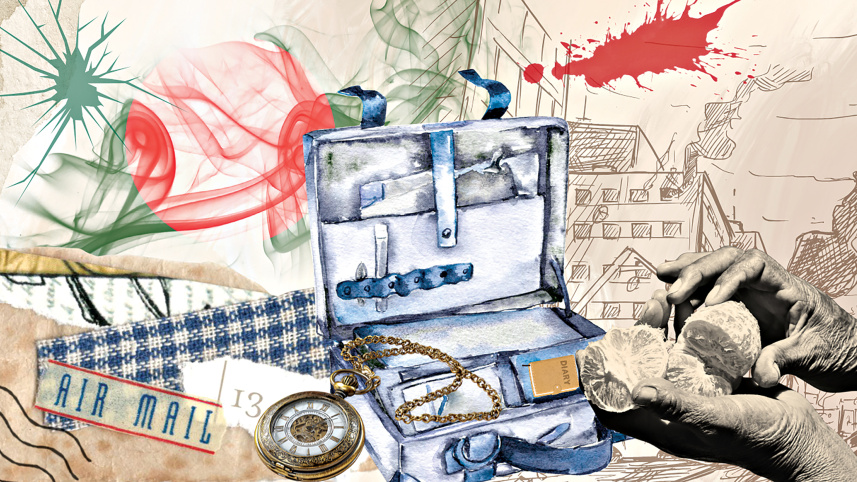
We once lived in Jackson Heights, Queens, New York City. Those days still return to me, especially when my grandmother’s death anniversary comes around. At such times, I drift back into the past and live quietly within my memories. My grandmother was no ordinary woman. You may call her Birangona, but to me she was a brave freedom fighter of Bangladesh, shaped by courage and sacrifice. Her name will forever remain engraved in my heart. The story is written in her memory.
The old, rusted key now rests in my hand.

As I run my fingers over its rough metal surface, I feel the soft, velvety touch of my grandmother’s hand—as if time itself has folded back. And it’s not only her touch I sense; I can also smell her. Grandmother used to rub jasmine and hibiscus oil into her hair. Whenever she entered a room, the air would fill with that sweet fragrance. Even now, I can smell it—as if she’s standing right beside me, smiling softly, her hair scented with hibiscus oil.
My eyes are full of wonder, and my heart trembles with curiosity.
What could be inside this magical suitcase?
Before she passed away, Grandmother had said something strange:
“After my death, this suitcase will belong to my only grandson, Nabil.”
From my very childhood, Grandmother had been my best friend. When I lived in Bangladesh, she was the center of my world. Once, she used to teach at a girls’ school in a small town. Perhaps because she was a teacher, she had a deep love for reading and knowledge. It was she who first placed a book in my hands—the collection of children’s stories.
Then one day, holding my parents’ hands, I left for America. I was only 10 years old. But even after all these years, I’ve never been able to accept that separation from her. I remember pleading with my father again and again,
“Baba, why do we have to go to America?”
But he never really answered.
He only said what all grown-ups say:
America is the land of opportunities—better studies, a good job, more money…
No one thought of the loneliness we were leaving behind—of my grandmother who would be left all alone. No one thought of the nights when I wouldn’t fall asleep wrapped in her arms, or of the sky-high stories she would whisper into my ear.
Our separation began the very day we boarded the plane for New York. I still remember, at the airport she placed her hand on my head, whispered a prayer, kissed my forehead, and hugged me tightly. She said softly in my ear:
“Nabil, don’t be sad, my dear. Life will have its hard times. But never forget your grandmother—ever! Write me a letter every month. Call me. I’ll be waiting by the phone. And when you go to America, you’ll read many new books, learn so many new things. But promise me, don’t read alone—read to me too. You’ll see, one day I’ll come to visit you there.”
And she kept her promise—she came to America twice.
But America never felt like home to her.
No matter how hard we tried, we couldn’t keep her there.
She used to say,
 For all latest news, follow The Daily Star's Google News channel.
 “How many days do I have left to live, my dear? I want to spend my last days in my own country—in my own soil.”
Did Grandmother really leave that suitcase for me? Did she assign me the solemn right—the single right—to open it? What could be inside? Perhaps, behind that mysterious suitcase, another grandmother will be discovered—a grandmother I never knew. Or perhaps some unknown secret of hers will be revealed from within. Maybe she hid something there she would not tell anyone else; maybe she wanted only me to know. The mystery tightened around me. For days I felt an odd mixture of curiosity and the scent of adventure. I could not wait.
Let me tell you a little about my father.
His name is Raqib Khan—a face full of quiet intelligence, fair complexion, a sharp, high nose. He stands nearly six feet tall. At first glance, he could easily be mistaken for a model. He works at a bank in New York and occasionally writes in Bangla newspapers. Recently, he has been working on a manuscript about the contribution of Bangladeshis around the world to Bangladesh’s Liberation War—in other words, he is preparing himself to be a future researcher on the history of our independence.
Though he lives in New York, his heart remains in Bangladesh. In our living room in New York hangs a black-and-white photograph of my grandfather—Bir Muktijoddha Farooq Khan. On the TV stand rest two flags side by side—one American, one Bangladeshi. Even on our car dashboard, there’s a small mat with the flag of Bangladesh. My father’s pride in his homeland never fades. How could it? He lost his father in 1971—only three months before independence, on a dark night in September, when the Pakistani military attacked their home.
It’s a long story, but let me tell it briefly.
Grandfather was the headmaster of a primary school. Secretly, he helped and sheltered freedom fighters in many ways. Often, in the deep of night, the Muktijoddhas would come to his house seeking refuge. Whatever little food was available, he and my grandmother would share with them gladly. The country was at war; the household often had very little to eat. Yet, my grandmother — her nick name was Mou — would quietly prepare flattened rice, puffed rice, molasses sweets, and other dry food for the freedom fighters. Whenever they left, she would pack food and clothes into little bundles for them to take.
My grandparents were so young then — my grandfather was thirty-five, my grandmother was only twenty-five. Freedom fighters would often say before leaving,
“Mou apa, we couldn’t eat properly this time. When Bangladesh will ger her freedom, we’ll come to your house and feast on korma and polao!”
She would laugh and reply,
“Not just korma and polao — when Bangladesh will born , I’ll slaughter a cow and feed the whole village!”
I heard all this from my grandmother herself. At that time, my father wasn’t even born. He was born later after liberation— on June 10, 1972.
My grandfather never lived to see his son’s face.
That night, when the Pakistani soldiers attacked, a few local collaborators (razakars) and two Pakistani troops broke into the house. They shot my grandfather twice in the head, killing him instantly. Grandmother was asleep in the next room. Awakened by the gunshots, she ran toward the pond behind the house and dove into the water, hiding beneath the floating hyacinths, barely keeping her nose above the surface — that’s how she survived.
The next morning, the razakars tied my grandfather’s body behind a bullock cart and dragged it through the streets, shouting,
“Pakistan Zindabad!”
Grandmother could do nothing but save her life that night.
But to me, she has always been a hero — a Birangana, a brave woman of unbreakable spirit. All my life, I saw in her a fearless character, steady and resolute. She never panicked, never lost composure. She did everything in her own quiet way, and that was the essence of her character.
One morning, while I was getting ready to go to university, Father suddenly called me. I saw his eyes were red — I knew at once that something terrible had happened. Without any preface, he said,
“Nabil, I have bad news. Please, don’t be upset. See, I’m holding myself together — be strong, my boy. Your grandmother… she’s no more. She left us a little while ago. I’m going to Bangladesh. I’ll stay for about a month.”
Saying this, he turned away and went into his room, wiping his eyes.
The woman whose love had filled my first ten springs — my grandmother — was gone! I couldn’t believe it. “Dadi is no more” — the words felt impossible. Father left for Bangladesh. I couldn’t go with him because my midterms were going on. I thought I’d visit her grave during my summer break. But inside, I was shattered.
At night, before falling asleep, I would think of her — her stories, her laughter, her scolding, her warmth. Sometimes I would even see her calm, gentle face in my dreams. She was such a remarkable woman.
In Bangladesh, Father arranged every detail of her funeral with love and precision. And that’s how, one ordinary day, Grandmother passed away — leaving us, little by little, with only her memory.
Almost a month went by. Then one morning, Father called from Bangladesh.
“Nabil, I have something to tell you. Before she passed away, your grandmother left behind an old suitcase for you. She told everyone — this suitcase must be opened only by Nabil, no one else. The key is kept with your aunt. Try to manage things, finish your midterms, and see if you can come.”
One morning I took a plane for Bangladesh. Our ancestral home isn’t far from Dhaka — about a two-hour drive. When the taxi pulled up to the house gate, my eyes blurred and my heart trembled. For a moment I thought Grandmother was standing in front of me again, coming forward to meet me. She would say, “Nabil, did the journey go well? Come in, come in — first a glass of cold lemon sherbet.” My father brought me into the house. For many days after I felt wrapped in nostalgia. Oh — everything was here, but Grandmother wasn’t. When things quieted down, father placed Grandmother’s key in my hand.
“Here — take the key. Tomorrow morning we’ll bring the suitcase from her room.”
The next morning, they brought the suitcase. It was an ordinary blue case, faded to a dusty gray with a layer of dirt. I carefully wiped the dust away. It seemed Grandmother had used it for many years. Perhaps she had kept all the secrets of her life inside.
I was alone in the room. The door closed behind me. Grandmother’s suitcase sat before me; the key rested in my palm. I hesitated. Was I to open the suitcase, or should I leave all her unknown stories intact and untouched? Maybe there was something else — perhaps Grandmother loved me enough to insist I open it. But still I had no final decision. I looked: a small rusty padlock hung at the front of the case. I fit the key into it, turned it gently, and the lock gave. Slowly I lifted the lid.
As the case opened a nostalgic smell — old perfume and the faint burn of ancient spirits — filled the room. The suitcase was crammed with papers. My eye fell first on a large photo album of Grandmother and me. On top of the album lay an envelope addressed in her hand: the recipient — “Enamul Haq, Nabil.” I began to read the letter. As the lines reached me my vision blurred; I could read no more for a while. I could only manage to hold back my urge to speak aloud. Her few lines contained insistence and tenderness:
“Never forget your homeland. Never forget the language. Never forget our culture. Remember — your identity, your blood carries Bengali culture for a thousand years. Never scorn that culture.”
Beside that envelope lay another small photo album. I found many pictures of Grandmother and me inside. Underneath the album lay an old broken black-rimmed pair of glasses. A label below read: “Your grandfather’s glasses.” There was also a small cloth bundle. I opened the bundle and found a little packet of letters. In one letter she had written:
“Nabil, there are a few small pieces of gold jewelry here. Your grandfather gave them to me when I was young. I give these to you now. When you marry, give them to your future wife.”
I took out the jewelry one by one — a finely-crafted necklace, two bracelets, a tiny nose ornament, a small ring. Each piece brought to my mind Grandmother’s face again. I wrapped the little black cloth around them carefully and put them back in their place.
On the right side of the suitcase something else caught my eye: a beautifully carved eye liner container. We call it surmadani. Under it she had written, “Your grandfather gave me this on our first wedding day. Keep it safe.” I cradled the little brass surmadani in my hands and sat there, fascinated. Beneath it I discovered an old notebook — not really a notebook but a stitched booklet. The paper was so fragile it looked as if the pages might fall apart. Across its cover, in thick black ink, someone had written: My Literary World. What — Grandmother secretly wrote literature?
I opened the booklet. On the first page I found a small poem. Throughout the small book there were poems, stories, careless sketches, moments of practiced handwriting. Ah — how could Grandmother have kept this from me? In this literary world she had walked alone; she had written not for fame but perhaps out of necessity, or out of hidden courage, or modesty. Maybe she never had the nerve to show anyone. My chest swelled. I remembered one Bengali famous writer name; Rash shunduri devi— how secretly she must have nurtured her own Bengali literary life. My heart filled with pride.
On the left side of the suitcase, I discovered a stack of notebooks and papers, carefully wrapped. I pulled them out. They weren’t glossy urban diaries — just a few plain, thick notebooks, their covers tied with coarse paper. Grandmother kept diaries? What could be inside? I reached for the first notebook. A dried yellow rose petal was pressed into the fold of the first page, as if someone had placed it there to mark a memory. The notebook began with the date: January 23, 1967. In small, uneven handwriting she had written:
“He is a good man. Today I am married to him. Alhamdulillah. Our life will be happy.”
I paused. I felt the duty of preserving her privacy, to guard those words that belonged to her alone. I set that diary aside and my eyes fell on the next: there on the cover in bold fountain-ink was written: 1971. My hands trembled.
Grandmother was twenty in 1967; by 1971 she was twenty-four. At that age her world had met 1971. I could no longer contain myself. I turned the page and saw a crude, anguished drawing of a beast — a hyena. Under the picture she had written, plainly: Hyena. The diary’s entries were fragmented, not chronological. Like the jagged pages, her life too had been ragged and scattered — fear, anxiety, and yet dreams.
Then I gasped at the entry dated October 22, 1971. In a small, urgent hand she had written:
“This hyena’s blood lives in my body. With this shame I cannot go anywhere. How will I show my face? How will I tell people that two Pakistani vultures came to my house and took my honor that night? How can I live in this society? This country? Yet I will not kill my child. I will raise my child to be a man who can wreak revenge. As a mother this is my prayer.”
Grandmother—at last, she could not be saved. This humiliation, this shame, had followed her all her life in silent contempt. This society — its people, my father, we — we had not known. Suddenly the scent of hibiscus in my nostrils sharpened; for a moment I felt Grandmother sitting before me. Her eyes burned with a vengeful fire. She seemed to say to me, “Nabil, those who insulted your grandmother — you must take revenge. For the humiliation the hyenas inflicted, you must make them pay. Do you hear me? Will you take revenge?” I grabbed the diary to my chest. Then a strange calmness replaced my tears — in its place rose a blazing desire for retribution.
I had carried my grandmother's suitcase with me when I went to America. She had left me the jewelry for my future wife. I had kept every legal document and paper she had left with great care. A few days before she had given her manuscript to a publisher; it was hoped the book would come out at the fair. And the diary — yes, I thought long and hard. At first, I wanted to burn the diaries in the river — let every bit of shame float away. Let her humiliation vanish with the water. But how could I? These small diaries were my inheritance, the marks of my identity. So, I kept them close.
That faded blue suitcase that had imprisoned Grandmother for so long — now I would free her from it. Her little diary would not remain a secret any longer. Grandmother’s blue suitcase is now with me in Bangladesh.
Adnan Syed is a resident of New York, USA, and occasionally writes for Star Books and Literature.
Comments