


Iran furious as Trump 'decertifies' nuke deal 258
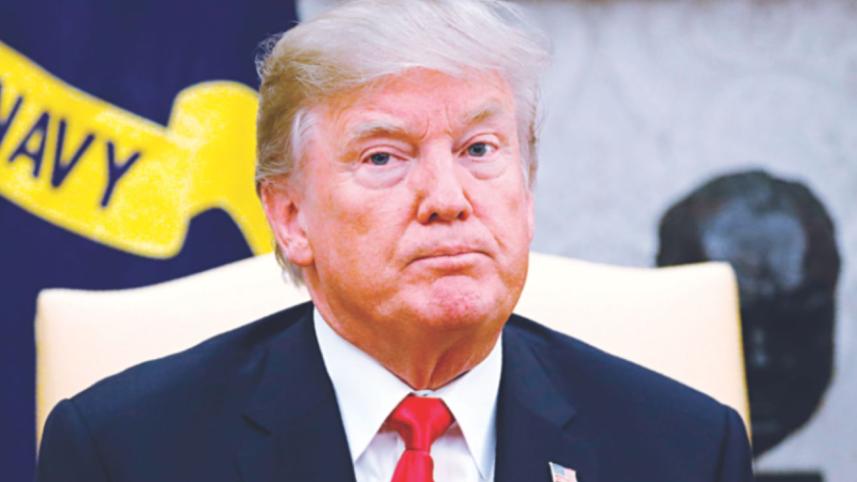
US President Donald Trump yesterday struck a blow against the 2015 Iran nuclear agreement in defiance of other world powers, choosing not to certify that Tehran is complying with the deal and warning he might ultimately terminate it.
Trump announced the major shift in US policy in a speech in which he detailed a more aggressive approach to Iran over its nuclear and ballistic missile programs and its support for extremist groups in the Middle East.

He accused Iran of "not living up to the spirit" of the nuclear agreement and said his goal is to ensure Tehran never obtains a nuclear weapon.
"We will not continue down a path whose predictable conclusion is more violence more terror and the very real threat of Iran's nuclear breakout," Trump said.
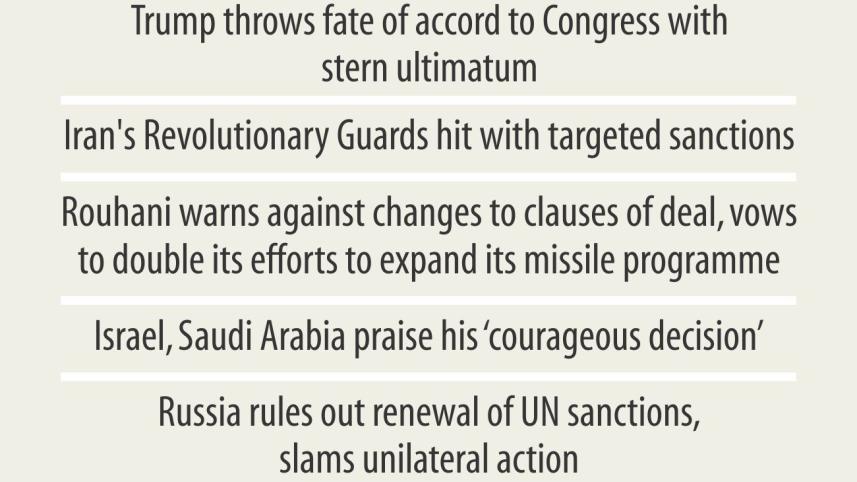
Trump's hardline remarks drew praise from Israel and Saudi Arabia, Iran's arch-foes, but were criticized by European allies.
The move by Trump was part of his "America First" approach to international agreements which has led him to withdraw the United States from the Paris climate accord and the Trans-Pacific Partnership trade talks.
His Iran strategy angered Tehran and put Washington at odds with other signatories of the accord such as Britain, France, Germany, Russia, China and the European Union, some of which have benefited economically on renewed trade with Iran.
Responding to Trump, Iranian President Hassan Rouhani said on live television that Tehran was committed to the deal and accused Trump of making baseless accusations.
Rouhani also vowed to double its efforts to build weapons for deterrence, expand its missile programme.
"The Iranian nation has not and will never bow to any foreign pressure...Iran and the deal are stronger than ever ... Iran's Islamic Revolutionary Guards Corps will continue its fight against regional terrorists," Rouhani said.
He added that Trump's decision to decertify the deal would isolate the United States as other signatories of the accord remained committed to it. The deal was not renegotiable, he said.
In Brussels, EU foreign policy chief Federica Mogherini said Washington could not unilaterally cancel the agreement.
"We cannot afford as the international community to dismantle a nuclear agreement that is working," said Mogherini, who chaired the final stages of the landmark talks. "This deal is not a bilateral agreement."
The leaders of Britain, France and Germany, reaffirming their commitment to the 2015 deal, issued a joint statement warning the United States against taking decisions that could harm the nuclear deal such as re-imposing sanctions.
The three leaders also said they shared US concerns over Iran's ballistic missile program and regional destabilizing activities and were ready to work with Washington to address those concerns.
In contrast, Russia's foreign ministry said there was no place in international diplomacy for threatening and aggressive rhetoric, and said such methods were doomed to fail in a statement issued after Trump's speech.
European allies have warned of a split with the United States over the nuclear agreement and say that putting it in limbo as Trump has done undermines US credibility abroad, especially as international inspectors say Iran is in compliance with the accord.
The chief of the UN atomic watchdog reiterated yesterday that Iran was under the world's "most robust nuclear verification regime" after Trump's announcement.
 For all latest news, follow The Daily Star's Google News channel.
 US Democrats expressed skepticism at Trump's decision. Senator Ben Cardin said: “At a moment when the United States and its allies face a nuclear crisis with North Korea, the president has manufactured a new crisis that will isolate us from our allies and partners.”
While Trump did not pull the United States out of the agreement, aimed at preventing Iran from developing a nuclear bomb, he gave the US Congress 60 days to decide whether to reimpose economic sanctions on Tehran that were lifted under the pact.
If Congress reimposes the sanctions, the United States would in effect be in violation of the terms of the nuclear deal and it would likely fall apart. If lawmakers do nothing, the deal remains in place.
Congress is more likely to take up legislation proposed by two Republican Senators that would set new restrictions on Iran, including reimposing US nuclear sanctions if Tehran were deemed to be within one year of developing a nuclear weapon.
Trump also directed US intelligence agencies to probe whether Iran might be working with North Korea on its weapons programs.
The president, who took office in January, had reluctantly certified the agreement twice before but has repeatedly blasted it as "the worst deal ever." It was negotiated under his predecessor, former president Barack Obama.
Trump warned that if "we are not able to reach a solution working with Congress and our allies, then the agreement will be terminated."
Trump also gave the US Treasury Department authority to impose economic sanctions against people in the Islamic Revolutionary Guards Corps or entities owned by it in response to what Washington calls its efforts to destabilise and undermine Iran's opponents in the Middle East.
The US Treasury said it had taken action against the Guards under a 2001 executive order to hit sources of terror funding and added four companies that allegedly support the group to its sanctions list, reported AFP.
US Secretary of State Rex Tillerson said that rather than reimposing sanctions, Trump wants the Republican-controlled Congress to fix what he considers flaws in the agreement.
Lawmakers would do this by amending the Iran Nuclear Agreement Review Act law to strengthen nuclear inspections, cover Iran's ballistic missile program and eliminate the deal's "sunset clause" under which some of the restrictions on Iran's nuclear program expire over time.
And the US military yesterday said it was reviewing the "entire breadth" of its security cooperation activities, force posture and plans to support Trump's new strategy on Iran.
A spokesman said the Pentagon was assessing the positioning of its forces as well as planning but offered few details.
Comments