


More building blocks of life found on Mars
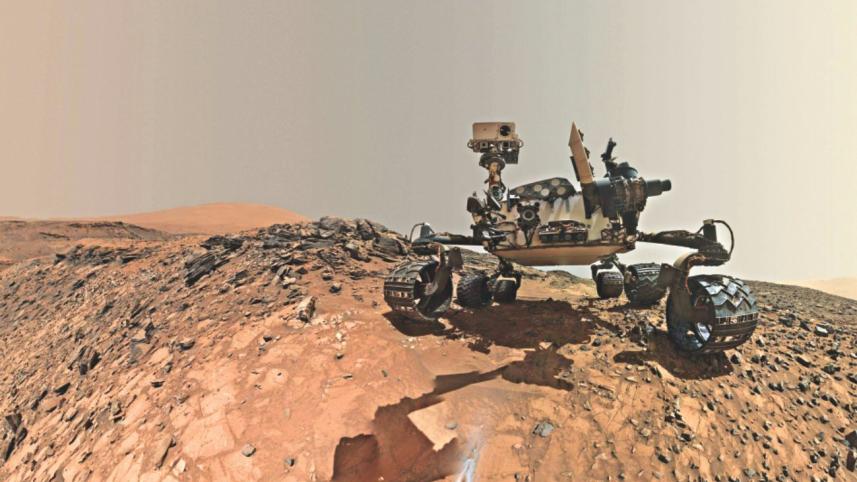
A Nasa robot has detected more building blocks for life on Mars -- the most complex organic matter yet -- from 3.5 billion-year-old rocks on the surface of the Red Planet, scientists said Thursday.
The unmanned Curiosity rover has also found increasing evidence for seasonal variations of methane on Mars, indicating the source of the gas is likely the planet itself, or possibly its subsurface water.

While not direct evidence of life, the compounds drilled from Mars' Gale Crater are the most diverse array ever taken from the surface of the planet since the robotic vehicle landed in 2012, experts say.
"This is a significant breakthrough because it means there are organic materials preserved in some of the harshest environments on Mars," said lead author of one of two studies in Science, Jennifer Eigenbrode, an astrobiologist at Nasa Goddard Spaceflight Center.
"And maybe we can find something better preserved than that, that has signatures of life in it," she told AFP.
Nasa's Curiosity rover has previously found organic matter on Mars. A smaller discovery was announced in 2014.
"This is the first really trusted detection," co-author Sanjeev Gupta, a professor of Earth science at Imperial College London, told AFP.
"What this new study is showing in some detail is the discovery of complex and diverse organic compounds in the sediments. That doesn't mean life, but organic compounds are the building blocks of life," he added.
"This is the first time we have detected such a diverse array of these sorts of things."
The compounds might have come from a meteorite, or from geological formations akin to coal and black shale on Earth, or some form of life, Eigenbrode said.
Their precise source is still a mystery. "We have detected the bits and pieces of something bigger," said Eigenbrode.
The samples were drilled from the base of Mount Sharp, inside a basin called Gale Crater that is believed to have held an ancient Martian lake.
"That is a good place for life to have lived if it ever existed on Mars," she said.
The mudstone rock was drilled from the top five centimeters (two inches) of the Martian surface and heated in a miniature analysis lab located on board the rover.
A French-built instrument revealed "several organic molecules and volatiles reminiscent of organic-rich sedimentary rock found on Earth, including: thiophene, 2- and 3-methylthiophenes, methanethiol, and dimethylsulfide," said the Science report.
 For all latest news, follow The Daily Star's Google News channel.
Comments