


A call for national cultural emancipation
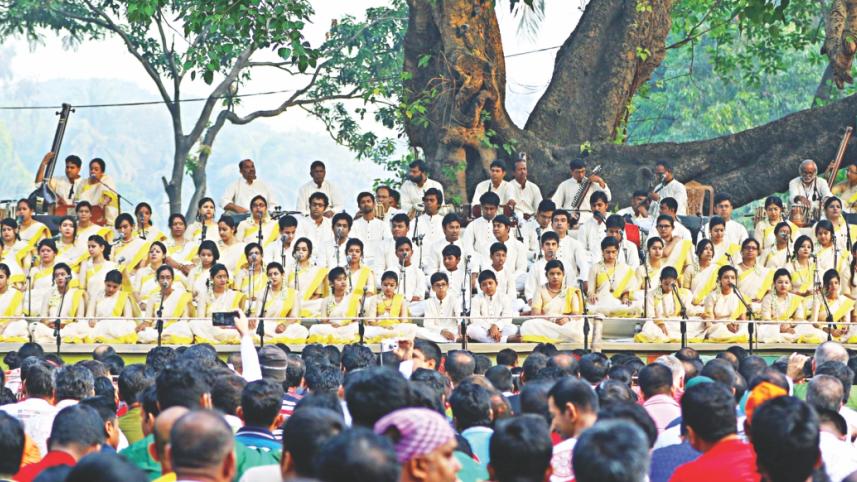
Chhayanaut, the leading cultural institution of the country, marked the Golden Jubilee of its landmark Borshoborn programmes at the Ramna Botomul, welcoming the Bangla New Year on Pahela Baishakh. Chhayanaut founder and chair Dr. Sanjida Khatun called for combined efforts to continue cultural practices and reaching out to all corners of Bangladesh to combat intolerance and religious extremism.
The programme began as per tradition with a classical instrumental recital, Rajrupa Chowdhury playing Raga Bhairav, an early morning raga, on the sarod. A number of chorus and solo songs followed – beginning with Rabindra Sangeet “Aloker Ei Jhorna-Dharay” and continuing with songs by Tagore, Kazi Nazrul Islam, Atulprasad Sen, Salil Chowdhury and Lalon Shah, among others, sung by eminent and promising singers alike: Iffat Ara Dewan, Shaheen Samad, Khairul Anam Shakil, Laisa Ahmed Lisa, Nasima Shaheen, Bijon Chandra Mistry, Chandana Majumder, and others. Syed Hasan Imam and Asaduzzaman Noor recited poems, while the musical performances came to a close with all artistes and the audience singing the national anthem in unison. “Dewana Madina”, a pala gaan by Dilu Boyati and his troupe was the last performance of the day.

In her address, Sanjida Khatun said “Our journey has been silent through the practice and propserity of our culture, not in slogans and rallies. The new generation is caught up in the tide of globalization. Let us accept that and propagate the best of our cultural achievements and on the internet, so our children can get a taste of all cultures. We must use these media for the advancement of our culture.” She also urged cultural activists to extend their activities to the remote parts of the country, to spread logical thinking to every citizen of the country. “We have neglected this part of our work and given the opportunity to those who manipulate religion to their gains to spread their messages,” she said. “The overall imancipation of Bangalees will not come if you and I are cultural-minded, but leave the rest of the country in the darkness.”
The celebrations of the Bangla New Year that Chhayanaut began in 1967 in the then East Pakistan has become the epicenter of Bangalee's biggest secular celebration of the Bangla Noboborsho in the decades that followed, overcoming hurdles like the 2001 tragic bomb blasts at the event that left 10 people dead.
Tight security measures were taken at the venue this year, to the extent which some attendees felt were a hindrance to their attendance and enjoyment of the programme, but the festive nature of Bangalees prevailed over the scorching heat, long queues and inconvenient security measures and the celebrations shone bright as ever, as a cultural beacon such as prominent as the Borshoboron deserves to.
 For all latest news, follow The Daily Star's Google News channel.
Comments