


US begins quiet diplomacy
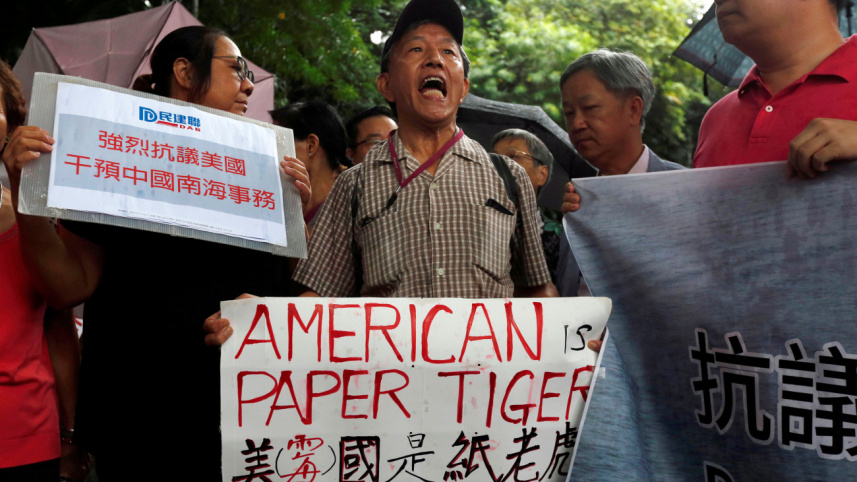
The United States is using quiet diplomacy to persuade the Philippines, Indonesia, Vietnam and other Asian nations not to move aggressively to capitalize on an international court ruling that denied China's claims to the South China Sea, several US administration officials said on Wednesday.
"What we want is to quiet things down so these issues can be addressed rationally instead of emotionally," said one official, who spoke on the condition of anonymity to describe private diplomatic messages.

Some were sent through US embassies abroad and foreign missions in Washington, while others were conveyed directly to top officials by Defense Secretary Ash Carter, Secretary of State John Kerry and other senior officials, the sources said.
"This is a blanket call for quiet, not some attempt to rally the region against China, which would play into a false narrative that the US is leading a coalition to contain China," the official added.
The effort to calm the waters following the court ruling in The Hague on Tuesday suffered a setback when Taiwan dispatched a warship to the area, with President Tsai Ing-wen telling sailors that their mission was to defend Taiwan's maritime territory.
The US officials said they hoped the US diplomatic initiative would be more successful in Indonesia, which wants to send hundreds of fishermen to the Natuna Islands to assert its sovereignty over nearby areas of the South China Sea to which China says it also has claims, and in the Philippines, whose fishermen have been harassed by Chinese coast guard and naval vessels.
Meanwhile, China yesterday warned of a "decisive response" to provocations in the South China Sea, as it faced mounting pressure to accept an international tribunal's ruling against its claims to most of the strategically vital waters.
"If anyone wants to take any provocative action against China's security interests based on the award, China will make a decisive response," foreign ministry spokesman Lu Kang said.
Southeast Asia will not issue a statement on the rejection of Chinese territorial claims in the South China Sea by an international tribunal, said regional diplomats yesterday, blaming the no-comment on pressure by Beijing.
The Association of Southeast Asian Nations (Asean) had weighed whether to speak out on Tuesday's ruling by the Permanent Court of Arbitration in The Hague, said Southeast Asian diplomats with knowledge of the matter.
But 10-member Asean, whose unity has increasingly come under strain in the shadow of Beijing's expanding presence in the South China Sea, could not find common ground on the highly sensitive issue involving its massive and powerful neighbour, they said.
"Asean officials had prepared a draft text but there was no agreement to release a joint statement," said a Southeast Asian diplomat, adding that China was believed to have leaned on its Asean allies Laos and Cambodia to prevent a statement in the highly charged affair.
"Some Asean countries are definitely not happy. Beijing's action can be seen as interference in Asean's centrality," the source said.
 For all latest news, follow The Daily Star's Google News channel.
Comments