


“We are American First, and Republican or Democratic second”

The US presidential election of 2016 will indisputably be remembered as one of the most interesting and head-turning events in the entire western political atmosphere. Other than the candidate's themselves, (whom both broke historical records of the lowest presidential candidate approval ratings) campaigns strategies, debates, and the reflection it revealed about American culture will be the topic of political and cultural analysis for a long time. Before discussing the post-election anti-Trump protests and what it says about the state of America's unity, one must realize the different factors that came together that led to president-elect Trump in the first place.
As hard as it may be to believe, Donald Trump had a clear strategy for this election, and it was to cater to the demands of not all Americans, as he made clear with his remarks, but certain groups in society on which he knew he could rely on for the vote. As a businessman would, he scoped the “market” of average voting Americans, and found many groups with demands and agendas that were not being taken seriously by the government or mainstream media. One unique group that deserves recognition consisted of both conservatives and democrats who were tired of the increasing and dominating “political correctness” culture. They wished for a politician that would speak their mind, regardless of the often vulgar and demeaning content. For these supporters, it wasn't as much of his content that they supported, but more his use of his right to freedom of speech, a fundamental pillar of American civilisation. Milo Yiannopoulos, a very famous and trendy British journalist mentioned this group in an interview with BBC, in which he coined the term “disaffected leftists”, meaning people who didn't agree with the direction their own political party was headed.

Another respectable group among the many are those who are anti-establishment, people who want an outsider more than anything in the office, instead of just another politician in the pockets of banks, monopoly-corporations, and elites. They relate and feel the effects of rising economic oppression of the middle class, and dislike the growth of wealth and power of the top 1%. A lot of these supporters supported outsider candidate Bernie Sanders, who is an outsider to the historic and traditional two party system, and felt strongly about money in politics along with income inequality. He was also found to be a victim of an unfair democratic chance, along with media-driven voter oppression, which worried some about Trump experiencing the same fate. Donald Trump also exploited existing propaganda about Muslims and used a technique in politics called “scapegoating” which is the act of shifting blame upon innocents for the simple reason of having a societal “villain” to fight. This negative painting of all those associated with Islam also created an anti-refugee mentality in America, which resonated with those who also felt strongly about immigration, specifically Mexican, and what it meant for the job market.
Economic globalisation, the outsourcing of production that American companies continue to lower production costs, the unfair treatment that America experiences from NATO and NAFTA, and mainly immigration, only became part of the debates because Donald Trump brought them in. Not only did Trump speak about these issues, he did it to the degree to which it became the deciding issues of the election, and when candidates have power over what issues decide the winner, it gives them a lead advantage in the race for the white house.
While Trump was finding new ways to attack, Hillary was stuck in the past defending and countering attacks from the previous week. However, it was not just Trump himself that got him to power, a good percent of it was those who opposed Hillary and her shortcomings with enough passion to vote for Trump. Her email scandal, the FBI investigation she was in the middle of, the “robotic and fake” vibe that she gave out, the DNC rigging against Bernie Sanders she was involved in, and the constant name-calling, degrading and “mud-slinging” her campaign spewed against Trump did not have the effect they wanted. In fact, the opposite, as it only angered and turned away potential Hillary supporters to Trump.
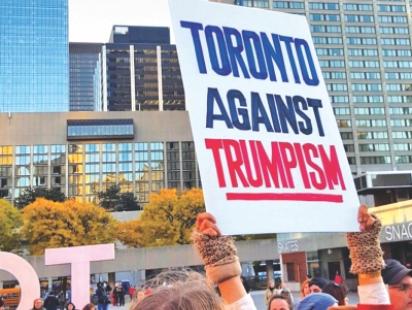
Post-election, a sizeable amount of Americans erupted at the results, shocked to realize how such an unqualified man of questionable character could be the leader of the free world in 2016, following almost a decade of progressive democratic leadership. The biggest force driving the protest is the opinion that the popular vote should be used to decide the president, instead of the Electoral College. This drive is mainly a big misunderstanding about the Electoral College. The founders of America never wanted a pure democracy, for an immense study in history will show the failures of pure democracies, as they allow the majority to easily tyrannize the rest of the nation. If the election was based on the popular vote, a politician would just cater to the people who live in large populated cities, and would ignore the needs and problems of those in rural areas. The founders took this in consideration when creating the Electoral College. In this system, every state has democratic and republican representatives, which are elected by the people in the state.
If you voted trump, you didn't really vote for trump, you voted for a representative who will vote for trump on your behalf. Even though the amount of representatives per state are influenced by the population, all the big city states together would not have the 270 electoral votes required to win the white house. This forces candidates to base their campaign and their policies nationwide, making for a better, more inclusive government. When you disconnect Trump from the white house, it becomes easier to protest, but when you realize that the US and all it stands for, and Donald trump are not two separate identities anymore, but in fact one, it makes more of a challenging moral concept. Freedom of assembly and freedom of protest are not only important, but a cornerstone of a truly free country made with the citizens in mind. Although I began as a Bernie supporter, and then to Gary Johnson, not accepting results of a fair democratic election will only divide the country further, when what it needs is unity. America may not need Donald Trump, but America has decided to pick him, so at the very least, Donald Trump is the president America deserves.
 For all latest news, follow The Daily Star's Google News channel.
Comments