


National Genocide Remembrance Day: The night the searchlight blinded justice
History often remembers wars through the cold geometry of maps and the sterile ink of treaties, but for those who survived the tempest of 1971, history is a haunting sensory memory—the acrid scent of gunpowder mingling with the first rains of spring, and the terrifying, rhythmic clatter of tanks as they invaded the narrow, sleeping arteries of Dhaka.
On the fateful night of March 25, 1971, a military campaign was unleashed under the chillingly ironic title “Operation Searchlight.” While the name suggests a quest to illuminate, its reality was a brutal, systematic attempt to extinguish the torch of a burgeoning democracy and the indomitable spirit of a nation. When the West Pakistan military issued orders from a couple of thousand miles away, they were aiming at the very heart and soul of the Bangalee people, attempting to erase a culture which refused to bow.
 For all latest news, follow The Daily Star's Google News channel.
 The tragedy of that dark night lay in its cold, clinical precision. It was a calculated, murderous strike designed to break our collective will. The primary targets were not fortified military installations, but the intellectual and cultural sanctuaries of our land. At Dhaka University, the “searchlight” fell upon dormitories where our brightest students and most revered professors—the visionary architects of our future—were hunted down the corridors of learning, treated as enemy combatants in the very rooms where they dreamt of a free tomorrow. The soil of the campus, once a garden of knowledge, was soaked in the blood of those whose only weapon was their conviction.
The arrest of Bangabandhu Sheikh Mujibur Rahman shortly after midnight was intended as a decapitation strike to silence the voice of the masses. The aggressors relied on a simple logic: remove the leader and the dream of freedom dies. But the planners of Searchlight committed the ultimate error of all authoritarian regimes—they mistook a single leader for the heartbeat of an entire population.
The historical significance of that night is etched in blood and tears; a permanent scar on the conscience of the world. It was the precise moment when the fragile attempt of a unified Pakistan shattered forever, and the glorious, sovereign reality of Bangladesh was baptised in the ultimate sacrifice. Operation Searchlight was the catalyst for a humanitarian catastrophe of staggering proportions, forcing nearly one crore souls—mothers clutching infants, elderly men carrying the weight of their ancestors—to flee across the border in a desperate, heart-wrenching exodus for survival.
Despite the sheer scale of the atrocities—with a death toll that remains a scar on human history, estimated to be between 300,000 and 30 lakh—March 25 remains a national Genocide Remembrance Day in Bangladesh rather than a globally recognised UN observance. The path to international justice has been obstructed by a complex web of Cold War legacies, legal technicalities, and the cold calculations of modern realpolitik.
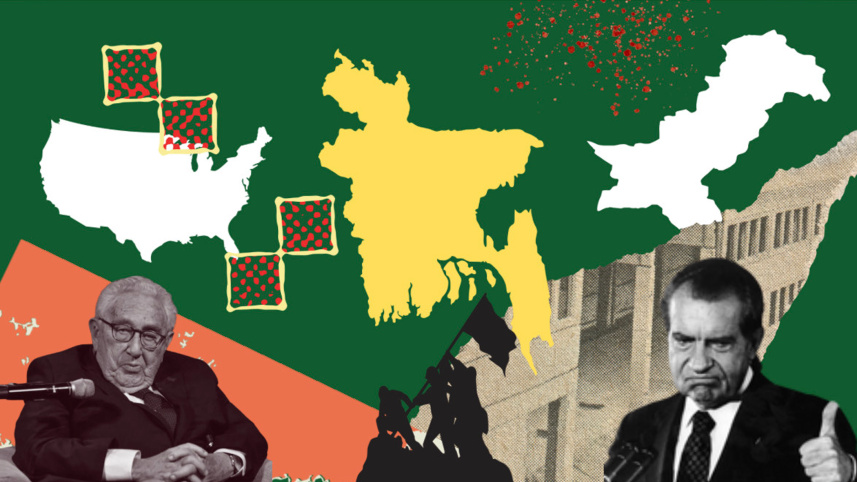
In 1971, the UN Security Council was paralysed by a “clash of titans.” The United States (under the Nixon-Kissinger administration) and China viewed Pakistan as a strategic bridge for their secret diplomatic opening. Consequently, they used their immense influence to frame these horrors not as a genocide, but as an “internal matter,” which would have done little to stop the violence. Vetoed by the Soviet Union, the resolution at the Security Council could not be passed. The UN was once again a stage for powerplay rather than a sanctuary for the oppressed.
A primary obstacle to early international condemnation was the unyielding stance of US leadership as then President Richard Nixon and National Security Advisor Henry Kissinger maintained a notorious “tilt” towards Pakistan, prioritising their secret intermediary, Yahya Khan, over the lives of millions. Declassified White House tapes and documents reveal a haunting truth: Kissinger famously brushed aside the moral outcries of his own diplomats, viewing the carnage through the cold lens of realpolitik by refusing to name it a genocide.
While then UN Secretary-General U Thant described the events as “one of the most tragic episodes in human history,” the UN as an institution remained a bystander. The organisation prioritised the abstract concept of state sovereignty over the lived reality of human suffering—a failure that preceded the Responsibility to Protect doctrine by decades.
The UN currently observes December 9 as the International Day of Commemoration and Dignity of the Victims of the Crime of Genocide. This date marks the 1948 signing of the Genocide Convention as the UN favours universal dates of remembrance to avoid “politicising” the calendar. To date, the UN has not officially recognised the 1971 genocide in Bangladesh.
The lack of a “unified” international forensic record, worsened by the systematic expulsion of foreign journalists during Operation Searchlight, has allowed revisionists to muddy the waters. Yet, documentation remains undeniable; the University College London (UCL) Fact Sheet estimates that up to 200,000 were slaughtered in the initial phase alone. Furthermore, the “Blood telegram” sent by US Consul General Archer Blood on April 6, 1971 remains a definitive witness which explicitly used the word “genocide” to describe the systematic erasure of the Hindu minority and Bangalee intellectuals.
Hope, however, is not lost. In 2023, the International Association of Genocide Scholars (IAGS) passed a landmark resolution formally recognising the 1971 atrocities as genocide. Most significantly, on March 20 this year, US Congressman Greg Landsman introduced House Resolution 1130 to the US House of Representatives. This historic resolution calls on the US government to formally recognise the 1971 atrocities—specifically those directed towards Bangalee Hindus, intellectuals, and students—as genocide, war crimes, and crimes against humanity. The resolution creates a framework for future US foreign policy in South Asia, and by formally using the term “genocide,” the House aligns with the UN Convention on the Prevention and Punishment of the Crime of Genocide. This strengthens the legal basis for future international tribunals or reparations discussions. Together with the 2022 House Resolution 1430 to officially label the actions of the Pakistani military as genocide, the bills call on the Pakistan government to formally apologise to the people and government of Bangladesh, acknowledge its own role in the atrocities, and prosecute any surviving perpetrators in accordance with international law.
While these resolutions are significant for historical and diplomatic recognition, they are still “simple resolutions,” meaning they express the “sense of the House” but neither carry the force of law nor mandate specific executive action unless adopted and followed by further legislative steps.
As we look back through the mist of history, we realise that March 25 was not merely a conflict of geography or “East versus West.” It was a trial of fire for our shared values—a clash between the fundamental right to exist and the cruel hand of oppression. It was the moment the river delta found its voice: a voice that sang of liberation even as it wept for its fallen.
The searchlights of 1971 were meant to blind us with fear. Instead, they ignited a fire of patriotism that guided us to liberty. We owe it to all the martyrs of the Liberation War and every nameless soul massacred during the nine months of the war to ensure their story is told with the honour it deserves. Bangladesh did not just survive; she was born of a fire that cannot be put out.
Tanziral Dilshad Ditan works in communications.
Views expressed in this article are the author's own.
Follow The Daily Star Opinion on Facebook for the latest opinions, commentaries, and analyses by experts and professionals. To contribute your article or letter to The Daily Star Opinion, see our guidelines for submission.
Comments