


Malaysia should relax criteria for recruiters
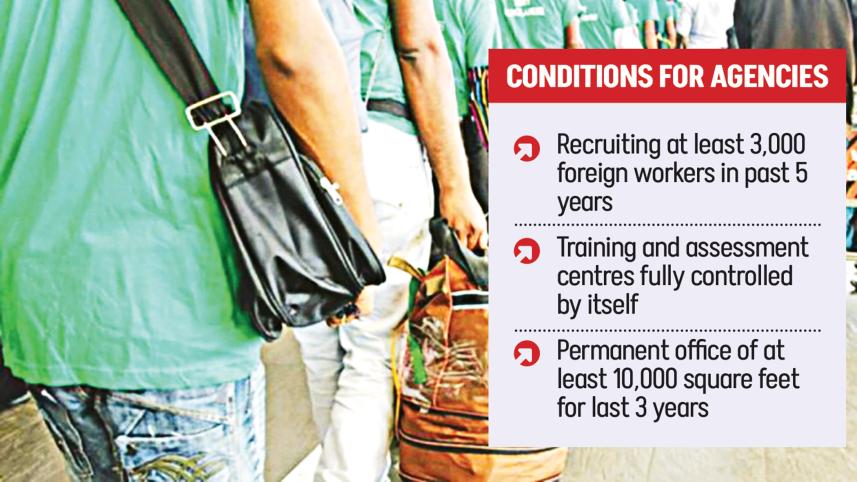
The concerns raised by migration experts, industry insiders, and government officials over Malaysia's new criteria for selecting Bangladeshi recruiting agencies are quite justified. According to a report, of the 10 conditions Malaysia has set for a fresh round of labour intake, seven seem reasonable and can be fulfilled by many of our more than 2,000 licensed agencies. These include having a valid licence for five years, experience of sending workers to at least three countries, a certificate of good conduct, having no record of forced labour, trafficking, extortion, money laundering, or labour-law breaches, and written employer testimonials. It is the remaining three conditions that have raised red flags, however.


Requiring an agency to have recruited at least 3,000 workers in the last five years, to operate training and assessment centres under its sole control, and to maintain a permanent office of at least 10,000 square feet for the last three years are requirements that few can meet. Not only are they impractical, but they are also unnecessary. For example, the training centre requirement is redundant as Malaysia itself doesn't mandate specific training, as per a former joint secretary of the Bangladesh Association of International Recruiting Agencies (BAIRA). This could instead inflate recruitment costs that already soared to Tk 450,000-600,000 despite a government cap of Tk 79,000 prior to the 2024 market closure.
Likewise, the large office-space requirement seems unnecessary as it has no proven link to recruitment quality or workers' protection. The 3,000-worker threshold is equally unrealistic for most local recruiters considering the disruptions caused by Russia-Ukraine war, global economic downturn, long-running syndication in the Malaysian labour market, and the closure of labour channels by some key destination countries in recent years. Against this backdrop, it is perfectly reasonable that the harsh conditions have raised fresh fears of syndication, concentrating power in the hands of a few large recruiting agencies while depriving the wider sector of fair competition and workers of meaningful protection.

We simply cannot afford a repeat of the 2016-18 and 2022-24 syndicate eras when a handful of agencies, reportedly backed by influential actors in both countries, monopolised the market, drove migration costs to unbearable levels, and ultimately contributed to Malaysia halting recruitment altogether, citing widespread labour exploitations. Enforcing those new conditions would be putting "old wine in a new bottle," as a migration researcher called it while speaking with this daily. Reportedly, Malaysia had initially sought a list of compliant agencies by November 15 but extended the deadline later. So far, about 1,000 agencies applied for selection, and the expatriates' welfare ministry shortlisted roughly 500. While the ministry has requested Malaysia to review the three contentious conditions, concerns about the new criteria very much remain.
We, therefore, urge the Malaysia government to revisit and redesign the selection process in a way that ensures fairness without complicating the process unnecessarily or making it susceptible to syndication risks. Bangladesh, for its part, must also rigorously vet its own recruiters, enforce cost ceilings, and prioritise worker welfare in its negotiations. Only a fair, competitive, and accountable recruitment system can help prevent the kind of exploitations that often haunted our workers in Malaysia and some other markets.
 For all latest news, follow The Daily Star's Google News channel.
Comments