


Youth upskilling in the age of AI: where to begin?
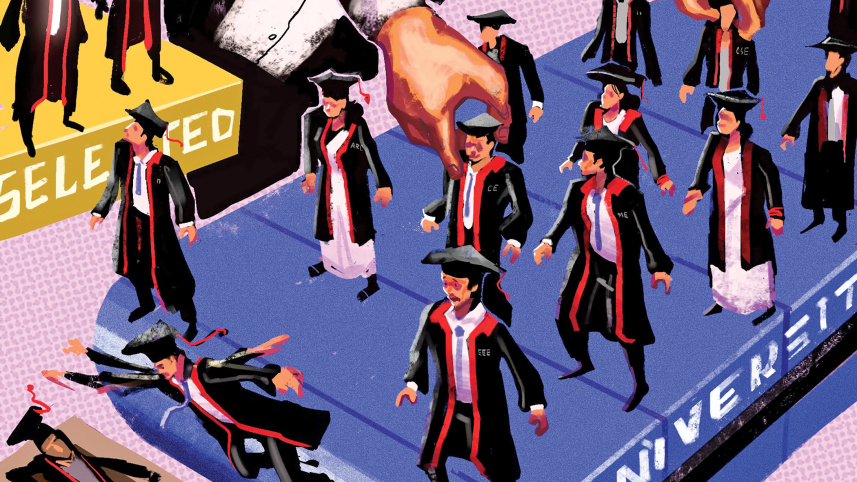
For today’s youth, the future no longer arrives quietly. It updates itself overnight; one morning, you wake up to find that a task you spent years learning can now be done by a machine in seconds, and by evening, there is a new tool promising to do even more.
Today, a four-year degree no longer guarantees a job. In fact, in 2024, Bangladesh had around nine lakh unemployed graduates. With artificial intelligence (AI) creeping into our lives, more entry-level jobs are bound to disappear. For young people in Bangladesh and across the world, this has created a peculiar mix of anxiety.

While AI offers unprecedented access to knowledge, productivity, and global opportunities, it has also unsettled the old promise that education naturally leads to stable employment. Basically, degrees still matter, but they no longer guarantee relevance.
Hence, upskilling, once a corporate buzzword, has now become a survival strategy in the age of AI and rapidly evolving technology. But when everything seems important, where does one even begin?
Understanding the shift before chasing skills
The first mistake many young people make is treating AI as a list of tools to master rather than a structural change to understand. Learning how to use one popular platform may help today, but it offers little protection tomorrow.
What AI is really doing is automating routine work, accelerating decision-making, and raising the baseline of what is considered “basic competence”. In practical terms, this means tasks that are predictable, repetitive, and rules-based are disappearing fastest. At the same time, roles that require judgment, creativity, context, and human connection are becoming more valuable.
For instance, data entry jobs are disappearing because they are repetitive and rules-based. However, leadership roles are now in demand because you need excellent leadership skills to navigate the changing dynamics of the workplace and work culture.
Upskilling, therefore, is not about racing machines at what they do best, but about leaning into what they cannot easily replicate. So, before signing up for yet another online course, young learners need to ask a more fundamental question: what kind of thinking does this skill train?
Digital literacy is no longer optional
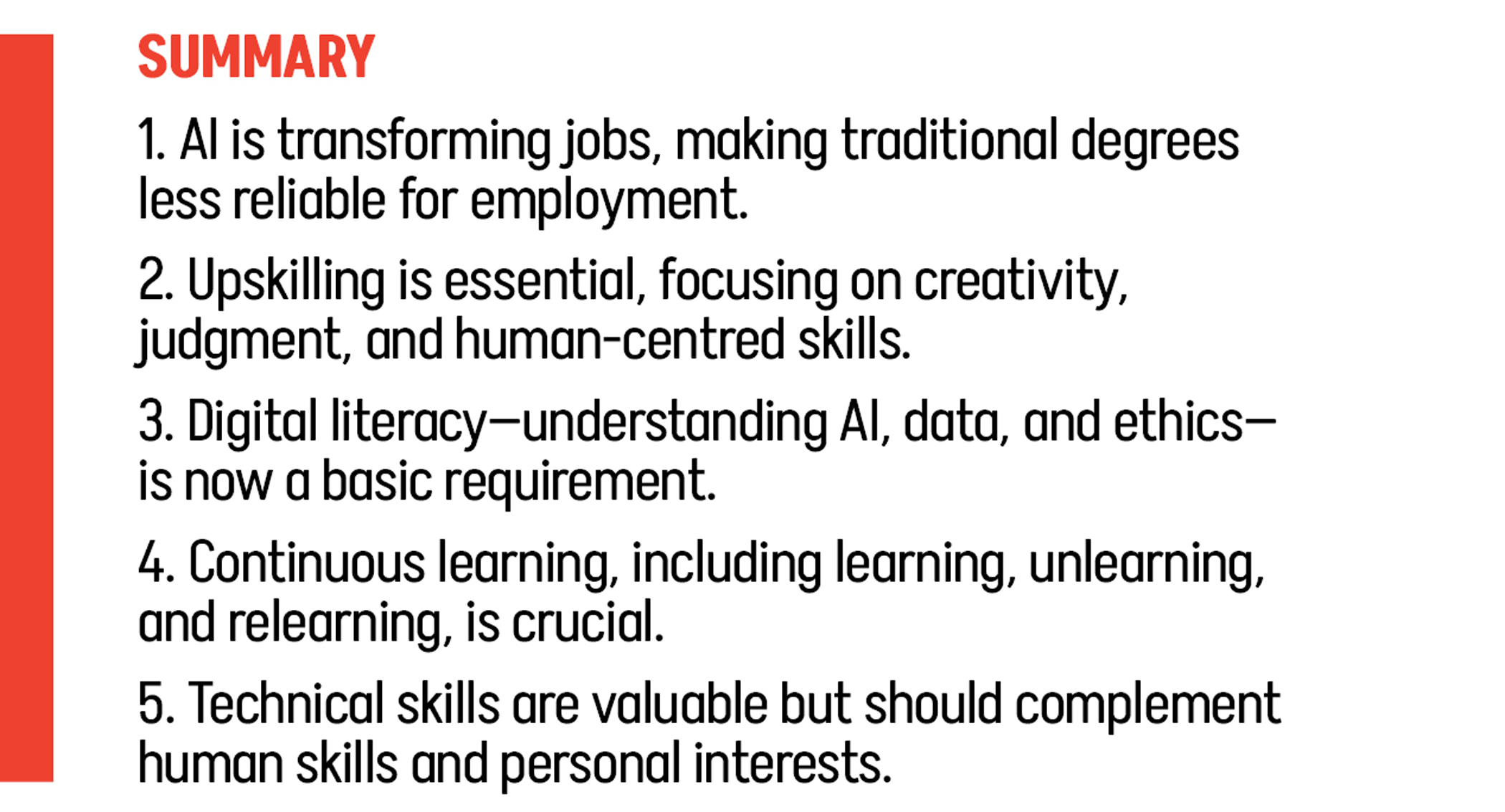
If you think that the starting point for upskilling in the age of AI is advanced coding or machine learning, you’re wrong. Basic digital literacy is where you start your upskilling journey in this age. This includes understanding how algorithms work at a conceptual level, how data is collected and used, and how digital platforms shape behaviour and decision-making.
Many young people in our country, as well as around the world, use AI tools daily without understanding their limitations. Be it ChatGPT or an AI image generator, they trust outputs without questioning sources, assume neutrality where there is bias, and confuse fluency with accuracy.
Digital literacy is as essential as reading and writing once were. This does not mean everyone must become a programmer. It means everyone must become an informed user. Knowing when to rely on AI, the ethics behind using AI, when to double-check, and when to apply human judgment is a skill in itself one that employers increasingly value.
Learning how to learn again
Perhaps the most underrated skill in the AI era is the ability to learn continuously without formal instruction. Traditional education trained students to complete syllabi, sit exams, and move on. Bangladeshis, in particular, are fixated on this education model, thinking that this approach is what will guarantee skills and, eventually, jobs.
The new reality, however, demands something different. It requires self-directed learning, rapid adaptation, and intellectual humility. That’s why employers today are having to train their employees in using AI for daily work tasks. Employees themselves are working out ways to accommodate AI tools in their day-to-day workflow.
Young people who are curious can succeed in such an environment, where continuous learning is a core component. They experiment with new tools, follow emerging trends, and are comfortable being beginners repeatedly. This mindset shift can be difficult, especially in cultures where failure is discouraged and linear career paths are celebrated.
Also, upskilling today does not happen once. It happens in cycles. You learn, apply, unlearn, and relearn. A tool or algorithm you used yesterday will start becoming irrelevant today and become completely irrelevant by tomorrow. Hence, you learn, unlearn, and relearn. That is how you have to approach upskilling in the age of AI.
Human skills will never lose value
 For all latest news, follow The Daily Star's Google News channel.
 Communication, critical thinking, collaboration, adaptability, and ethical reasoning are no longer treated as soft skills that are simply tucked away in job descriptions. They have turned into core competencies in the AI era.
Think about it: an AI system can generate content, but it cannot read a room. It can analyse data, but it cannot understand social nuance or moral consequence.
For youth upskilling, this means investing time in skills that are transferable across roles and industries. Writing clearly, thinking logically, working with diverse teams, and managing uncertainty will remain valuable regardless of how technology evolves.
Technical skills still matter
None of this is to say technical skills are irrelevant. On the contrary, technical literacy has become a powerful enabler. Skills such as data analysis, basic coding, digital marketing, UI/UX design, and AI tool integration can significantly expand opportunities.
The key is to learn these skills with purpose, not panic. Chasing every trending technology leads to shallow competence and burnout. Instead, young people should identify how technical skills complement their existing interests or academic backgrounds.
A student of economics who learns data analytics gains analytical depth. A journalism student who understands AI-assisted research gains speed and reach. A business graduate who understands automation gains a strategic advantage. Upskilling works best when it builds on a foundation, not when it tries to replace one overnight.
Institutions are lagging; individuals cannot afford to
One uncomfortable truth is that formal education systems are struggling to keep pace with technological change. In Bangladesh, especially, curricula move slowly, while AI evolves rapidly. This gap leaves students underprepared for the realities of modern workplaces.
But waiting for institutions to catch up is a luxury young people cannot afford. The most effective upskilling today happens outside classrooms: through online platforms, open-source communities, internships, freelancing, and self-initiated projects.
Thankfully, institutions are starting to catch up. For instance, many universities in Bangladesh now offer courses and programmes on AI, data science, and so on. It’s a welcome shift from the traditional computer science programmes that focus on generalised courses and topics.
That being said, those who have already graduated or are looking to stay ahead of the curve need to take it upon themselves to keep learning new things.
Ethics and responsibility
Upskilling in the age of AI is not only about employability. It is also about responsibility. As young people gain access to powerful tools, questions of misuse, misinformation, bias, and environmental cost become unavoidable.
Understanding AI ethics, data privacy, and social impact is not reserved for policymakers and technologists. It is part of being an informed citizen in a digital society. Youth who engage critically with these issues will be better prepared to shape technology, rather than simply adapt to it.
Where should the youth begin?
In the age of AI, youth upskilling begins with awareness. Understand how AI is reshaping work and society, build digital literacy, and strengthen human skills that machines cannot replace. At the same time, choose technical skills strategically, not impulsively.
Remember: there is no single roadmap when it comes to upskilling in the modern day. Young people need not know everything, but they must remain open to change, adaptable, and willing to grow.
Comments