


When electoral symbols were still up for grabs

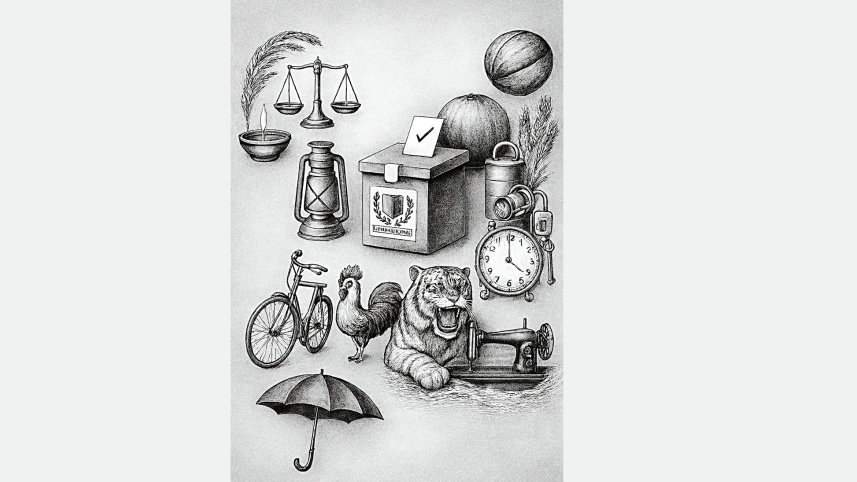
There was a time when the boat was not confirmed for the Awami League, nor was the paddy sheaf the BNP’s permanent symbol.
Electoral symbol distribution was not always as straight forward as it seemed yesterday when the election office finalised 118 symbols for the candidates without any notable discontent.

In the case of the National Citizen Party’s demand for the water lily, after months long dispute with the Election Commission, the party finally settled on the water lily bud in November 2025.
THE FIRST DISPUTES: 1973
The debate over symbols began even before the country’s maiden parliamentary election. Both the Awami League (AL) and the Jatiya Samajtantrik Dal (JSD) demanded the boat.
On January 25, 1973, the EC met political parties to reserve the symbols. The commission adopted the principle that a party which had used a symbol in the previous election would have prior right in the next election. Based on this principle, the EC allocated the boat to the Awami League.
Barrister Aleem-Al-Razi, representing the National Awami Party (Bhasani), opposed this decision. He argued that the terms “last election” and “existing political party” had no application, as this was Bangladesh’s first election and all political parties should be considered new. Since both the AL and the JSD were new parties, he said, the symbol should be allocated through a coin toss.
Aleem’s contention was supported by JSD representative Shajahan Siraj, Bangla Jatiya League representative Oli Ahad, and several other party representatives.
Tofail Ahmed, representing the Awami League, countered that his party had existed prior to independence and had used the boat in the preceding election. Therefore, he argued, the Awami League had a rightful claim to the symbol.
The EC ruled that the JSD was a newly formed party and that there was no question of a coin toss. It allocated the boat to the Awami League and its nominees. The JSD challenged the decision in the High Court, which dismissed the petition and upheld the commission’s decision.
Meanwhile, the sheaf of paddy was allocated to the National Awami Party (Bhasani) under the same prior-use principle.
BNP GETS PADDY SHEAF: 1979
According to reports, around 50 parties applied for symbols ahead of the 1979 parliamentary election. The newly formed Bangladesh Nationalist Party (BNP), along with 16 other parties, demanded the paddy sheaf.
The NAP (Bhasani) had used paddy sheaf in 1973. Major General Ziaur Rahman had also used it in the 1978 presidential election as a nominee of a six-party alliance, the Jatiyatabadi Front.
This front included the Jatiyatabadi Ganatantrik Dal, NAP (Bhasani) led by the late Mashiur Rahman, United People’s Party, Bangladesh Muslim League led by Shah Azizur Rahman, Bangladesh Labour Party, and Bangladesh Tafsili Federation.
Applicants for the paddy sheaf fell into four groups including BNP and four factions of NAP (Bhasani) -- NAP-B (Nurur Rahman and Zahid), NAP-B (Gazi), NAP-B (Naser), and NAP-B (Bazlus Sattar), among others.
To reach a fair decision, the chief election commissioner invited all parties to present their arguments.
BNP’s Maudud Ahmed told the commission that party chair Ziaur Rahman had contested the 1978 presidential election as a nominee of the Jatiyatabadi Front. He said NAP (Bhasani) was registered and recognised under the Political Parties Regulation, 1976, and was a component of the Front.
Maudud argued that this NAP (Bhasani) had used the paddy sheaf in the 1970 and 1973 elections and had formally applied to the EC to allocate the symbol to Ziaur Rahman during the presidential election.
A dispute arose over which election should be considered the “last election” -- the 1978 presidential election or the 1973 parliamentary election. The CEC clarified that, as the EC conducts both presidential and parliamentary elections, the 1978 presidential polls should be regarded as the last election.
 For all latest news, follow The Daily Star's Google News channel.
 Representatives of NAP-B factions -- Gazi Shabidullah, Naser Khan Bhasani, and Sakhawat Ali Sikdar -- opposed BNP’s claim. They argued that NAP (Bhasani) had been dissolved upon merging into the BNP and that the existing NAP-B factions were the true successors to the original party and therefore entitled to the paddy sheaf. They further asked the commission to allow the NAP-B factions to determine the rightful claimant among themselves.
The CEC noted that the only registered NAP (Bhasani) was the one led by Mashiur Rahman, which had been a component of the Jatiyatabadi Front that sponsored Ziaur Rahman as its presidential candidate.
He said the EC had widely publicised the allocation of the paddy sheaf to a presidential candidate and none of the NAP-B factions had protested either to the EC or in the media. By their silence, he said, they had waived their claim under the legal doctrine of waiver and acquiescence.
He also stated that determining the true successor of the original NAP (Bhasani) was a matter for the courts, not the EC.
After hearing all submissions and without an amicable settlement, the EC relied on the doctrine of prior use. Since Ziaur Rahman had used the symbol as chair of the Jatiyatabadi Front and was now seeking the same symbol, the commission allocated the sheaf of paddy to the BNP.
THE PLOUGH AND THE BOAT: 1986
Ahead of the 1986 polls, 33 parties sought election symbols. Eight parties, including the Jatiya Party, applied for the plough. Three parties -- Jamaat-e-Islami Bangladesh, Bangladesh Islami Andolan, and Bangladesh Bekar Samaj -- sought the scales.
The Awami League and Bangladesh Krishak Sramik Awami League (BaKSAL) applied for the boat.
The scales were allotted to Jamaat-e-Islami, as it was their first preference. This was the first time since independence that Jamaat participated in an election under its original name.
As for the plough, there were eight applicants, six of which had already adopted other symbols.
The remaining claimants were the Jatiya Party (JP) and the Bangladesh Jatiya League (BJL). Advocate Gias Uddin, representing the BJL, stated that the plough was previously reserved for his party and used in earlier elections. Therefore, it should not be allocated to any other party.
At this stage, JP Secretary General Professor MA Matin argued that the Jatiya League had merged into Jana Dal, which had then become the JP.
He emphasised that the JP was the largest political party in the country and had nominated candidates in all constituencies. Thus, legally, the plough belonged to the JP. He also stated that the claim of a larger party should prevail over that of a smaller party. The commission then reserved the plough for the JP.
PERMANENT SYMBOL ALLOCATIONS
The AL, BNP, and Jamaat did not participate in the 1988 polls. In the 1991 election, following discussions and settlements, the paddy sheaf went to the BNP, the plough to the JP, the boat to the AL, and the scales to Jamaat.
This allocation continued in the 1996 (June) and 2001 elections.
A dispute over the plough between HM Ershad and Anwar Hossain Manju in a 1999 by-election was resolved by the High Court in favour of Ershad’s JP.
Ahead of the 2008 polls, the EC introduced party registration and formally reserved symbols in same manner as in 1991, reserving the plough for Ershad’s JP.
Comments