


Policy dialogue: Insaf, dignity, shared prosperity
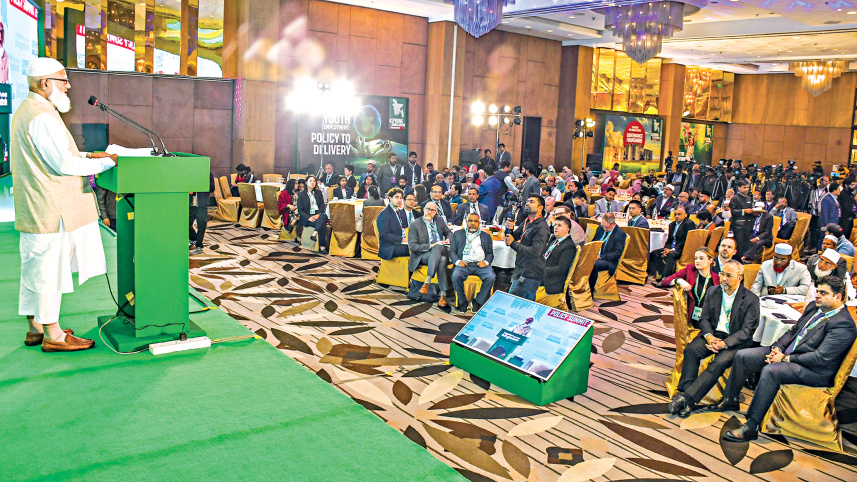
Bangladesh Jamaat-e-Islami yesterday announced a series of policy commitments at its “Policy Summit 2026”, outlining proposals on governance, taxation, social security, employment, education and healthcare, while pledging zero tolerance for corruption if it comes to power.
At an event attended by diplomats, politicians, academics, industrialists, journalists and members of civil society, Jamaat Ameer Shafiqur Rahman laid out his party’s vision for a “new and prosperous Bangladesh”.

“Bangladesh could be rebuilt on insaf, dignity and shared prosperity,” he said at the inauguration of the event themed “Aspiring Bangladesh” held at InterContinental Dhaka.
He argued for a shift in economic thinking, saying employment must be treated as a public priority, informal work gradually formalised, labour rights enforced and welfare viewed as “social infrastructure” and not charity.
Shafiqur also stressed partnerships between the state and citizens, the public and private sectors, and Bangladesh and the international community.
Under its fiscal proposals, Jamaat said it would gradually reduce tax and value-added tax (VAT) from current rates, with a long-term target of lowering tax to 19 percent and VAT to 10 percent.
The party also announced plans to introduce a ‘Smart Social Security Card’, integrating National Identity (NID), Taxpayer’s Identification Number (TIN), health services and social welfare benefits into a single platform.
For industries, gas, electricity and water charges would not be increased over the next three years. It also pledged to reopen closed factories through public-private partnership arrangements, with 10 percent ownership allocated to workers.
For the agricultural sector, the party proposed interest-free loan facilities for farmers.
Under a Qard-e-Hasana scheme, five lakh graduates would receive interest-free loans of up to Tk 10,000 per month for a maximum period of two years after graduation or until they secure employment.
The party announced interest-free education loans of Tk 10,000 per month for one lakh students based on merit and financial need.
It also said 100 students each year would be provided interest-free loans to study at leading global universities, including Harvard, MIT, Oxford and Cambridge, with the aim of supporting meritorious students from low-income families.
The party further announced plans to merge Eden College and Begum Badrunnesa College to establish what it described as the world’s largest women’s university.
On healthcare, the party pledged free medical services for citizens aged over 60 and children under five, alongside plans to establish specialised hospitals in all 64 districts.
In its proposed “First Thousand Days Programme”, Jamaat said it would ensure primary healthcare and nutrition security for mothers and children from pregnancy until a child reaches the age of two. This initiative would be brought under the social security framework.
Tracing Bangladesh’s political journey since 1947 and 1971, the Jamaat chief said the promise of independence -- political freedom, economic justice and human dignity -- remained unfulfilled even after more than five decades.
“Democratic institutions have weakened, accountability has eroded and citizens have too often been denied their rightful voice,” he said, while blaming governance failures and authoritarian practices over the past 17 years for hollowing out institutions and shrinking democratic space.
Referring to the July uprising, he said young people once again rose to reclaim their rights and future.
“After a dark period of authoritarian rule, we now stand in a phase of democratic transition,” said Shafiqur, who is contesting in the election from Dhaka-15.
Turning to the economy, he said Bangladesh’s challenge today was “not survival, but stability”.
 For all latest news, follow The Daily Star's Google News channel.
 “Growth alone is no longer sufficient. Economic success must be measured by whether people can plan their lives with confidence, provide for their families with dignity and participate meaningfully in society.”
He pointed to unemployment, inflation and the dominance of insecure informal work, saying young graduates struggled to convert education into opportunities and women continued to face barriers.
He underscored women’s role in nation-building, saying expanding women’s participation was “not only a matter of justice; it is an economic necessity”.
At the same time, Bangladesh possessed “enormous potential”, he said, citing the country’s young and industrious workforce, migrant workers, global diaspora and strategic geographic position.
On governance, the Jamaat chief said good governance was central to transformation and pledged “zero tolerance against corruption”.
To flesh out its plan, the party organised in-depth discussions across six separate sessions: Strategy for Bangladesh: Governance Framework; Promoting Prosperity: Economy, Business and Investment; Youth Employment: Unleashing the Power of Gen Z and Alpha; Delivering on Equity: Women and Inclusion in Action; Education for the Future: Policy for Change; and Health Matters: Policy for Transformation. Each session also featured a question-and-answer segment.
In the first session of the summit, Dilara Choudhury, a former professor and chair of Jahangirnagar University’s department of government and politics, asked how women’s participation in the highest policymaking forum could be ensured.
In response, Dewan AH Alamgir, the session’s keynote speaker, said: “Women’s participation in politics needs to be increased further. Depending on education, access to opportunities and their preferences, women’s participation in the economy and politics can be expanded.”
Responding to another question on why the party had not nominated any women candidates in the upcoming national election, Jamaat’s Nayeb-e-Ameer Syed Abdullah Mohammad Taher said: “Jamaat has no objection to direct representation of women. At the Consensus Commission, a proposal has been placed to field women candidates directly in five percent of the seats. Jamaat agrees with this. The party will implement it gradually.”
In the same session, Debapriya Bhattacharya, distinguished fellow at the Centre for Policy Dialogue, asked how Jamaat planned to finance and meet the costs of the promises it was making.
In reply, Alamgir, a development consultant and member of Palli Karma-Sahayak Foundation’s general body, said the matter would be discussed in detail in the next session.
Alongside Jamaat’s top leaders, others in attendance included human rights activist Nur Khan Liton; senior Supreme Court lawyer Shahdeen Malik; former MP Akhtaruzzaman; Ibn Sina Trust member (Administration) AKM Sadrul Islam; The Daily Star Editor Mahfuz Anam; Prothom Alo Executive Editor Sajjad Sharif; veteran editor Abul Asad; Naya Diganta Editor Salahuddin Muhammad Babar; The New Nation Editor Mokarram Hossain; and Manabkantha Editor Mohammad Shahidul Islam, among others.
Diplomats of the US, the UK, China, India, Pakistan, Kosovo, Turkey, Malaysia, Sri Lanka, Brunei, Australia, Italy, Denmark, Singapore, the Philippines, Indonesia, the Maldives, Iran, Canada, Palestine, Afghanistan, Libya, Algeria, the EU, France, Germany, Japan, Norway, Sweden, the Netherlands, South Korea, Bhutan, Thailand, Switzerland, Spain, Brazil, the UN, UNDP and IRI were present.
Comments