


Business community wants well-defined economic roadmap



Political parties need to prioritise law and order, macroeconomic stability, and ease of doing business in their election manifestos, say business leaders and trade bodies.
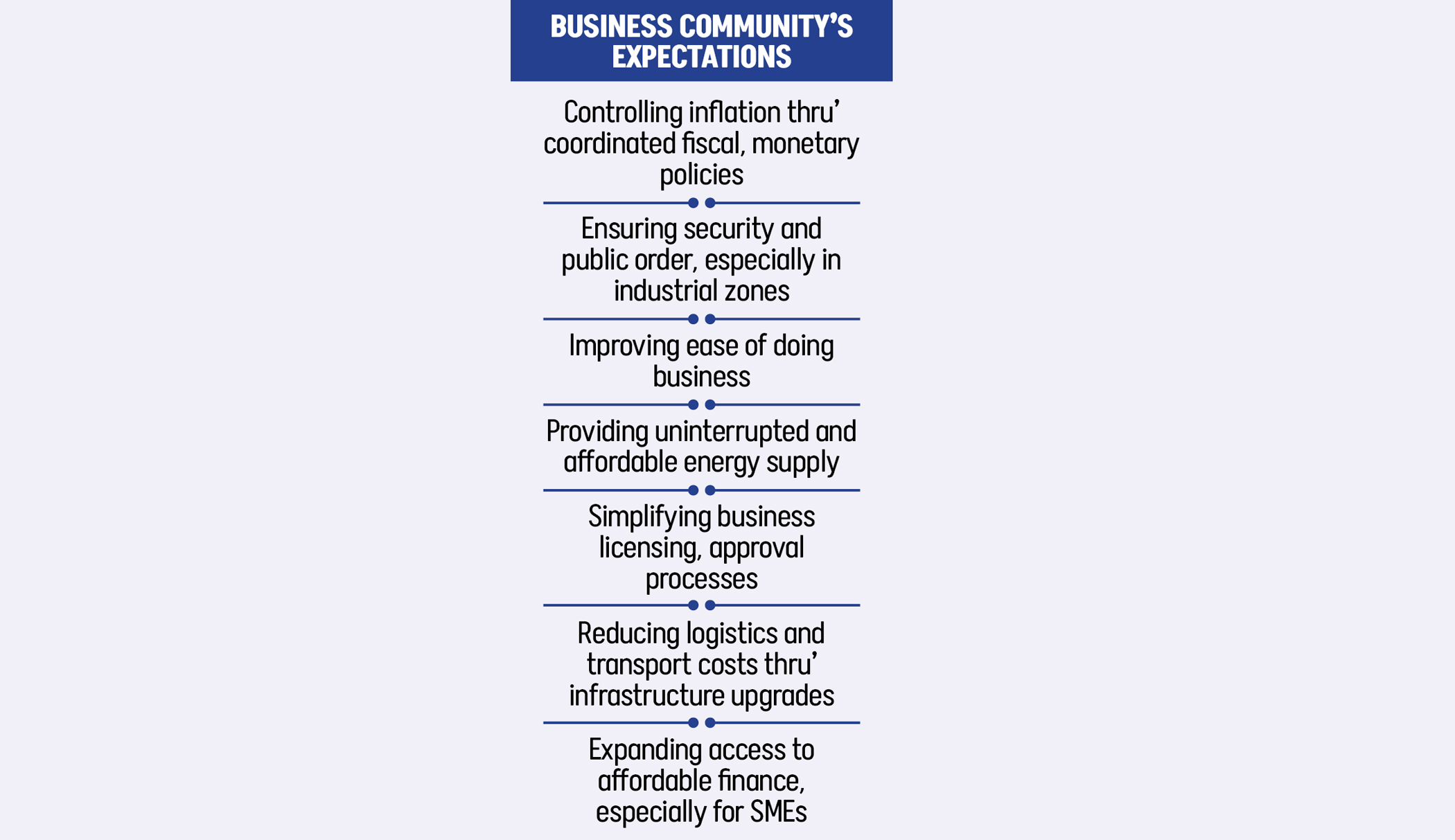
The parties should focus on maintaining law and order to facilitate a better business environment, and commit to time-bound reforms, better access to finance, and reduction of logistics costs to support sustainable growth.

“Ensuring security and public order should be the top priority in the manifestos of political parties,” Faisal Samad, director of Bangladesh Garment Manufacturers and Exporters Association (BGMEA), told The Daily Star.
Underscoring the need for an environment that would instill confidence among businesspeople, he said businesses must be provided with adequate energy supplies, and utility prices in the industrial sector should be lowered to help them stay competitive in the global market.
Mohammad Hatem, president of Bangladesh Knitwear Manufacturers and Exporters Association (BKMEA), said the parties must commit to restoring law and order in industrial zones and implementing reforms to the customs system and the National Board of Revenue (NBR) to facilitate trade and business.
“At present, banks are imposing various charges on businesses, along with high interest rates. Political parties should clearly outline in their manifestos how they plan to address these issues if they are voted to power.”
Echoing his views, Taskeen Ahmed, the president of Dhaka Chamber of Commerce and Industry (DCCI), said political parties should make lowering the cost of doing business a top priority in their manifestos.
“They should cover issues such as developing railways, waterways, and ports; simplifying the licensing and approval process; strengthening infrastructure planning and coordination; and expanding fully automated systems for customs and trade to reduce the lead time.”
He also said they should make time-bound commitments to tackle urgent issues such as energy shortages and take measures to ensure smooth day-to-day business operations.
“The business community expects a credible roadmap that ensures policy certainty, enhances competitiveness, and supports sustainable economic growth.”
Tapan Chowdhury, managing director of Square Pharmaceuticals Ltd, said, “We want a more business-friendly environment. Businesses remain hesitant to make investment decisions because of the existing uncertainties.”
In recent times, many workers lost jobs due to the closure of several factories. The next government will need to take measures to help reopen these industrial units, he added.
Hoping for a fair election and a smooth transition of power, MA Jabbar, managing director of DBL Group that mainly exports garments, said the next government should choose the right people to run the crucial ministries if they want to serve people in the true sense.
On a similar note, Abul Kasem Khan, vice chairman of A.K. Khan & Company Ltd, said, “We expect to have a stable government… The economy must not face any setback because of political instability.”
Emphasising the importance of both political stability and economic clarity, Mohammed Amirul Haque, president of the LPG Operators Association of Bangladesh (LOAB), said, “We expect political parties to outline the direction they intend to take the economy. This should be clearly reflected in their manifestos.”
He highlighted regulatory hurdles in the LPG sector, saying companies currently need to obtain and renew licences annually from as many as 26 different authorities. This could be addressed by creating a centralised regulatory body.
“We hope that whichever party comes to power will focus on removing bureaucratic red tape and ensuring policy consistency… Frequent policy changes make long-term business planning difficult,” said Amirul, also managing director of Premier Cement.
Political parties must offer a clear economic roadmap and explain how the private sector will contribute to national development, he observed.
“We want ease of doing business. Still, we need 27 to 29 signatures from officials at government offices to start a business venture. We want deregulation and a one-stop service in the real sense.”
 For all latest news, follow The Daily Star's Google News channel.
 Asif Ibrahim, former president of Dhaka Chamber of Commerce and Industry (DCCI), stressed the need for a comprehensive plan to put in place a multimodal transport network comprising railways, waterways, seaports, and land ports to relieve pressure on roads, which handle over 70 percent of freight movement.
“Digitisation of customs, permits, and freight tracking could cut clearance times by 30 to 50 percent.” Simplifying licensing procedures and rationalising tariffs would also improve efficiency and transparency, he added.
Ibrahim recommended expanding private investment and public-private partnerships (PPPs) to modernise infrastructure.
Targeted support for Small and Medium-sized Enterprises (SMEs) -- through trade finance, cargo insurance, and regulatory simplification -- could help reduce hidden costs and strengthen Bangladesh’s competitiveness in global trade.
Meanwhile, the Metropolitan Chamber of Commerce and Industry (MCCI) has prepared a 10-point reform agenda, urging political parties to incorporate key private sector demands into their manifestos.
The agenda starts with restoring macroeconomic stability by reducing inflation through coordinated fiscal and monetary policies, along with ensuring a predictable exchange rate.
The chamber advocates banking sector reforms to curb irregular lending and improve recovery mechanisms for non-performing loans.
Regarding the tax policy, MCCI calls for a simplified and digitised system that will ensure compliance with regulations and expand the tax base without overburdening existing taxpayers.
The chamber also underscores the need to boost export competitiveness ahead of Bangladesh’s graduation from LDC status through free trade agreements (FTAs), tariff rationalisation, and round-the-clock operations at ports and customs.
It also called for improving the investment climate and reforming the energy sector to ensure reliable and affordable supply.
Comments